Welcome back. Earlier lessons followed a bill through presentment, presidential inaction, veto, and a possible congressional override. This module turns to the limits of those powers. Here, the central issue is a tempting compromise: can a President sign a bill containing provisions they support while vetoing only the provisions they oppose?
By the end of this lesson, you should be able to explain why the answer is no for a federal bill, including a spending bill, and how Clinton v. City of New York (1998) applies that rule to an attempted line-item veto.
The choice presented to the President
Imagine that both chambers of Congress pass an identical spending bill. It funds disaster preparedness, a medical research program, and a transportation project. The President supports the first two provisions but objects strongly to the third.
The President’s constitutional veto power concerns the bill presented by Congress, not a menu of provisions within it. Signing the bill approves it as passed, including the transportation provision. An ordinary veto rejects the bill as passed, including the provisions the President favors. Congress may then reconsider the whole bill and potentially override the veto. Alternatively, Congress can pass a different bill and present that version to the President. The President cannot produce that different version by approving two provisions and vetoing the third.
The Congressional Research Service flowchart below is a useful visual reminder of the earlier lessons: its signature and veto branches concern the presented legislation as a whole. There is no branch in which selected provisions are removed while the rest is signed.
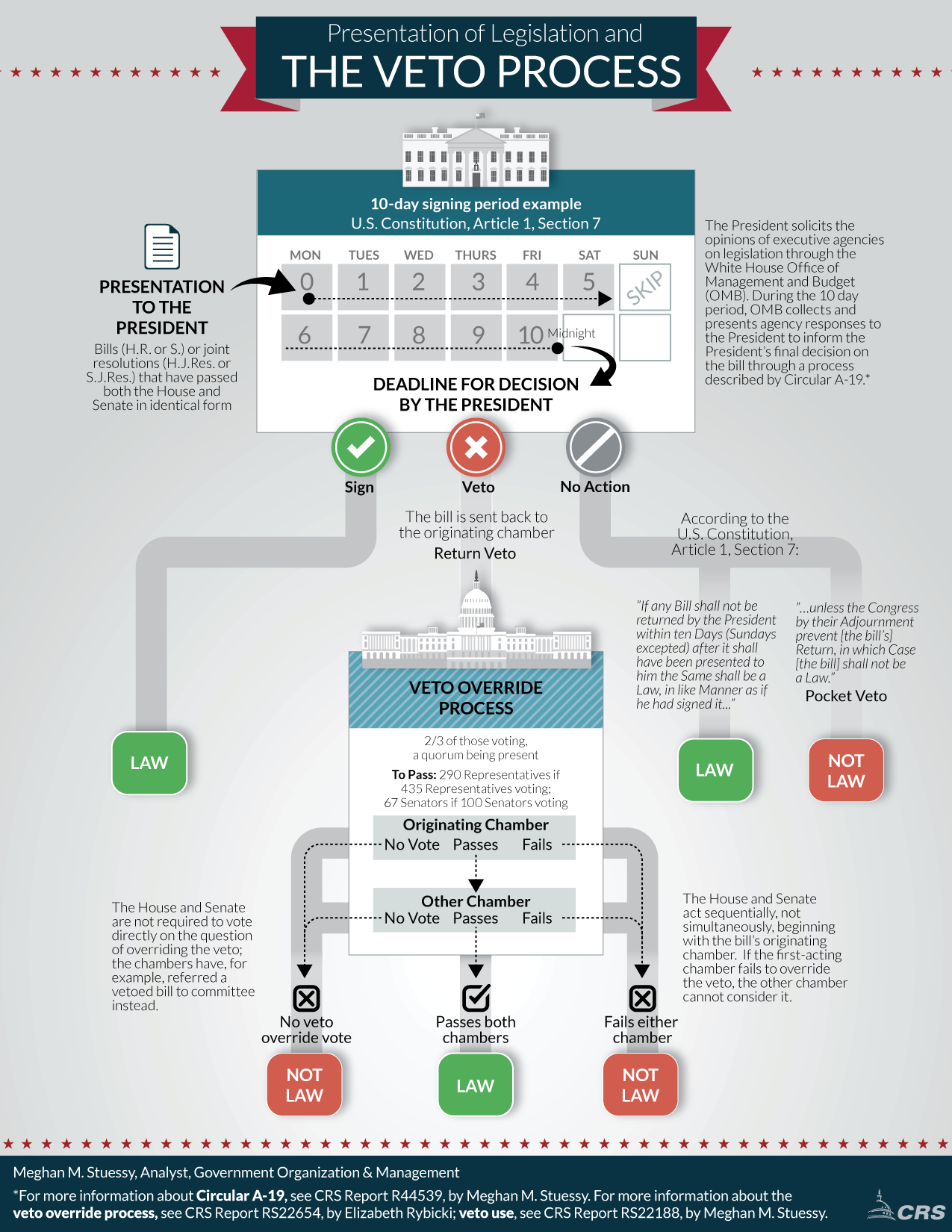
This constraint can make presidential decisions difficult. A bill may combine measures the President considers necessary with measures they would reject if those measures arrived separately. That is not an oversight in the veto procedure; it is part of what makes the final text a matter for both Congress and the President, rather than for either to rewrite alone.
Line Item Veto | Constitution Annotated | Congress.gov | Library of Congress
Read the Library of Congress’s Constitution Annotated essay for the whole-bill rule, the attempted statutory alternative, and the Supreme Court’s reasoning. It will supply the legal framework for the spending-bill example in this lesson.
In the “Line Item Veto” essay, begin with the opening discussion. Continue through that opening paragraph’s account of proposals for a line-item veto. Then read the Act and ruling, beginning at the paragraph about the 1996 Act and continuing to the end of the essay’s discussion of the Court’s historical-practice reasoning. Focus especially on when the attempted cancellations occurred: the President had already signed the bills.
Why the timing in Clinton v. City of New York matters
Congress passed the Line Item Veto Act of 1996, and the President signed it. The Act purported to let the President cancel certain spending items and specified tax benefits within five days after signing a bill. Its name described what it was meant to achieve politically, but the procedure is important legally: it did not ask the President to choose provisions while an unsigned bill awaited presentment. It purported to authorize cancellations after the entire bill had become law.
That distinction drove the Supreme Court’s decision in Clinton v. City of New York. When the President signed the bills at issue, their provisions became law. A subsequent cancellation of selected provisions therefore changed the legal effect of laws that had already been enacted. In the Court’s view, this was not an ordinary veto. It was an attempt by the President to amend or partly repeal a statute unilaterally.
The Court identified two differences from the constitutional veto you studied earlier:
- Timing: an ordinary veto rejects a bill before it becomes law; the Act’s cancellations operated after signing.
- Scope: an ordinary veto concerns the bill presented by Congress; the Act’s cancellations targeted selected portions while leaving the rest in place.
To amend or repeal a federal statute, a new measure ordinarily must pass both the House and the Senate in identical form and be presented to the President. Congress’s earlier passage of a statute granting cancellation authority could not replace that constitutional procedure for later laws. The Court held the Line Item Veto Act unconstitutional under the Presentment Clause.
Clinton v. City of New York Case Brief Summary | Law Case Explained
Watch Quimbee’s Clinton v. City of New York Case Brief Summary for a concise explanation of the Court’s comparison between a constitutional veto and the Act’s cancellation power.
Start at the two differences: listen for the contrast between action before and after enactment, and between rejection of a whole bill and cancellation of a part. Continue through the holding, which connects changes to existing law with the constitutional process for legislation. The lesson’s account of the Act and case provides the context for this segment; you need not watch the video’s earlier factual setup.
The word veto can obscure the difference. Calling a post-signature cancellation a “line-item veto” does not make it a use of the ordinary constitutional veto. The question is what the President’s action does to the law, and whether the Constitution permits the President to do it through that procedure.
Apply the rule to a mixed-provision spending bill
Return to the hypothetical bill. Suppose it contains:
- funding for disaster preparedness;
- funding for medical research; and
- funding for a transportation project the President opposes.
If the President signs the bill, all three provisions become law according to their terms. The President cannot make the third provision legally disappear by announcing, alongside the signature, that it is “vetoed.” The rest of the bill cannot become a President-edited version of the text Congress passed.
If the President vetoes the bill, all three provisions are rejected at that stage. Congress can attempt an override or pursue new legislation. In the latter case, Congress could remove or change the transportation provision, but the revised text would need to pass both chambers and go through presentment again.
If Congress wants the President to make separate signature-or-veto decisions on the programs, it can consider passing them as separate bills. The relevant unit for the federal veto is the bill presented, not every policy choice collected within it.
There is an important distinction between removing a provision from a law and administering a law that leaves room for discretion. A statute may itself give executive officials choices about how to implement a program. Exercising an authority genuinely supplied by that statute is not automatically a line-item veto. But an instruction or announcement cannot simply cancel a provision that has become law. The scope of any implementation discretion depends on the statute; the President cannot create a cancellation power by changing its label.
The constitutional limit in one account
The Presentment Clause gives the President a substantial role in making federal law: a whole bill can be signed or vetoed, and an ordinary veto can be overridden through the required congressional votes. It does not give the President authority to approve a bill while excising disfavored provisions. Clinton v. City of New York reinforces the boundary from the other side of enactment: once a signed bill is law, a statute cannot empower the President to cancel selected parts of it as a substitute for the constitutional process of changing the law.
The next lesson will distinguish this legislative veto power from executive orders—directions concerning the exercise of existing executive authority, not a means of unilaterally amending or repealing statutes.