Welcome. This first module follows a federal bill from final agreement in Congress to the President’s desk. Today’s question is deliberately narrow: what must happen before the President can act, and what exactly happens when the President signs a bill or returns it with an ordinary veto? Later lessons will address the action deadline, inaction, and Congress’s response to a veto.
Plan on about 35–40 minutes for the readings and lesson. The important distinction to carry throughout is between Congress agreeing on a bill and that bill becoming law.
Before presentment: one bill, one text
The House and Senate cannot send competing versions of a bill to the President and ask for a choice between them. Both chambers must agree to the same text. Sometimes the second chamber accepts the first chamber’s bill unchanged. If it amends the bill, the chambers must resolve their differences and each agree to the resulting version.
Introduction to the Legislative Process in the U.S. Congress | Congress.gov | Library of Congress
Read the Congressional Research Service’s account of how the House and Senate reach a single bill. It establishes the condition that must be met before presentment.
In “Resolving Differences Between the Chambers,” read the first three paragraphs. Begin with the requirement for identical text and stop just before the paragraph beginning “Sometimes, the resolution of differences.” Focus on why passage of different versions does not complete Congress’s work, and on what changes when one chamber agrees to the other’s proposal.
Suppose the House passes a hypothetical H.R. 42, a bill funding flood-response equipment. The Senate passes it with an amendment changing the amount of funding. At that point, both chambers have voted on the bill, but not on identical text. If the House then agrees to the Senate’s amendment, they have agreed to one final version. That version is enrolled—prepared in final official form—and presented to the President.
“Presented” has a precise role here. It is not another name for a member of Congress proposing a bill. Presentment is the delivery of the bill that has cleared both chambers in identical form to the President for constitutional action. A proposal still in committee, or a bill passed by only one chamber, has not reached this stage.
What the Constitution asks the President to do
Article I, Section 7 gives the two familiar responses in unusually direct language: if the President approves the presented bill, the President signs it; if not, the President returns it with objections to the chamber in which it originated. Read that language before considering the practical steps.
The Presidential Veto and Congressional Veto Override ...
Read the constitutional passage reproduced by the National Archives. Its wording distinguishes signing a bill from returning one with objections.
In “Background information on the veto process for the teacher,” find the Article I, Section 7 passage introduced immediately after the sentence explaining that the word “veto” does not appear in the Constitution. Read the full quoted passage, stopping before the paragraph beginning “The Framers of the Constitution.” For now, concentrate on “sign it,” “return it,” “Objections,” and “that House in which it shall have originated”; we will study the reconsideration requirement later.
Notice that the Constitution describes an ordinary veto as a return, not merely a refusal to sign. The President sends the bill back with objections to its chamber of origin. That chamber enters the objections in its Journal and may reconsider the bill. Signing has a different immediate result: the bill becomes law without another vote in Congress.
The Congressional Research Service connects these constitutional instructions to enrollment and presentment:
Introduction to the Legislative Process in the U.S. Congress | Congress.gov | Library of Congress
Return to the Congressional Research Service account for the steps immediately after both chambers agree on identical text.
Under “Presidential Action,” read the first two paragraphs, stopping before the paragraph about enacted bills being delivered to the Office of the Federal Register. Track where the enrolled bill goes, what signing accomplishes, and where a vetoed bill is returned. The paragraphs also mention inaction and override votes; treat those as previews rather than topics to calculate today.
The President has a limited period to act after presentment—ten days, excluding Sundays. You do not need to calculate that period yet. For this lesson, the point is that presentment starts the period in which the President can sign or issue an ordinary veto. Doing nothing is a separate possibility; it is not, by itself, an ordinary veto.
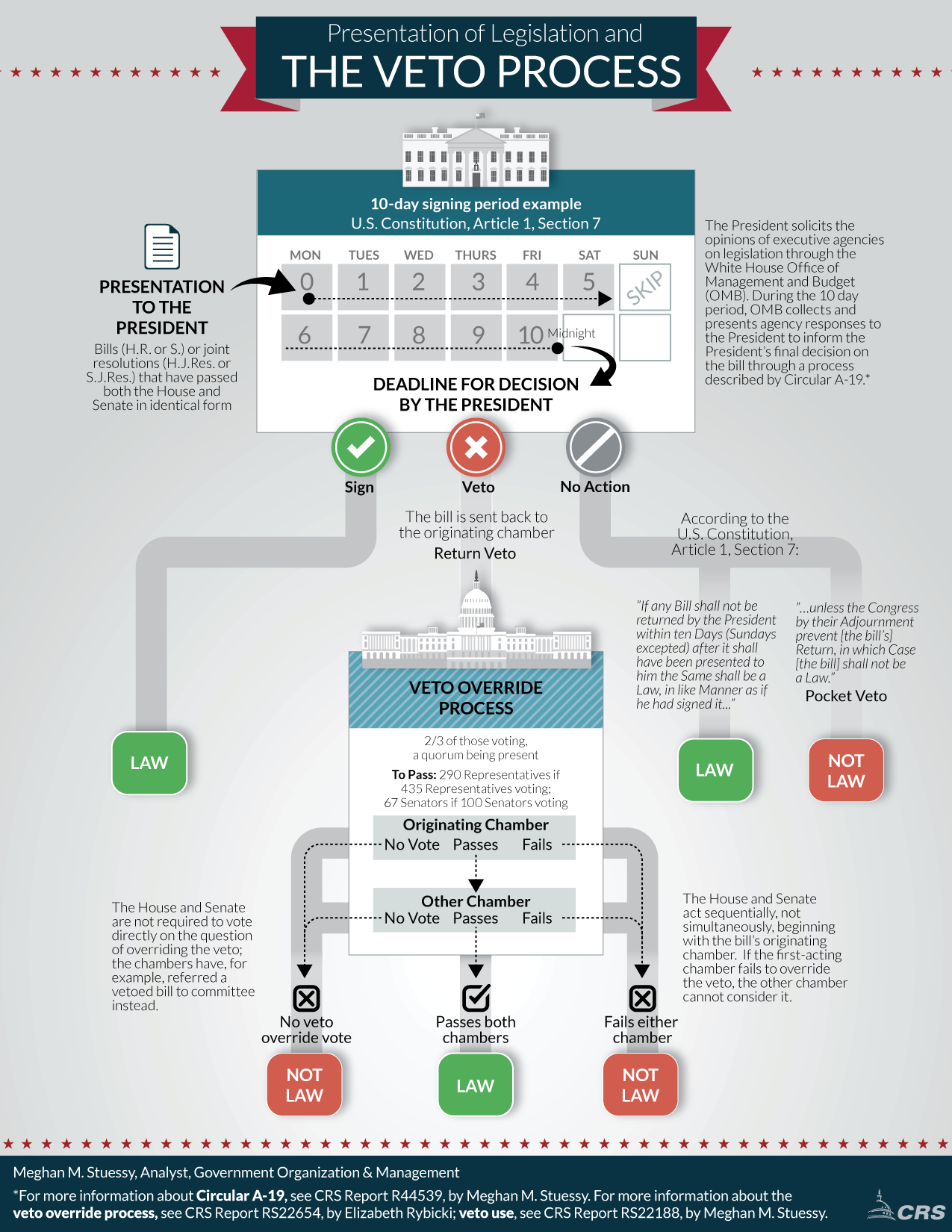
The upper portion of the flowchart makes the fork visible. On the sign route, the bill becomes law. On the veto route, it goes back to the originating chamber rather than becoming law by presidential approval. The diagram’s inaction and override routes will matter in subsequent lessons.
Follow an ordinary veto back to its source
Return to hypothetical H.R. 42. Once both chambers have approved its final text and it has been presented, the President might sign it. In that case, H.R. 42 becomes law. The President does not send a revised bill back for Congress to approve.
Alternatively, the President might reject the bill and return it with objections. Because H.R. designates a House-originated bill, the return goes to the House, even if the Senate proposed the amendment that produced its final wording. “Chamber of origin” means where the bill originated, not which chamber most recently changed or voted on it. The House receives the objections and can decide whether to reconsider; the bill does not become law simply because Congress passed it the first time.
A historical example makes the address on the veto message less abstract. In the National Archives account, S. 518 was a Senate-originated bill. Its number identifies the chamber to which the President returned the bill with objections.
The Presidential Veto and Congressional Veto Override ...
Use the National Archives’ 1973 example to see how a real bill number determines the destination of an ordinary veto.
In “Background information on the veto process for the teacher,” locate the discussion beginning with a facsimile of a 1973 veto and bill S. 518. Read the account through the veto message. Stop before the sentence beginning “This date indicates.” Focus on what the “S.” in the bill number reveals and why the message is addressed to the Senate; leave the later override votes for another lesson.
A useful way to distinguish the two outcomes is to look at what happens to the same enrolled text. Signing approves that text and makes it law. An ordinary veto returns that text, accompanied by objections, to the originating chamber. The President is not using the veto to edit the bill into a preferred version. Nor can the President use this bill-veto procedure on a statute that is already law: its object is a bill presented for approval.
Key takeaways
A federal bill reaches presentment only after the House and Senate have agreed to identical text. The enrolled bill then goes to the President. A signature makes it law; an ordinary veto returns it with objections to the chamber where it originated, which may reconsider it. The chamber of origin does not change just because the other chamber amended the bill.
Next, you will put the ten-day period on a calendar and determine when presidential inaction makes a bill law without a signature.