Hello! Welcome back to our study of Engineering Economics.
In our last lesson, we established the core decision rule for standalone projects: accept a project if its Internal Rate of Return (IRR) is greater than your Minimum Acceptable Rate of Return (MARR). This rule is powerful, but it relies on a critical assumption: that a project has a single, unique IRR.
Today, we will explore what happens when that assumption breaks down. Our learning objective is to identify the potential for multiple rates of return in non-conventional cash flow patterns. You will learn to spot the types of projects where the standard IRR rule can be misleading, a crucial skill for any manager evaluating complex investments, especially in technology where projects can have unusual cost and revenue structures.
Simple vs. Non-Simple Investments
The possibility of multiple IRRs depends entirely on the pattern of a project's cash flows over time. We can classify projects into two main types based on these patterns.
These class notes from Penn State's engineering economy course offer a clear definition of simple (conventional) and nonsimple (non-conventional) investments. This distinction is the key to today's lesson.
Please read the two slides titled 'Simple versus Nonsimple Investments' (slides 20 and 21). Focus on how the number of sign changes in the cash flow series determines the classification.
As the notes explain, the core difference is the number of times the net cash flow changes sign (from negative to positive, or vice versa).
-
Simple (or Conventional) Investment: Has only one sign change. Typically, this is an initial investment (negative cash flow) followed by a series of positive cash flows (revenues or savings).
- Example: You spend $100k to develop a mobile app (
-) and then receive $40k in revenue each year for the next five years (+, +, +, +, +). The cash flow sequence is(-, +, +, +, +, +).
- Example: You spend $100k to develop a mobile app (
-
Non-Simple (or Non-conventional) Investment: Has more than one sign change. This often occurs in projects that require significant future investment or have end-of-life costs.
- Example: You launch a platform for an initial cost (
-), generate subscription revenue for a few years (+), and then have to invest in a major, costly infrastructure overhaul or data migration to comply with new regulations (-). The cash flow sequence could be(-, +, +, -, +).
- Example: You launch a platform for an initial cost (
Your experience with project management and building platforms from scratch likely involves both types. A straightforward website build for a client is a simple investment. A more complex SaaS product that requires periodic, large-scale reinvestment would be a non-simple investment.
Test your understanding!
Classify the following project cash flow patterns as either Simple or Non-Simple:
- A project to replace servers:
-$50k, +$15k, +$15k, +$15k, +$15k - A mining operation:
-$1M, +$400k, +$400k, +$400k, -$500k(the last flow is for site cleanup) - Developing and selling a software license:
-$200k, +$500k
Show answer
- Simple. There is only one sign change, from
-$50kto+$15k. - Non-Simple. There are two sign changes: from
-$1Mto+$400k, and then from+$400kto-$500k. - Simple. There is only one sign change, from
-$200kto+$500k.
The Problem of Multiple IRRs
Now for the crucial point: Multiple IRRs can only occur in non-simple investments.
Why does this happen? Recall that the IRR is the discount rate i* that makes the Net Present Worth (NPW) of a project equal to zero. The NPW formula is a polynomial equation in terms of (1+i*).
An n-degree polynomial can have up to n real roots. For a simple investment, it turns out there is only one positive, real root. However, for a non-simple investment with multiple sign changes, it's possible to have more than one positive, real root. Each of these roots is, by definition, an Internal Rate of Return.
Let's look at a concrete case.
The following resource provides a worked example of a project with a non-simple cash flow that results in three distinct IRRs. This clearly illustrates the problem.
Please review the slide titled 'Example 8.2'. Look at the cash flow profile and note how it has three sign changes. The slide demonstrates that setting the Future Worth (or Present Worth) to zero yields three different valid interest rates: 20%, 40%, and 50%.
The cash flow in the example is:
- Year 0: -$4,000
- Year 1: +$16,400
- Year 2: -$22,320
- Year 3: +$10,080
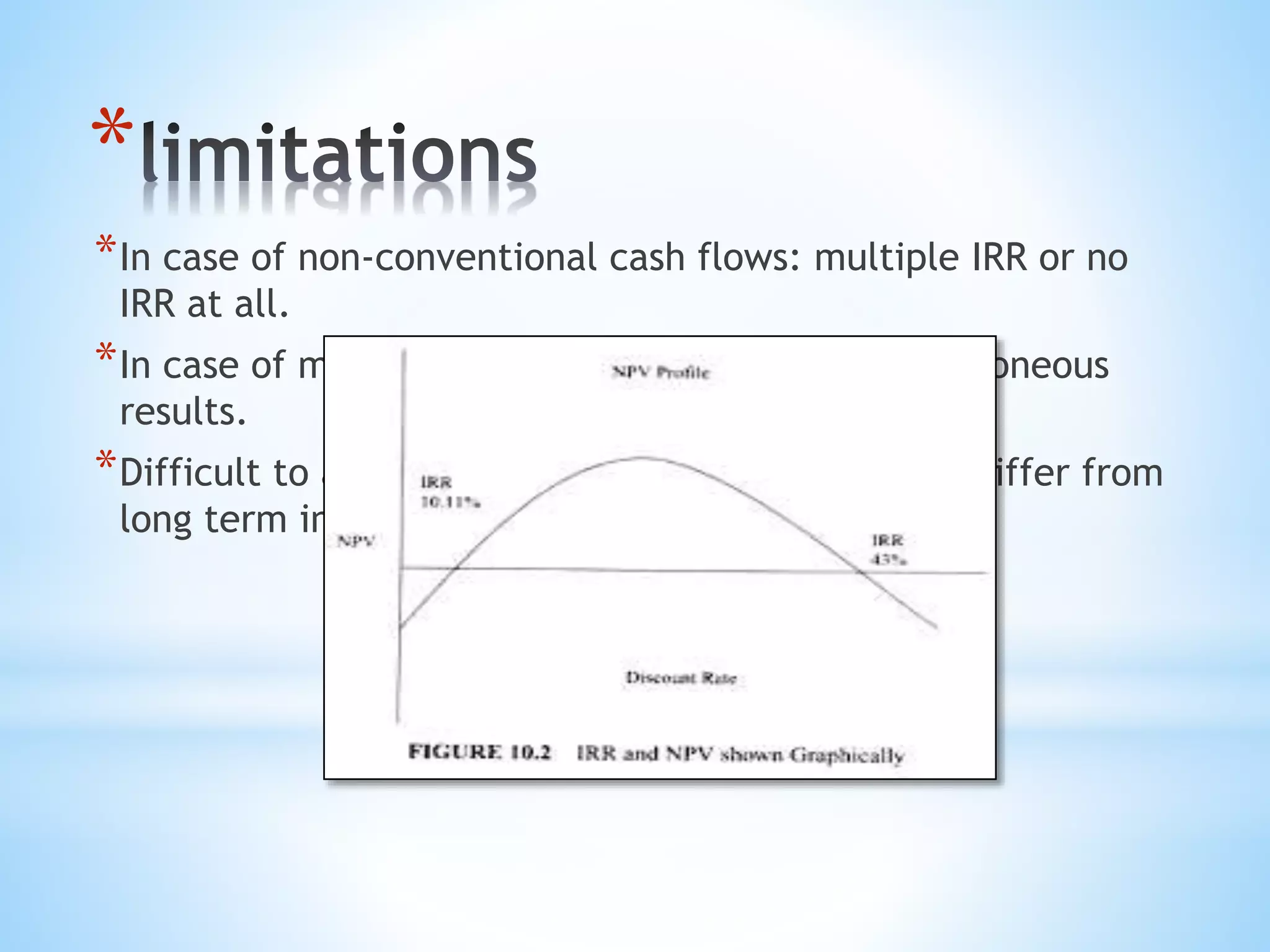
This is a classic non-simple cash flow with three sign changes. As shown, it has three different IRRs: 20%, 40%, and 50%. If you plot the NPW of this project against the discount rate, the curve crosses the horizontal axis at three different points.
The following image illustrates this concept graphically for a project with two IRRs.
Why This Breaks the Decision Rule
The existence of multiple IRRs makes the IRR > MARR decision rule ambiguous and unreliable.
Consider the project from the example with IRRs of 20%, 40%, and 50%.
- If your company's MARR is 15%, all three IRRs are greater than the MARR. Does this mean you should accept?
- If your MARR is 30%, one IRR is lower (20%) and two are higher (40%, 50%). Do you accept or reject?
- If your MARR is 45%, two IRRs are lower and one is higher. What now?
The simple decision rule collapses because it doesn't provide a clear signal. You cannot logically compare the MARR to a set of different IRRs.
This is the single most important limitation of the IRR method. When faced with a non-simple investment, you should not use the IRR to make an accept/reject decision. The recommended approach is to fall back on Net Present Worth (NPW) analysis, which always provides a single, unambiguous value for any given MARR, making it a more robust decision tool.
Note: For completeness, you should know that methods have been developed to "fix" this issue, such as the External Rate of Return (ERR) or Modified Internal Rate of Return (MIRR). These methods, discussed briefly in the Rate of Return Analysis resource, adjust the cash flow analysis to ensure only one rate is produced. However, the most common and direct solution in practice is to simply use NPW analysis.
Conclusion
Today we've uncovered a critical weakness in the IRR method. While powerful for simple projects, it can be misleading for more complex investments.
- Key Takeaways:
- Investment projects are classified as simple (one sign change in cash flows) or non-simple (more than one sign change).
- Non-simple investments can produce multiple IRRs.
- When multiple IRRs exist, the standard
IRR vs. MARRdecision rule is ambiguous and should not be used. - As a manager, your first step before trusting an IRR figure should be to inspect the cash flow pattern. If you see more than one sign change, you should rely on the NPW method for your decision.
Preview of the Next Lesson
We have now explored how to evaluate a single project using IRR and identified its major limitation. The next challenge is comparing two or more projects when you can only choose one (i.e., they are mutually exclusive). Simply picking the project with the highest IRR can lead to the wrong decision. In our next lesson, we will learn how to properly use IRR in these situations by applying incremental rate of return analysis to compare two mutually exclusive alternatives.