Hello! Welcome back to our course on Engineering Economics.
In our last lesson, we focused on the mechanics of calculating the Internal Rate of Return (IRR). We learned that IRR is the unique discount rate at which a project's Net Present Worth (NPW) becomes zero, and we practiced finding it using trial and error.
Today, we'll put that calculation to use. Our goal is to evaluate project acceptability by comparing its IRR to the Minimum Acceptable Rate of Return (MARR). This is a fundamental decision rule in capital budgeting and one of the most common ways businesses decide whether to move forward with an investment, be it new machinery, a marketing campaign, or a software development project.
The IRR Decision Rule
Once you have calculated a project's IRR, the decision-making process is straightforward. You compare the project's inherent rate of return (the IRR) to the minimum return your company requires on its investments (the MARR).
The formal decision criterion is simple yet powerful.
Lecture 9 (S'04) Methods for Evaluating Individual Projects
The following brief reading from an MIT course note lays out the decision rule clearly. As you read, focus on the direct comparison between the required rate of return and the calculated IRR (i*).
Please read the section titled '2. Internal Rate of Return (IRR) Method', focusing only on the two bullet points under 'Decision criterion:'.
To summarize and formalize the rule:
- If IRR > MARR: Accept the project. The project is expected to earn a return greater than your minimum requirement, thus creating economic value.
- If IRR < MARR: Reject the project. The project's expected return is not sufficient to cover the cost of capital and the risk involved.
- If IRR = MARR: The project is marginally acceptable. It is expected to earn exactly the required return, creating no additional value but causing no loss. The decision could be made based on non-economic factors.
This rule provides a clear-cut benchmark for evaluating standalone projects.
What Does MARR Represent?
To apply the rule effectively, it's crucial to understand what MARR represents in a business context like the ones you've managed.
Internal Rate of Return (IRR): Formula and Examples
The article 'Internal Rate of Return (IRR): Formula and Examples' from Investopedia provides excellent context on how companies determine their required return. It uses the terms Weighted Average Cost of Capital (WACC) and Required Rate of Return (RRR), which serve the same function as our MARR.
Read the section titled 'Using IRR With WACC'. Notice how firms establish a Required Rate of Return (RRR) that is often higher than their basic cost of capital (WACC) to account for risk.
As the reading explains, the MARR isn't an arbitrary number. It's typically anchored to the firm's Weighted Average Cost of Capital (WACC)—the blended cost of its debt and equity financing. In essence, if a project can't earn at least the cost of the money used to fund it, it's a losing proposition.
Often, a company will set its MARR (or RRR) higher than its WACC to account for the specific risk of the project and the opportunity cost of not investing that capital elsewhere. For a high-risk R&D project, the MARR might be 25%, while for a low-risk equipment upgrade, it might be 12%.
Why the IRR Rule Works: The Link to NPW
You might be wondering why this simple comparison works. The IRR rule is not an independent concept; it's directly linked to the Net Present Worth (NPW) analysis we've already discussed. A project is acceptable if its NPW, calculated at the MARR, is positive.
Let's visualize this connection.
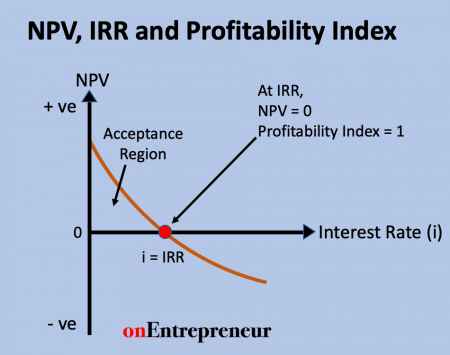
Here is the key insight:
- The IRR is the discount rate where
NPW = 0. - The NPW curve for a conventional project slopes downward. This means as the discount rate increases, the NPW decreases.
- Therefore, if you pick a discount rate (your MARR) that is less than the IRR, you will be at a point on the curve where the NPW is positive.
So, the rule IRR > MARR is simply a proxy for the rule NPW > 0. They are two sides of the same coin and will always lead to the same accept/reject decision for a single, conventional project.
Applying the Rule: A Practical Example
Let's walk through an example. Imagine your company is considering two potential software development projects and has a MARR of 10%.
Internal Rate of Return (IRR): Formula and Examples
The Investopedia article provides a clear, practical example of applying this decision rule to two separate projects.
Please read the section 'IRR Example'. Follow the cash flows for Project A and Project B, see their calculated IRRs, and note the final decision made by comparing each IRR to the 10% cost of capital (our MARR).
Let's break down the decision process from the example:
Project A:
- Calculated IRR: 16.61%
- Company MARR: 10%
- Comparison: 16.61% > 10%
- Decision: Accept Project A. It is expected to generate returns well above the minimum threshold.
Project B:
- Calculated IRR: 5.23%
- Company MARR: 10%
- Comparison: 5.23% < 10%
- Decision: Reject Project B. Investing in this project would mean deploying capital for a return that is lower than the company's cost of capital, effectively destroying value.
This clear application of the IRR vs. MARR rule allows management to quickly filter projects that meet their minimum financial criteria.
Test your understanding!
You are the general manager of a tech company. The development team proposes building a new automated deployment tool that will save significant engineering time.
- Initial Development Cost: $50,000
- Projected Annual Savings: $20,000 per year for 4 years
- The finance team has calculated the IRR for this project to be 15.2%.
- Your company's MARR for internal efficiency projects is 12%.
Should you approve this project? Why or why not, in terms of value creation?
Show answer
Yes, you should approve the project.
The project's IRR of 15.2% is greater than the company's MARR of 12%. This means the project is expected to generate a return that exceeds the minimum required return for such an investment. By undertaking this project, the company is creating economic value because the return on capital is higher than the cost of that capital.
Conclusion
Today, we've established the critical link between calculating an IRR and using it to make sound investment decisions. This simple comparison is a cornerstone of financial analysis for engineers and managers.
- Key Takeaways:
- The primary rule for project acceptability is: Accept if IRR > MARR, and Reject if IRR < MARR.
- The MARR is the firm's minimum required return, based on its cost of capital and the project's risk.
- The IRR rule is consistent with the NPW rule. If a project's IRR exceeds its MARR, its NPW calculated at the MARR will be positive.
Preview of the Next Lesson
The IRR rule works perfectly for evaluating a single, independent project. But what happens when you have two good projects, like in our example where Project A's IRR was 16.61% and another potential project might have an IRR of 20%, but you only have the budget for one? Simply picking the one with the highest IRR isn't always the right answer.
In our next lesson, we will address this by learning how to apply incremental rate of return analysis to compare two mutually exclusive alternatives.