Hello! Welcome to your next lesson in Engineering Economics.
In our last session, we explored a major pitfall of using the Internal Rate of Return (IRR): the problem of multiple IRRs that can arise with non-conventional cash flows. We concluded that when faced with such a project, falling back on Net Present Worth (NPW) analysis is the most reliable approach.
Today, we address another critical challenge in project selection: choosing between two mutually exclusive alternatives. This is a common scenario in business. For example, you might have to decide between two different software platforms to license, or two potential hardware architectures for a new product. You can only pick one. A tempting but often incorrect approach is to simply choose the project with the higher IRR.
Our goal for this lesson is to learn how to apply incremental rate of return analysis to compare two mutually exclusive alternatives. This powerful technique ensures you make the economically superior choice by focusing on the return generated by the additional capital required for the more expensive option.
The Flaw of Comparing IRRs Directly
When projects are mutually exclusive, picking the one with the highest IRR can lead you to select a less valuable project. Why? The reason is that IRR is a relative measure (a percentage), while our goal is to maximize the absolute value created (the net present worth). A high IRR on a small investment might create less overall value than a moderate IRR on a much larger investment.
Let's look at a scenario where this issue becomes clear.
Using Rate of Return, Net Value and Ratios for Mutually ...
The following resource from Penn State's College of Earth and Mineral Sciences introduces a classic example comparing two mutually exclusive projects with very different investment sizes and IRRs. It perfectly illustrates the problem we are tackling.
Please read 'Example 4-1' which describes Project A and Project B. Note their initial costs, incomes, and salvage values. The text calculates the IRR for each, showing that both are satisfactory compared to a 15% MARR.
From the example, we have:
- MARR = 15%
- Project A: Invest $40,000, get a fantastic IRR of 100%.
- Project B: Invest $400,000, get a solid IRR of 50%.
Both projects are acceptable since their IRRs are well above the 15% MARR. If you were forced to choose, which one would you pick? Project A's 100% IRR looks incredibly attractive. However, choosing Project A means investing only $40,000. The remaining $360,000 of your available capital would presumably be invested elsewhere, earning only the MARR of 15%.
The real question isn't "Which project has the better IRR?" but rather, "Is the additional $360,000 required for Project B working hard enough for me?" To answer this, we need incremental analysis.
The Incremental Analysis Procedure
Incremental analysis evaluates the profitability of the additional investment that separates the two projects. You essentially create a third, hypothetical project representing the difference in their cash flows.
The step-by-step process is a cornerstone of engineering economic analysis.
Vol. II, Essay 4: Financial Assessment
This essay from the MIT OCW course on Project Evaluation clearly outlines the procedure for using incremental analysis with mutually exclusive alternatives.
First, read the section starting with 'To deal with these questions, it is necessary to do the analysis one step at a time...' up to the bulleted list. This explains the logic. Then, review the bulleted list under the heading 'Choosing Among Mutually Exclusive Alternatives.' This gives you a concise, repeatable procedure.
Here is a summary of the procedure for comparing two alternatives (let's call them A and B, where B has a higher initial cost):
- Order the projects by initial investment (A, then B).
- Calculate the IRR for the cheaper project (A). If IRR(A) < MARR, reject A and evaluate B as a standalone project. If IRR(A) ≥ MARR, project A is acceptable, and you proceed to the next step.
- Create the incremental cash flow stream (B - A). Subtract the cash flows of project A from the cash flows of project B for every period. The initial cost of this stream will be
Cost(B) - Cost(A). - Calculate the IRR of this incremental cash flow stream, denoted as
IRR(B-A). - Apply the decision rule:
- If
IRR(B-A) ≥ MARR, the extra investment is justified. Choose the more expensive project (B). - If
IRR(B-A) < MARR, the extra investment is not justified. Stick with the cheaper project (A).
- If
Applying Incremental Analysis: A Worked Example
Let's apply this procedure to our Project A vs. Project B scenario.
Using Rate of Return, Net Value and Ratios for Mutually ...
The following video walks through the exact example we've been discussing. It visualizes the process of calculating the individual IRRs, constructing the incremental project, and making the final decision.
Watch the video from the beginning until the end (11:56). Pay close attention to the section from 5:50 onward, where the presenter explains and calculates the incremental analysis (B-A).
As the video and supporting text explain:
- Order: Project A ($40k) then Project B ($400k).
- Check Cheaper Project: We found IRR(A) = 100%, which is > 15% MARR. So, Project A is our current best option.
- Incremental Cash Flow (B - A):
- Initial Cost: -$400,000 - (-$40,000) = -$360,000
- Annual Income: +$200,000 - (+$40,000) = +$160,000 for years 1-5
- Salvage Value: +$400,000 - (+$40,000) = +$360,000 in year 5
- Calculate Incremental IRR: The IRR of this new cash flow stream,
IRR(B-A), is 44.4%. - Decision: Since
IRR(B-A)of 44.4% is greater than the MARR of 15%, the additional investment is more than justified. Therefore, we choose Project B.
Even though Project B has a lower overall IRR (50%) than Project A (100%), it is the better economic choice because it puts more capital to work at a rate significantly higher than our minimum requirement.
Test your understanding!
You are choosing between two manufacturing machines, M1 and M2. Your company's MARR is 12%.
- M1: Costs $50k, generates $15k/year for 5 years.
- M2: Costs $80k, generates $22k/year for 5 years.
The IRR of the incremental cash flow (M2 - M1) is calculated to be 15.2%. Which machine should you choose and why?
Show answer
You should choose Machine M2.
The incremental investment of $30k (from $50k to $80k) generates an additional $7k per year. The rate of return on this specific increment is 15.2%. Since this incremental IRR (15.2%) is greater than your MARR (12%), the extra investment is justified.
Consistency with Present Worth Analysis
A great way to build confidence in this method is to realize that it should always yield the same recommendation as Present Worth (PW) analysis. The project selected using incremental IRR will always be the project with the higher PW when discounted at the MARR.
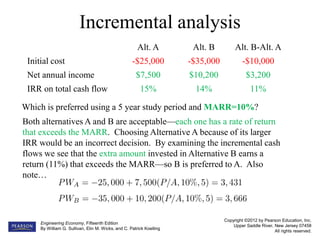
This provides a valuable cross-check. If you run an incremental IRR analysis and a PW analysis and they point to different alternatives, there is an error in your calculations.
Conclusion
You now have a robust method for comparing two mutually exclusive projects using rate of return. It corrects for the misleading nature of simply comparing IRR percentages on investments of different sizes.
- Key Takeaways:
- When comparing mutually exclusive projects, do not simply choose the one with the highest IRR.
- The difference in investment size is critical. You must analyze the return on the incremental investment.
- The decision rule is to accept the more expensive alternative only if the incremental IRR (
IRR(larger - smaller)) is greater than or equal to your MARR. - This method is consistent with Present Worth analysis; both will lead to the same project choice.
Preview of the Next Lesson
We've mastered the comparison of two alternatives. What happens when you have three, four, or even more mutually exclusive options? For example, deciding between several different cloud server configurations, each with different costs and performance benefits. In our next lesson, we will perform incremental analysis for multiple mutually exclusive alternatives, extending today's logic to handle more complex decisions.