Hello! Welcome back to our course on engineering economics.
In our last lesson, we established the principle of economic equivalence. We learned that to compare different financial alternatives, we must first bring all their associated costs and revenues to a single, common point in time. This is the foundational "why" of project evaluation.
Today, we move from the "why" to the "how." We'll tackle the most common pattern of cash flows you'll encounter in business and engineering: the uniform series, also known as an annuity. Our goal for this lesson is to learn how to calculate the present and future value of a uniform series of cash flows. This is a powerful tool for evaluating everything from software subscriptions and equipment leases to loan payments and structured savings plans.
What is a Uniform Series (Annuity)?
A uniform series is a sequence of equal cash flows occurring at regular intervals. In your work, this could be a monthly SaaS subscription fee, an annual software maintenance contract, or quarterly revenue from a client.
The most common type, and the one we'll focus on, is the ordinary annuity. It has three key characteristics:
- Equal Payments: The amount of each cash flow () is the same.
- Equal Intervals: The time period between each cash flow is the same (e.g., monthly, yearly).
- End-of-Period Payments: The cash flows occur at the end of each time period.
This cash flow diagram visually represents an ordinary annuity:
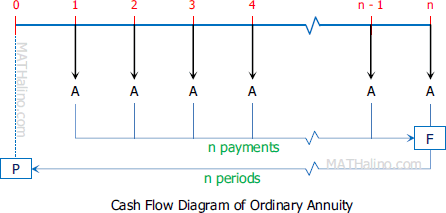
The fundamental question we want to answer is: what is the single equivalent value of this entire series of payments, either today () or at some point in the future ()?
Calculating the Future Value of a Uniform Series
Imagine your company decides to set aside a fixed amount of money, say $10,000, at the end of each year to save for a major server upgrade in 5 years. How much will you have in the account after the final deposit?
One way to solve this is the "brute force" method: treat each $10,000 deposit as a single payment and calculate its future value at year 5 using the formula we learned previously. Then, you'd sum them all up.
- The 1st deposit compounds for 4 years.
- The 2nd deposit compounds for 3 years.
- ...and so on, until the last deposit, which has zero time to compound.
This is tedious and error-prone, especially for long time horizons. Fortunately, mathematicians have simplified this summation into a single, elegant formula.
The MIT lecture notes present this formula, known as the Uniform Series Compound Amount Factor.
Spring 2007 Project Financing & Evaluation
These slides from an MIT course provide the concise formula we need to find the future value (F) from a uniform series (A).
Please review the slide titled 'Interest Formulas: Series' that introduces the 'Uniform Series Compound Amount Factor (F=A x Factor)'. Focus on the formula itself and the accompanying cash flow diagram. This is on page 20 of the PDF.
As the resource shows, the formula to find the Future Value () of a uniform series () is:
The term in the brackets is the (F/A, i, n) factor. This formula efficiently calculates the total accumulated amount, including all principal payments and the interest earned on them over time.
Calculating the Present Value of a Uniform Series
Now, let's look at the other side of the coin. Suppose you are considering a 5-year contract for a project management tool that costs $20,000 per year. As a manager, you need to understand the total equivalent cost of this contract in today's money to compare it against other alternatives (like buying software with a large one-time upfront cost). This is a present value problem.
We can derive the present value formula from the future value formula we just learned. We know the relationship between any single and is . By substituting our uniform series formula for into this equation, we get the formula for the Present Value () of a uniform series ().
Uniform Series of Cash Flows - Present & Future Value | Loan Payments & Savings Plans
This video provides a very clear derivation of the present value formula from the future value formula. This helps connect the two concepts.
Watch the segment from 20:47 to 22:15. Notice how the presenter simply substitutes the future value formula into the basic present value relationship to arrive at the new formula.
The resulting formula, also found in the MIT slides, is the Uniform Series Present Value Factor:
The term in the brackets is the (P/A, i, n) factor. This lets you calculate the lump sum amount today that is economically equivalent to a future stream of uniform payments.
Test your understanding!
You're offered a choice for a cloud service:
- Pay $30,000 upfront for a 3-year license.
- Pay $12,000 at the end of each year for 3 years.
Your company's MARR is 10%. Which option has a lower present value cost? Use the P/A formula to find the present value of option 2.
Show answer
The present value of Option 1 is simply $30,000.
For Option 2, we have , , and .
The present value of the annual payments is approximately $29,842. This is slightly cheaper than the $30,000 upfront cost, making Option 2 the better financial choice.
Application and Spreadsheet Functions
Your background in software engineering gives you a great advantage here. While manual calculations are essential for understanding, in practice, these formulas are embedded in tools you already use.
This resource provides an excellent summary table connecting these engineering economy concepts to familiar spreadsheet functions.
Engineering Economy - Uniform Series Formulas
This webpage is highly practical. It summarizes the formulas and, most importantly for you, maps them directly to Excel/Google Sheets functions.
Review the section with 'Table (2-2)'. Pay close attention to the 'Excel Function' column. Note how PV is used for P/A calculations, FV for F/A, and PMT is used for the annuity payment, 'A'.
The key takeaways are:
=PV(rate, nper, pmt)calculates the present value of an annuity.=FV(rate, nper, pmt)calculates the future value of an annuity.=PMT(rate, nper, pv, [fv])calculates the annuity payment amount.
These functions are standard in most programming language libraries for finance as well, making it easy to incorporate this analysis into custom applications or scripts you might build.
Conclusion
Today, we've added two of the most important tools in engineering economics to our toolkit. We can now move beyond single payments and analyze repeating cash flow streams.
- Key Takeaways:
- A uniform series (annuity) is a series of equal, regular, end-of-period payments ().
- The Future Value (F) of an annuity can be found using the Uniform Series Compound Amount Factor (F/A). This tells you what a series of savings or investments will be worth in the future.
- The Present Value (P) of an annuity can be found using the Uniform Series Present Value Factor (P/A). This tells you the equivalent upfront cost or value of a series of future payments.
- These calculations are easily performed using standard spreadsheet functions like
FVandPV.
Preview of the Next Lesson
We have now learned how to find and when we know the annuity payment . In the next lesson, we will flip the problem around. We will learn how to determine the required uniform payment () needed to achieve a desired future amount or to pay off a present loan. This involves the Capital Recovery and Sinking Fund factors, which are essential for planning loans, mortgages, and savings goals.