Hello! Welcome back to our study of engineering economics.
In the last lesson, we focused on converting a uniform series of payments () into an equivalent single lump sum, either in the present () or in the future (). This is useful for finding the total value of a stream of cash flows.
Today, we're going to flip that problem on its head. We'll start with a single lump sum—either a present amount or a future goal—and determine the equivalent uniform series of payments. This directly addresses our learning outcome: to convert present and future values to an equivalent uniform series using the capital recovery and sinking fund methods.
This skill is fundamental for financial planning. For example:
- If your company takes out a loan to buy new servers, how much is the annual payment?
- If you need to save for a major software platform upgrade in three years, how much do you need to set aside each quarter?
Let's dive into the two key concepts that answer these questions.
Two Sides of the Same Coin: Capital Recovery and Sinking Funds
At the heart of today's lesson are two factors that are inverses of the ones we learned last time.
- Capital Recovery (Finding A from P): This answers the question, "If I receive a lump sum of money today (), what uniform series of payments () is equivalent to it over 'n' periods?" This is the principle behind loan and mortgage payments.
- Sinking Fund (Finding A from F): This answers, "If I want to have a lump sum of money in the future (), what uniform series of payments () must I make to accumulate it?" This is the basis for planning targeted savings goals.
The following short video introduces the formulas for both factors.
Engineering Economic Analysis - Uniform Series
This video segment from Learning OnDemand succinctly introduces the formulas for the Sinking Fund factor (finding A from F) and the Capital Recovery factor (finding A from P).
Watch from 09:51 to 11:26. The first part explains the sinking fund factor (A/F). The second part explains the capital recovery factor (A/P). Notice how they are derived from the formulas we already know.
Now, let's explore each of these in more detail.
Capital Recovery Factor (A/P)
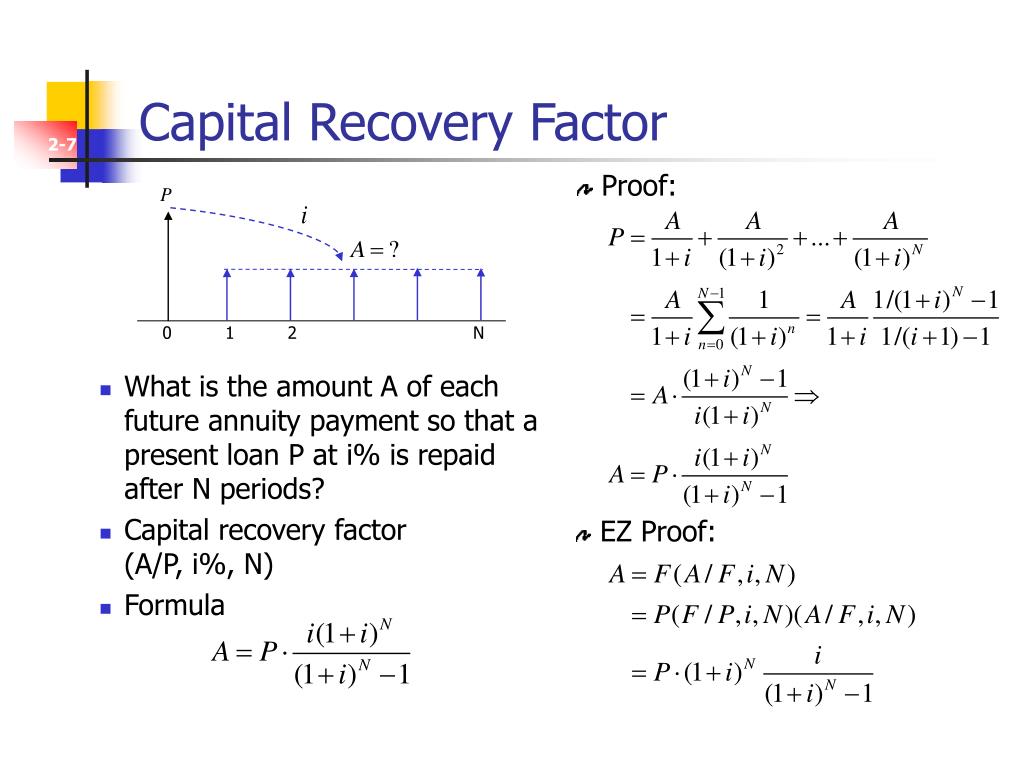
Imagine your company invests $50,000 in new development hardware. This is your present value, . To be a worthwhile investment, this hardware must generate savings or profits over its useful life. The capital recovery factor helps you determine the minimum equivalent annual benefit () your company must realize to "recover" the initial capital, accounting for the time value of money.
The formula to find when you know is:
The term in the brackets is the Capital Recovery Factor, denoted as (A/P, i, n).
This image provides an excellent visual summary of the concept, including the cash flow diagram and the formula.
Worked Example: Capital Recovery
Let's watch a practical example of this factor in action.
Uniform Series Capital Recovery Factor - Engineering Economics Lightboard
The Engineering Economics Guy provides a very clear, step-by-step walkthrough of a capital recovery problem.
Watch the entire video (about 5.5 minutes). Pay close attention to how the cash flow diagram is constructed and how the A/P factor is used to find the equivalent annual savings needed to justify an initial investment.
Test your understanding!
Your startup needs to purchase a new server for $50,000. You secure a loan at 6% annual interest to be paid back over 5 years with equal year-end payments. What is the required annual payment ()?
Show answer
Here we have , , and . We need to find .
Using the Capital Recovery formula:
The annual payment to the bank would be approximately $11,870. This amount covers both the principal and the interest.
Sinking Fund Factor (A/F)
Now, let's look at the other scenario. Suppose you know you will need $200,000 in 5 years () to replace a critical piece of lab equipment. You want to set up a "sinking fund" by depositing an equal amount of money at the end of each year into an account that earns interest. How much should you deposit each year?
The formula to find when you know is:
The term in the brackets is the Sinking Fund Factor, denoted as (A/F, i, n).
Application Example: Sinking Fund
The concept of a sinking fund is crucial for long-term financial planning, like saving for retirement or future capital expenditures.
Vol. II, Essay 2: Equivalence of Cash Flows
The MIT resource you've reviewed before provides a great real-world application of the sinking fund concept for retirement planning.
Read the section titled 'Sinking Funds' (it starts on page 36 of the PDF). Focus on how it frames the problem of saving for a future goal, which in this case is a retirement nest egg. This is a classic application of finding A given F.
Test your understanding!
You want to fund a marketing campaign that you estimate will cost $100,000 in 4 years. If you can invest the money in an account that earns 5% annually, how much must you deposit at the end of each year to reach your goal?
Show answer
Here we have , , and . We need to find the annual deposit, .
Using the Sinking Fund formula:
You would need to deposit approximately $23,200 each year to have $100,000 ready for your campaign in four years.
From Formulas to Tools
Given your background, you know that repetitive calculations are best left to computers. While understanding the formulas is vital, in practice you will use spreadsheet software or financial libraries. The function you'll use for both capital recovery and sinking funds is PMT.
This resource provides an excellent summary table that bridges the gap between the engineering economy factors and the spreadsheet functions you would use in a business setting.
Find and review 'Table (2–2)'. The key insight here is that the PMT function handles both scenarios. When you're given P (Capital Recovery), you use the pv argument. When you're given F (Sinking Fund), you use the fv argument.
In Google Sheets or Excel:
- Capital Recovery (A from P):
=PMT(rate, nper, pv) - Sinking Fund (A from F):
=PMT(rate, nper, , fv)(Note the extra comma to skip thepvargument)
Conclusion
Today we've completed the toolkit for handling uniform series cash flows. You can now convert back and forth between a single lump sum (P or F) and an equivalent uniform series (A).
- Key Takeaways:
- The Capital Recovery Factor (A/P) converts a present value () into an equivalent uniform series (). It's used to calculate loan payments.
- The Sinking Fund Factor (A/F) converts a future value () into an equivalent uniform series (). It's used to calculate the periodic savings needed to reach a future goal.
- In practice, the spreadsheet function
PMTis the efficient tool for both calculations.
Preview of the Next Lesson
You now have a solid foundation in the mechanics of uniform series. In our next lesson, we will put this knowledge to immediate practical use. We'll focus on applying these formulas to evaluate common business decisions in the tech world, such as comparing different software subscription plans and licensing models.