Hello! Welcome back.
In our last two lessons, we built the foundational skills for working with uniform series cash flows. You learned how to find the present or future value of a series of payments (P/A and F/A factors) and how to determine the payment series equivalent to a single lump sum (A/P and A/F factors).
Today, we'll put those skills into practice in a scenario that's highly relevant to your work in software development and management. Our goal is to apply uniform series formulas to evaluate software subscription and licensing models. You've likely faced "build vs. buy" or "subscribe vs. own" decisions many times. This lesson will provide a formal economic framework to guide those choices, moving from intuition to a data-driven comparison.
Framing the Decision: Perpetual vs. Subscription Models
In the software world, two dominant licensing models create very different cash flow patterns for the customer:
-
Perpetual License (+ Maintenance): This is the traditional model. You pay a large, one-time fee upfront to "own" the software license in perpetuity. This is often followed by smaller, recurring annual maintenance/support fees.
- Cash Flow Profile: A large initial outflow (), followed by a uniform series of smaller outflows ().
-
Subscription (SaaS - Software as a Service): This is the prevalent cloud-based model. You pay a recurring monthly or annual fee for the right to use the software. There is usually no large upfront cost.
- Cash Flow Profile: A pure uniform series of outflows (), with little to no initial cost.
This image, from a vendor's perspective, shows the difference in cumulative revenue over time. For our analysis as a customer, we can simply invert this to think about cumulative costs.
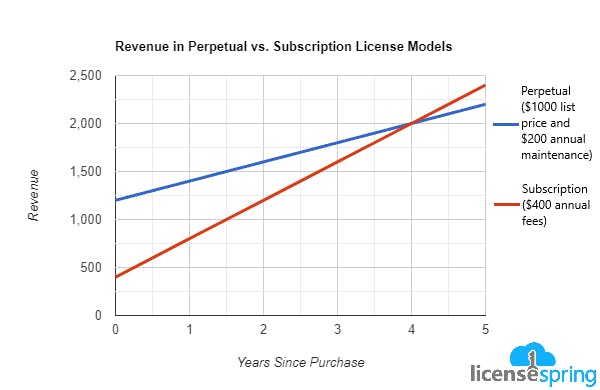
The key question is: which model is economically better over the long term? To answer this, we need to compare their costs on an equal footing.
The Analytical Framework: Present Worth (PW) Comparison
Because these models have different cash flow timings, we cannot simply add up the costs over a few years. We must account for the time value of money. The standard method for this is Present Worth (PW) analysis.
The goal is to convert all expected costs from each model into a single equivalent value at time zero (). The model with the lower total Present Worth of Costs is the more economically favorable choice.
The main tool we'll use is the P/A factor, which converts a uniform series () into a present value ().
To refresh your memory on the mechanics of finding the present value of a uniform series, please watch this short video. It demonstrates the three common methods: using factor tables, applying the formula directly, and using a spreadsheet function.
Engineering Economics - A/P & P/A
This video from Sofia Explains ItAll provides a clear walkthrough of how to calculate the Present Value (P) of a uniform series (A).
Watch the entire video (approximately 11 minutes). Focus on how the problem is broken down and how the P/A factor is used to find the equivalent present value of the annual payments. Pay special attention to the Excel PV function shown at the end, as this is the tool you'd most likely use in a real-world scenario.
Worked Example: SaaS vs. Self-Hosted Backup Solution
Let's apply this framework to a realistic problem. Your company needs a new enterprise backup solution and is comparing two alternatives. We will use cost estimates inspired by a real-world analysis of these models. For our analysis, let's assume a project lifespan (study period) of 5 years and a Minimum Acceptable Rate of Return (MARR) of 12%.
Alternative 1: Self-Hosted Solution (Perpetual Model)
- Initial Investment (): $175,000 for server hardware, perpetual software licenses, and implementation services.
- Annual Operating Costs (): $40,000 per year for software maintenance, power, cooling, and partial salary for an IT administrator.
Alternative 2: SaaS Solution (Subscription Model)
- Initial Investment (): $10,000 for setup and initial training.
- Annual Operating Costs (): $75,000 per year for the subscription fee, which covers all infrastructure and support.
Analysis
Our task is to calculate the Present Worth of all costs for each alternative.
1. PW of Self-Hosted Solution ()
The total PW is the sum of the initial cost and the present worth of the annual costs.
First, let's find the value of the P/A factor. You can find this in a 12% interest table or calculate it:
Now, substitute this back into the equation:
2. PW of SaaS Solution ()
The calculation is similar:
Decision
Comparing the two, we have:
- PW of Costs (Self-Hosted): $319,192
- PW of Costs (SaaS): $280,360
Based on this economic analysis, the SaaS Solution is the preferred alternative as its equivalent present worth of costs is nearly $39,000 lower over the 5-year study period.
This type of analysis, comparing the present worth of alternatives, is a cornerstone of engineering economics. The image below shows another example of this exact methodology applied to a manufacturing problem, including how it looks in a spreadsheet.

Test your understanding!
Your company is choosing a new Customer Relationship Management (CRM) platform. You need to decide between two options over a 4-year period, with a MARR of 10%.
- Option A (Perpetual License): An upfront cost of $50,000, plus an annual maintenance and support fee of $8,000.
- Option B (SaaS Subscription): An annual subscription fee of $20,000, with no upfront cost.
Which option is more economical? Calculate the Present Worth of costs for each.
Show answer
First, find the (P/A, 10%, 4) factor.
Option A (Perpetual):
Option B (SaaS):
Conclusion: The SaaS subscription (Option B) has a lower present worth of costs and is the more economical choice. In a spreadsheet like Excel or Google Sheets, you could calculate this as =-PV(10%, 4, 20000).
Beyond the Numbers: Strategic Considerations
While the PW analysis gives us a clear economic winner, a good manager knows the numbers are only part of the story. Your decision must also include qualitative factors. The following resource provides an excellent summary of these strategic considerations.
Enterprise Backup Pricing: SaaS Vs Self-Hosted Deployment ...
This article from Zmanda on backup pricing provides a great high-level framework for making the final decision between SaaS and Self-Hosted models. We used it for our cost estimates, and now we'll use it for the strategic view.
Read the section titled 'What Decision Framework Should Organizations Use?'. It provides bullet points on when to choose SaaS and when to choose a Self-Hosted model. Think about how these points relate to your own business and project management experience.
Key factors to consider include:
- Capital Budget (CapEx) vs. Operating Budget (OpEx): Does your company prefer a large one-time capital expense or a predictable recurring operational expense? Startups often prefer OpEx to preserve capital.
- Expertise and Personnel: Do you have the in-house talent to manage a self-hosted solution, or is it better to offload that responsibility to a SaaS vendor?
- Scalability and Flexibility: SaaS models typically make it easier to scale services up or down as your needs change.
- Control and Security: Self-hosted solutions offer more control over data, which can be critical for regulatory compliance or data sovereignty requirements.
Conclusion
Today you've bridged the gap between theory and practice by using uniform series formulas to analyze a common and important software procurement decision.
- Key Takeaways:
- Perpetual and Subscription licensing models have distinct cash flow profiles (large P + small A vs. just A).
- Present Worth (PW) analysis is the standard method to compare these alternatives on an equal economic footing by converting all costs to their equivalent.
- The alternative with the lowest Present Worth of Costs is generally the preferred economic choice.
- Quantitative analysis must always be supplemented with qualitative, strategic considerations to make a well-rounded business decision.
Preview of the Next Lesson
Our analysis today assumed that the annual costs were uniform. But what if costs are expected to increase over time, for example, due to inflation or planned upgrades? In our next lesson, we will learn how to model cash flows that change by a constant amount each period using the arithmetic gradient series.