Hello! Welcome to the start of a new module, Module 3: Evaluating Cash Flow Series.
In the previous module, we built the foundation of financial mathematics. We focused on single sums of money, learning how to calculate their present and future values using interest rates. We wrapped up by learning the Rule of 72, a quick mental shortcut for estimating growth. These tools are essential, but most real-world engineering and business decisions involve more than just one-off payments.
Today, we'll address the core concept that allows us to compare complex financial alternatives. Our learning outcome is to define economic equivalence and its role in comparing alternatives. This principle is the bridge between the simple calculations we've done so far and the powerful analysis of entire projects with multiple cash flows over many years—such as comparing different software-as-a-service (SaaS) subscription plans or evaluating a technology investment with ongoing maintenance costs.
What is Economic Equivalence?
At its heart, economic equivalence is a simple but profound idea: different amounts of money at different points in time can be equal in economic value, given a specific interest rate.
If two different payment plans or cash flow streams are economically equivalent, it means a rational decision-maker would be indifferent to choosing one over the other. The financial outcome is the same.
Let's watch a short video clip that introduces this concept very clearly.
Time Value of Money Engineering Economics Live Class Recording
The 'Engineering Economics Guy' provides a great explanation using a simple example. He introduces the idea of being 'indifferent' between two choices, which is the essence of equivalence.
Watch the segment from 05:11 to 07:10. Focus on how a 10% interest rate makes receiving $100 today the same as receiving $110 in a year.
As the video explains, if you can earn 10% on your money, receiving $100 today is economically equivalent to receiving $110 in one year. Why? Because you can take the $100, invest it for a year at 10%, and it will grow to $110.
The Role of Equivalence in Comparing Alternatives
You might be wondering, "Why is this so important?" The answer lies in a golden rule we touched on in the last module: You cannot simply add or subtract sums of money that occur at different points in time.
Think about your experience scaling tech platforms. You might face a choice:
- Alternative A: Pay a $50,000 one-time license fee for a software component.
- Alternative B: Pay $15,000 per year for a 4-year subscription to an equivalent component.
Simply adding up the payments for Alternative B ($15k * 4 = $60k) and comparing it to Alternative A's $50k is incorrect and misleading because it ignores the time value of money. The payments for B are spread out, and those future payments are "cheaper" in today's money.
Economic equivalence provides the mechanism to make a fair comparison. It allows us to transform a series of cash flows into an equivalent single value at a common point in time—usually the present.
Present Worth and Annual Worth Explained Engineering Economics Live Class Recording
Let's watch another clip from the 'Engineering Economics Guy' that powerfully illustrates why we can't just add up cash flows.
Watch from 02:55 to 03:39. The instructor presents an investment and asks what's wrong with simply summing up the annual returns. The answer is the key to why equivalence is necessary.
By using the time value of money formulas we've learned, we can convert all future cash flows (like subscription payments or maintenance costs) into their present worth (PW). Once all alternatives are expressed as a single value at time zero, they can be directly and fairly compared. This is the central role of equivalence in decision-making.
The Four Principles of Economic Equivalence
To make this concept more concrete, let's look at four fundamental principles that govern it.
3.3 Economic Equivalence – Engineering Economics
This article from a University of Saskatchewan OER provides a clear definition and then lays out four key principles. Understanding these will solidify your grasp of the topic.
First, read the introduction and Example 3.3 to reinforce the definition. Then, carefully read the section '3.3.1 Principles of Economic Equivalence' which details the four principles.
Here is a summary of those four critical principles:
-
Comparisons Require a Common Time Basis: You can't compare a present cost to a future revenue stream directly. You must move all cash flows to a single point in time, typically the present (time 0), before comparing them.
-
Equivalence Depends on the Interest Rate: This is crucial. Two cash flow streams might be equivalent at a 10% interest rate but not equivalent at 15%. Your conclusion is tied to the rate you use (e.g., your MARR).
-
Comparisons May Require Conversion to a Single Cash Flow: To compare complex patterns of cash flows, we collapse them into a single equivalent number, like the Net Present Value (NPV) or an equivalent annual amount.
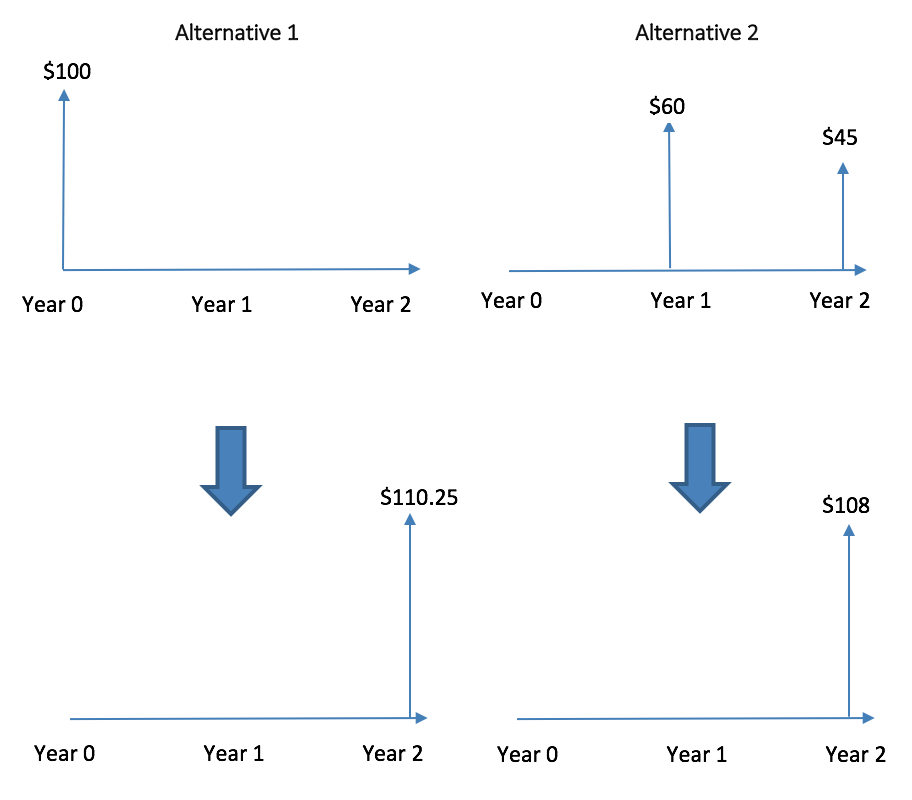
*This image from the reading illustrates Principle 3. It shows how two different cash flow patterns (Alternative 1: a single payment; Alternative 2: two smaller payments) can be converted to their equivalent values at a future point (Year 2) for comparison.*
4. Equivalence is Maintained Regardless of Point of View: As long as the same interest rate is used, the equivalence holds true whether you are the one paying the money or the one receiving it.
The MIT lecture slides you have access to frame this perfectly. They state that the objective of engineering economy is to compare the economic value of alternatives, and the basis for this is finding equivalent cash flows.
These MIT slides concisely state the objective and basis of engineering economic analysis, directly highlighting the role of equivalence.
Review slides 2 and 3 (labeled 'Engineering Economic Analysis: Slide 2' and 'Slide 3'). Notice how they frame the entire process around evaluating alternatives by determining equivalence.
Test your understanding!
You're evaluating two database solutions for a new project.
- Option A: A one-time license cost of $10,000, paid now.
- Option B: A "free" open-source option, but it will require an estimated $12,100 in specialized developer training and setup costs, which will be paid in two years.
Your company's MARR is 10%. Are these two options economically equivalent? Which one is the better financial choice?
Show answer
To compare them, we need to find the present worth (PW) of each option at a 10% interest rate.
- PW of Option A: The cost is already at the present, so .
- PW of Option B: We need to discount the future cost of $12,100 back two years to the present.
Since the present worth of both options is $10,000, they are economically equivalent at a 10% MARR. Based purely on this financial analysis, you would be indifferent between the two.
Conclusion
Today, we've introduced the foundational concept for comparing different investment and project alternatives. You've learned how economic equivalence allows us to make fair, apples-to-apples comparisons of cash flows that occur at different times.
- Key Takeaways:
- Economic Equivalence means that different cash flow streams have the same economic value when adjusted for the time value of money at a specific interest rate.
- Its primary role is to enable the comparison of alternatives by converting all cash flows to a single, common point in time (like present worth).
- Equivalence is critically dependent on the interest rate (discount rate or MARR) used in the calculation.
- The "golden rule" of engineering economics is that you cannot add or subtract money from different time periods without first making them equivalent.
Preview of the Next Lesson
Now that we understand why equivalence is necessary, our next few lessons will focus on the how. We will develop the tools to handle common patterns of cash flows. In our next session, we will start with the most common pattern: the uniform series, also known as an annuity. This will give us the formula to efficiently find the present or future value of recurring, equal payments like software subscriptions, loan payments, or annual maintenance contracts.