Hello! Welcome back to our journey through depreciation methods.
In our last few lessons, we've explored the mechanics of straight-line and declining balance depreciation. We saw that while straight-line is simple, declining balance better reflects how technology assets lose value and provides an "accelerated" deduction. However, we also noted a key flaw with the pure declining balance method: it doesn't fully depreciate an asset by the end of its life.
Today, we'll see how tax law addresses this. This lesson focuses on the Modified Accelerated Cost Recovery System (MACRS). Our goal is not to become tax accountants but to explain the purpose of accelerated depreciation methods like MACRS and understand why they are so important for a business's financial strategy. This is the system you would encounter when planning for capital expenditures in a US-based company, like purchasing a new fleet of servers or office equipment.
1. The "Why" Behind MACRS: Purpose and Tax Benefits
At its core, MACRS is the standardized depreciation system required by the U.S. Internal Revenue Service (IRS) for most tangible assets. Instead of letting every business invent its own depreciation schedule, MACRS provides a consistent and predictable framework.
Its primary purpose, however, is not just standardization. It is designed to be an accelerated system. To understand why that's so important, let's read a short overview.
Modified Accelerated Cost Recovery System (MACRS)
This article from Investopedia clearly defines MACRS and, more importantly, spells out its tax benefits. As you read, focus on the connection between 'faster acceleration' and a business's taxes.
Read the sections 'What Is the Modified Accelerated Cost Recovery System (MACRS)?' and 'What Are the Tax Benefits of Depreciation?'. Pay close attention to the explanation of why being able to deduct greater amounts early is beneficial.
As the article highlights, the fundamental purpose of MACRS is to allow businesses to recover their capital costs more quickly. This has a direct and powerful impact on cash flow due to the time value of money.
By taking larger depreciation deductions in the early years of an asset's life, a company lowers its taxable income more significantly upfront. This means paying less tax sooner. That conserved cash can then be immediately reinvested into the business—for R&D, hiring, marketing, or other projects. A tax dollar saved today is worth more than a tax dollar saved five years from now. MACRS is essentially an economic policy tool designed to incentivize businesses to invest in new assets.
2. The "How" of MACRS: A System of Rules
So, how does MACRS achieve this acceleration? It's not one single depreciation formula, but rather a system built on a few key principles. It prescribes which accelerated method to use for which type of asset.
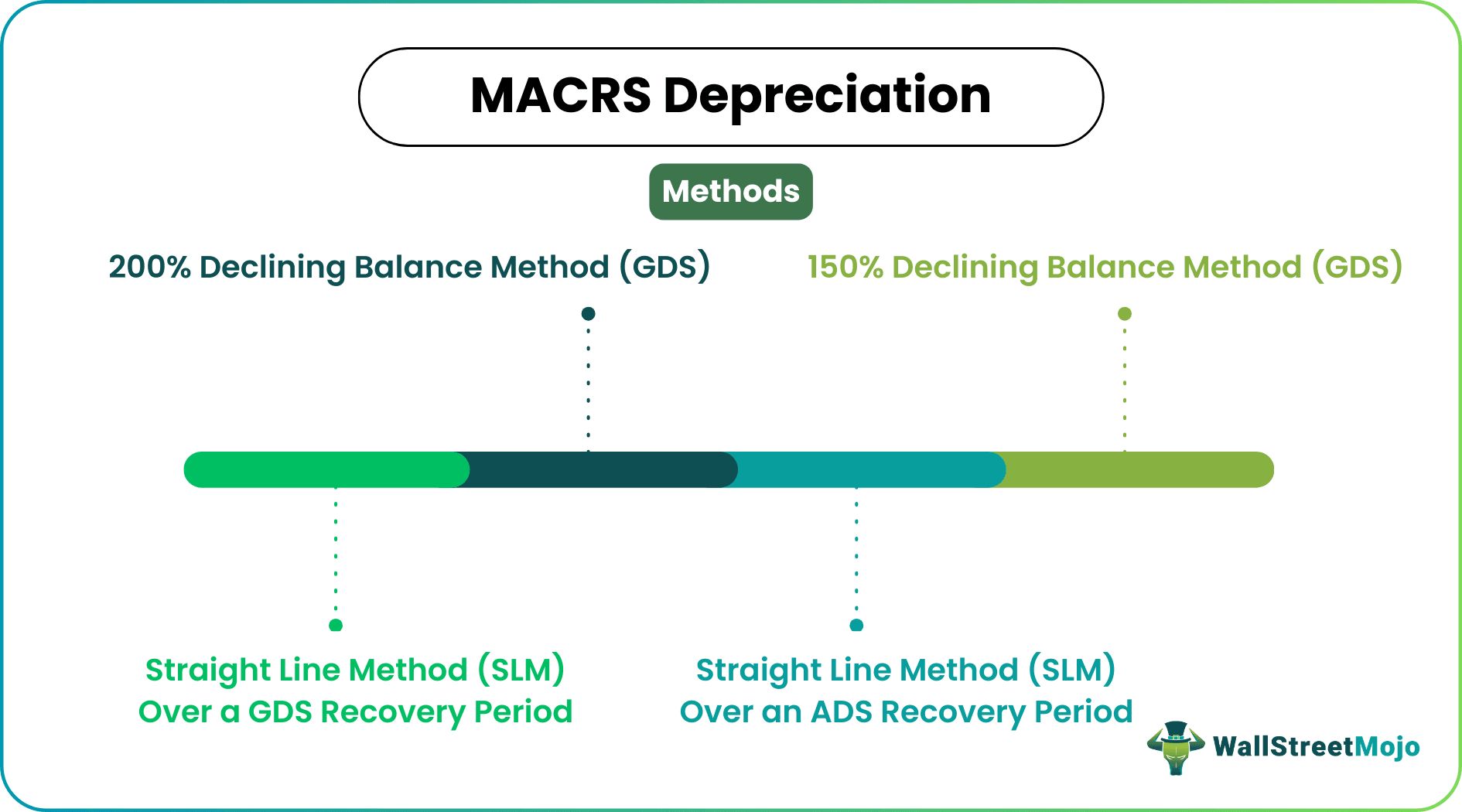
As you can see, MACRS is built on the declining balance method we just learned about. However, it refines it to make it practical for tax purposes.
To see how these rules come together, let's look at a resource that explains the mechanics.
Business Costs that May Be Capitalized
The following material from Penn State's Engineering Management program explains the mechanics of MACRS. It directly addresses the problem we identified with the pure declining balance method.
Read the section titled '4. Modified Accelerated Cost Recovery Systems (MACRS)'. Note how it describes MACRS as a 'declining balance switching to straight line' method. Then, look at the example table to see how pre-calculated rates are used to depreciate an asset. The key is to understand the process, not to memorize the specific rates.
This resource reveals the three key features that make MACRS work:
-
Declining Balance with a Switch to Straight-Line: This is the core mechanism. MACRS uses the DDB (200%) or 150% DB method to get large deductions upfront and then automatically switches to the straight-line method at the optimal point. This ensures the asset is depreciated completely to a zero salvage value (for tax purposes, salvage value is assumed to be zero under MACRS). This solves the "incomplete depreciation" problem of the pure DB method.
-
Property Classes: MACRS simplifies things by grouping assets into classes with defined recovery periods. For your field, the most relevant is the 5-year property class, which includes computers, servers, and related peripheral equipment. Office furniture and fixtures fall into the 7-year class.
-
Conventions (e.g., Half-Year Convention): MACRS assumes, by default, that an asset is placed in service in the middle of the year, regardless of the actual purchase date. This is called the half-year convention. This is why a 5-year asset is actually depreciated over 6 calendar years—you get a half-year of depreciation in Year 1 and the final half-year in Year 6.
The great advantage for businesses is that all this complexity—the DB calculation, the optimal switch-over point, and the half-year convention—is pre-calculated by the IRS and published in simple tables. You simply find the correct property class for your asset and multiply its initial cost by the percentage given in the table for each year.
Test your understanding!
A company you co-founded is deciding whether to invest 1,500,000 ETB in new server hardware. The finance team presents two depreciation schedules: one using the Straight-Line method and one using the prescribed MACRS method. The total depreciation amount over the asset's life is the same in both schedules (1,500,000 ETB).
Why would you, as a manager focused on business growth, strongly prefer the project analysis that uses the MACRS schedule?
Show answer
You should prefer the MACRS schedule because of the time value of money. The MACRS schedule provides larger tax deductions in the early years. This increases the project's after-tax cash flow early in its life. Early cash flow is more valuable than later cash flow because it can be reinvested sooner, reduces the project's risk, and results in a higher Net Present Worth (NPW). For a growing business, improved short-term cash flow is critical for funding operations and seizing new opportunities.
Conclusion
Today we've demystified one of the most practical aspects of engineering economics. While the rules can seem complex, the underlying purpose is straightforward and aligns with the core financial principles we've been discussing.
- Key Takeaways:
- The Modified Accelerated Cost Recovery System (MACRS) is the standard method for tax depreciation in the United States.
- Its primary purpose is to stimulate investment by allowing businesses to recover asset costs faster, which provides larger tax savings in the early years of an asset's life.
- This acceleration leverages the time value of money, improving a project's cash flow and making capital investments more financially attractive.
- MACRS achieves this by using a standardized system based on the declining balance method with an automatic switch to straight-line, organized by pre-defined property classes and conventions.
Preview of the Next Lesson
We now have a solid grasp of how depreciation is calculated, from simple straight-line to the tax-mandated MACRS. We're ready to integrate this into our full financial models. In the next lesson, we will learn how to determine the appropriate corporate income tax rate and its effect on cash flows. This is the final piece of the puzzle we need to begin performing complete after-tax economic analyses.