Hello! Welcome back to your study of engineering economics.
In our last lesson, we explored MACRS and saw how accelerated depreciation reduces a company's taxable income more quickly in the early years of an asset's life. This concept of "taxable income" is our jumping-off point for today. While depreciation itself isn't a cash flow, it directly impacts the amount of cash you'll actually pay in taxes.
This lesson addresses a crucial step in moving from a before-tax analysis to a more realistic after-tax analysis. Our learning outcome is to determine the appropriate corporate income tax rate and its effect on cash flows. We'll define how taxable income is calculated, learn how to combine federal and state taxes into a single "effective" rate, and see precisely how taxes transform a project's cash flow statement.
1. What is Taxable Income?
Before we can apply a tax rate, we need to understand what we're applying it to. A company isn't taxed on its gross revenue, but on its taxable income. In your experience scaling businesses, this is analogous to calculating net profit before taxes.
The formula is straightforward and directly incorporates the depreciation concepts we've just covered.
This resource from a textbook on Engineering Economy provides a clear and concise definition of taxable income. It formalizes the relationship between income, expenses, and depreciation.
Please read the first slide in this section, which defines 'Taxable income'. It's a short but critical formula.
As the resource states, the formula is:
- Gross Income: This is all the revenue generated by the project (e.g., sales, service fees). For your SaaS platforms, this would be the Monthly Recurring Revenue (MRR).
- Allowable Expenses: These are the operational costs of doing business, such as salaries, marketing, materials, and server hosting costs.
- Depreciation Deductions: This is the non-cash expense we calculate using methods like Straight-Line or MACRS.
Only after subtracting all these items do we arrive at the income figure that will be subject to taxation.
2. Determining the Effective Corporate Tax Rate
Once we have the taxable income, we need a tax rate to calculate the tax owed. In the United States, corporate income is taxed at both the federal and state levels. To simplify our analysis, we combine these into a single effective tax rate.
Federal and State Taxes
- Federal Rate: The federal corporate income tax in the U.S. was changed to a flat 21% in 2018. The resources for this course were created before this change and may reference older, higher bracketed rates (like 34%), but we will use the current rate for our understanding.
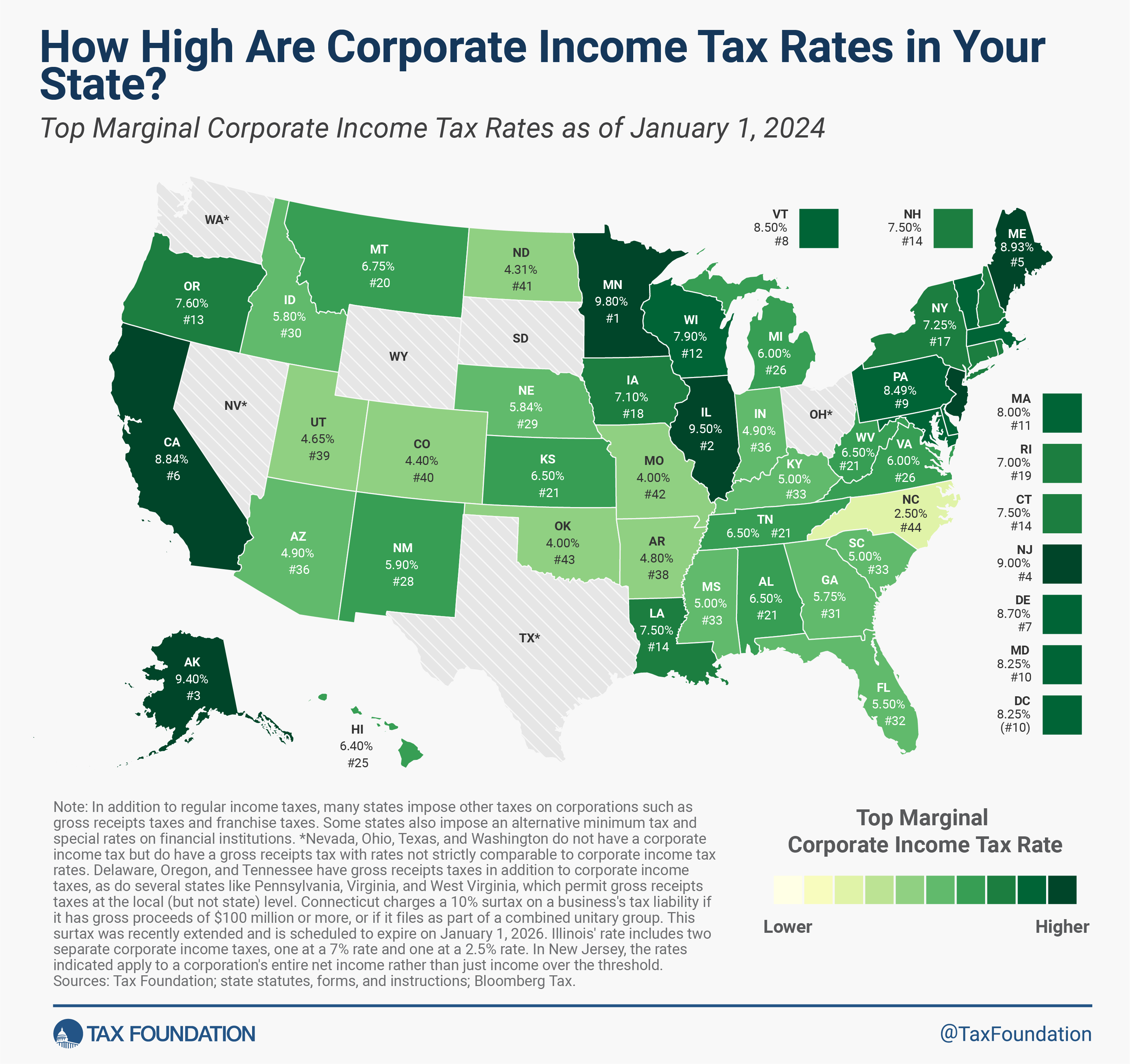
- State Rate: State tax rates vary significantly from one state to another, which can be a major factor in business decisions.
Take a look at this map to see how much the rates can differ.
Calculating the Effective Tax Rate
We can't simply add the federal and state rates together. This is because state income taxes are a deductible expense for federal income tax purposes. The money a company pays in state tax is not subject to federal tax.
This leads to the following formula for the effective tax rate ().
1.011 Project Evaluation - Review
This review document from an MIT course provides the standard formula for calculating the effective tax rate. This is the key formula for this section.
Focus on the formulas provided under the 'MARR' heading for 'Effective Tax Rate'. The document uses a 34% federal rate as an example, but the formula itself is what's important.
The formula is:
Example:
Imagine your company is based in a state with a 6% corporate income tax. The federal rate is 21%.
- State Rate = 0.06
- Federal Rate = 0.21
The effective tax rate would be:
Notice this is less than the simple sum of the two rates (6% + 21% = 27%), reflecting the tax savings from the state tax deduction.
3. The Effect of Taxes on Project Cash Flows
Now we can put it all together to see how taxes impact the final cash flow of a project. The goal is to calculate the After-Tax Cash Flow (ATCF).
The tax payment itself is a direct cash outflow:
And the After-Tax Cash Flow is simply the Before-Tax Cash Flow (BTCF) minus the taxes paid.
Where BTCF = Gross Income - Allowable Expenses.
Let's look at an illustrative example.

In this example, for Year 1:
- Before-Tax Cash Flow is $1,000.
- Taxable Income is also $1,000 (since there's no depreciation).
- The tax rate is 39%, so Taxes = $1,000 * 0.39 = $390.
- The After-Tax Cash Flow = $1,000 - $390 = $610.
This clearly shows that taxes are a significant cash outflow that directly reduces the net cash generated by a project.
The Depreciation Tax Shield
We can also express the ATCF formula in a way that highlights the benefit of depreciation:
This form is powerful because it reveals two components:
- After-Tax Operating Income:
(Gross Income - Expenses) * (1 - t) - Depreciation Tax Shield:
(Depreciation * t)
The "tax shield" is the actual cash savings generated because depreciation is a deductible expense. It quantifies the value of the depreciation deduction we learned about in the last lesson. For every dollar of depreciation, you save t dollars in taxes.
Test your understanding!
A software project is projected to generate $500,000 in revenue next year. The operating expenses (salaries, hosting) are estimated at $200,000. The depreciation charge for the servers and equipment for the year is $50,000. The company's effective tax rate is 30%.
Calculate the following:
- The Taxable Income for the year.
- The taxes owed.
- The After-Tax Cash Flow (ATCF) for the year.
- The value of the depreciation tax shield.
Show answer
-
Taxable Income = Revenue - Expenses - Depreciation
= $500,000 - $200,000 - $50,000 = $250,000 -
Taxes Owed = Taxable Income * Effective Tax Rate
= $250,000 * 0.30 = $75,000 -
After-Tax Cash Flow (ATCF) = (Revenue - Expenses) - Taxes
= ($500,000 - $200,000) - $75,000
= $300,000 - $75,000 = $225,000 -
Depreciation Tax Shield = Depreciation * Effective Tax Rate
= $50,000 * 0.30 = $15,000. This is the amount of cash saved due to the depreciation deduction. You can verify the ATCF using the tax shield formula:
ATCF = ($300,000 * (1-0.30)) + ($50,000 * 0.30) = ($300,000 * 0.70) + $15,000 = $210,000 + $15,000 = $225,000.
Conclusion
Today, we've connected the dots between revenue, expenses, depreciation, and the actual cash flow a project generates after accounting for taxes. This is the foundation of realistic financial evaluation for any for-profit enterprise.
- Key Takeaways:
- Taxable Income is the basis for tax calculations, defined as
Gross Income - Expenses - Depreciation. - The Effective Tax Rate combines state and federal taxes, properly accounting for the federal deduction of state taxes:
t = State Rate + (1 - State Rate) * Federal Rate. - Taxes are a cash outflow that directly reduces a project's profitability.
- Depreciation provides a tax shield (
Depreciation * t), which represents the real cash savings resulting from this non-cash deduction.
- Taxable Income is the basis for tax calculations, defined as
Preview of the Next Lesson
We now have all the individual components needed to perform a complete after-tax analysis. We know how to calculate depreciation over an asset's life, and we know how to determine the tax implications for any given year. In our next lesson, we will synthesize these skills to calculate after-tax cash flows for an entire investment project, setting the stage for evaluating its overall worth using Net Present Worth analysis.