Hello! Welcome back to our discussion on depreciation.
In our last lesson, we covered the straight-line method, where the cost of an asset is spread evenly over its useful life. This results in a constant depreciation expense each year. While simple, this often doesn't match how technology assets, like the ones you build and manage, lose their value—they tend to depreciate faster in the beginning due to rapid technological obsolescence.
Today, we will address this by learning how to calculate declining balance depreciation for an asset. This is a type of accelerated depreciation method, which allows for larger depreciation expenses in the early years of an asset's life and smaller expenses later on. For a business, this is a powerful tool for improving cash flow through larger, earlier tax deductions.
1. The Concept of Accelerated Depreciation
The main advantage of an accelerated method like declining balance is tied directly to the time value of money, a concept we covered in Module 2. By claiming a larger depreciation expense in the first few years, a company can reduce its taxable income more significantly upfront. This means paying less tax earlier, which frees up cash for other investments or operations.
The declining balance method achieves this by applying a constant rate of depreciation to the asset's declining book value each year, rather than a constant amount.
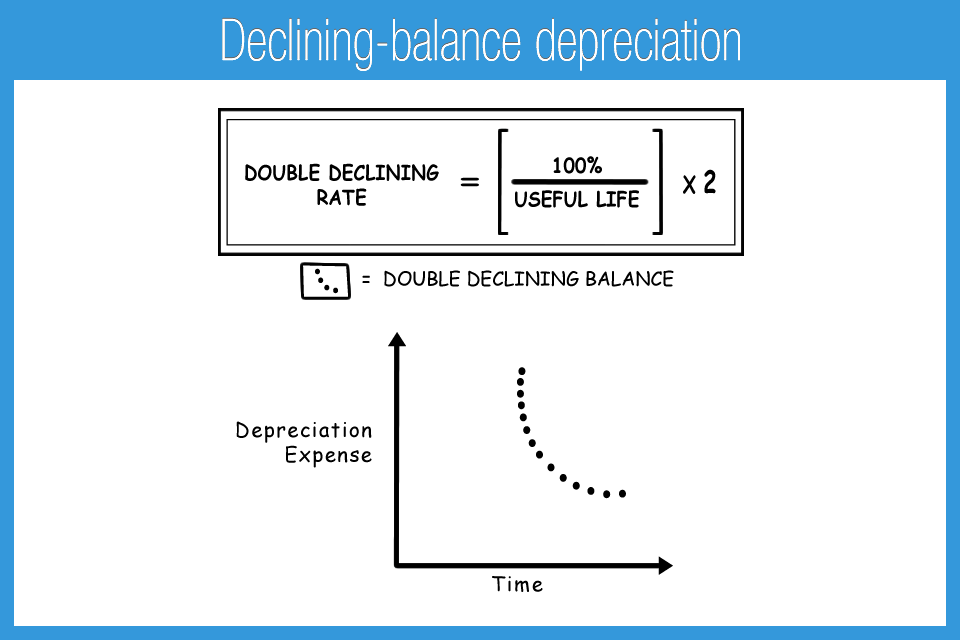
2. The Declining Balance (DB) Formula
The calculation for declining balance depreciation is iterative. The depreciation in any given year depends on the book value from the end of the previous year.
Capital Costs: Capitalization, Depreciation and Taxation
To understand the formula, let's look at this concise definition from an MIT OpenCourseWare lecture.
In these presentation slides, find the heading 'Depreciation Methods (cont.)' and then the subheading 'C. Declining Balance Method'. Focus on the formula provided and the definition of the 'double-declining balance' (DDB) method.
As the resource indicates, the depreciation charge in year () is a fixed fraction () of the book value at the end of the previous year ():
The book value is, as always, the initial cost minus accumulated depreciation:
The rate, , is typically a multiple of the straight-line rate (). A very common implementation is the Double Declining Balance (DDB) method, where the multiplier is 2.
where is the useful life of the asset.
So, for an asset with a 5-year life, the straight-line rate is 1/5 or 20%. The DDB rate would be 2/5 or 40%.
3. A Step-by-Step Walkthrough
The best way to understand this is to see it in action. The following video provides a clear, step-by-step demonstration of how to calculate depreciation using this method. It also highlights some of the unique characteristics of the declining balance approach.
Business Costs that May Be Capitalized | EME 460
This video from Penn State's Engineering Management program walks through the entire calculation process for the declining balance method, including a spreadsheet example.
Watch the video titled 'Declining Balance Depreciation Method'. Focus on how the adjusted basis (book value) is calculated each year and then used to find the depreciation for the next year. The video also explains how to calculate the depreciation rate from a percentage (like 150% DB). A full transcript is available below the video if you prefer to read.
As you saw in the video, the process for each year is:
- Determine the Book Value at the beginning of the year (). For year 1, this is the asset's initial cost.
- Calculate the Depreciation Expense for the current year by multiplying the book value by the fixed rate ().
- Update the Book Value by subtracting the current year's depreciation ().
This next image provides a great summary of this process with a table and chart for a sample asset.

4. Important Considerations
There are two critical rules to remember when using the declining balance method:
- Salvage Value as a Floor: Unlike the straight-line method, the salvage value is not used to calculate the annual depreciation amount. However, an asset cannot be depreciated below its estimated salvage value. If a calculation would cause the book value to drop below the salvage value, the depreciation expense for that year must be adjusted to make the final book value exactly equal to the salvage value.
- Incomplete Depreciation: The pure declining balance method will never fully depreciate an asset to zero (or even to its salvage value) because the calculation always leaves a remaining balance. As the video mentioned, the sum of depreciation charges at the end of the useful life is often less than the initial depreciable cost.
This second point is a significant drawback, which is why in practice, tax systems often prescribe a hybrid method, which we will discuss in a future lesson.
Test your understanding!
Let's revisit the server infrastructure your company purchased for 500,000 ETB. It has a useful life of 5 years and an estimated salvage value of 50,000 ETB.
Using the Double Declining Balance (DDB) method:
- What is the depreciation expense for Year 1?
- What is the book value of the servers at the end of Year 2?
Show answer
First, calculate the DDB rate:
- Useful Life = 5 years
- DDB Rate = 2 / 5 = 0.40 or 40%
1. Depreciation for Year 1:
- Book Value at start of Year 1 () = 500,000 ETB
- Depreciation Year 1 () = 0.40 * 500,000 ETB = 200,000 ETB
2. Book Value at End of Year 2:
- Book Value at end of Year 1 () = 500,000 - 200,000 = 300,000 ETB
- Depreciation Year 2 () = 0.40 * 300,000 ETB = 120,000 ETB
- Book Value at end of Year 2 () = 300,000 - 120,000 = 180,000 ETB
Conclusion
You have now learned your second major depreciation method. Understanding how to calculate declining balance depreciation is crucial for analyzing investments, especially in technology, where front-loading depreciation can significantly improve a project's financial attractiveness.
- Key Takeaways:
- Declining balance is an accelerated depreciation method that applies a constant rate to a declining book value.
- The Double Declining Balance (DDB) method uses a rate that is twice the straight-line rate ().
- This method provides larger tax deductions in the early years of an asset's life.
- An asset cannot be depreciated below its salvage value, and the pure DB method does not fully depreciate an asset by the end of its useful life.
Preview of the Next Lesson
The fact that the pure declining balance method doesn't fully depreciate an asset is a practical problem. In our next lesson, we will explore the common solution: calculating declining balance depreciation with a switch to the straight-line method to ensure the asset is fully depreciated by the end of its life. This hybrid approach is a key step toward understanding the real-world depreciation systems used by tax authorities.