Hello! Welcome back to our study of Benefit-Cost Analysis.
In our last lesson, we mastered the conventional benefit-cost (B/C) ratio, where we grouped all project costs—both the initial investment and ongoing operational costs—into the denominator. This gave us a measure of a project's overall profitability.
Today, we'll explore a different perspective by learning to calculate the modified benefit-cost (B/C) ratio and understanding when it is used. The key change is how we treat ongoing costs. This "modification" allows us to answer a slightly different, but critically important, question: "How efficiently is our initial capital being put to work?" For you as a manager and entrepreneur, this perspective is invaluable when you have a limited capital budget and need to decide which projects will generate the most value from that initial outlay.
What is the Modified B/C Ratio?
The conventional B/C ratio tells us about a project's overall value proposition. The modified B/C ratio reframes the analysis to focus on the efficiency of the capital investment itself. It does this by moving recurring costs, such as annual maintenance and operation (M&O) costs, out of the denominator and treating them as a reduction in benefits (a "disbenefit") in the numerator.
The formula is as follows:
Let's break down the components:
- Numerator: This represents the net benefit generated by the project's operations. We take all the good things (benefits) and subtract all the recurring bad things (disbenefits and M&O costs).
- Denominator: This is now purely the initial capital investment required to launch the project. In software, this is typically your development costs, initial hardware setup, or major software license purchases.
The following resource provides a clear definition of the modified B/C ratio.
This document from the University of British Columbia clearly defines both the conventional and modified benefit-cost ratio formulas.
Please read the section titled 'Benefit – Cost Ratios'. Focus on the definition and formula for the 'modified benefit–cost ratio (BCRM)'. Note how it differs from the conventional ratio.
This image provides an excellent visual summary of the structure of the modified B/C ratio calculation.

When to Use the Modified B/C Ratio
So, why have two different ratios? Because they answer two different questions. For any single project, if the conventional B/C is greater than 1, the modified B/C will also be greater than 1. They will always lead to the same accept/reject decision.
The real power of the modified B/C ratio emerges when you are comparing or ranking multiple projects, especially under capital rationing (i.e., you have a fixed investment budget).
- Conventional B/C asks: "Do the total benefits outweigh the total costs?"
- Modified B/C asks: "For every dollar of initial capital I invest, how many dollars of net operating benefit will I get back?"
The resource you just read, Chapter 10, states that the modified B/C ratio is "advantageous in measuring the net gain per dollar invested by the sponsor." This makes it a measure of capital efficiency.
Imagine you have a $1M capital budget to fund new software projects.
- Project A requires a $1M investment and has a modified B/C of 1.5.
- Project B requires a $200k investment and has a modified B/C of 3.0.
While Project A might have larger total benefits, Project B is far more efficient with your limited capital. It returns $3 of net operating benefit for every $1 invested. You could fund Project B and still have $800k left for other high-efficiency projects. The modified B/C ratio makes this type of prioritization clear.
Calculation Example: SaaS Feature Revisited
Let's revisit the automated irrigation control feature from our last lesson to see the modified B/C ratio in action and compare the results.
Project Data:
- Initial Development Cost (Year 0): $200,000
- Annual O&M Costs (Years 1-5): $30,000
- Annual Benefits (Years 1-5): $110,000
- MARR: 15%
- Project Lifespan: 5 years
- P/A Factor:
Calculation Steps:
-
Identify the Denominator (PV of Initial Investment):
The initial development cost is the only capital investment. -
Calculate the Numerator (PV of Net Benefits):
First, find the present value of the benefits and the ongoing O&M costs.Now, subtract the ongoing costs from the benefits.
-
Compute the Modified B/C Ratio:
Comparison and Interpretation:
- Conventional B/C Ratio (from last lesson): 1.23
- Modified B/C Ratio: 1.34
Both ratios are greater than 1.0, so the project is economically justified. The key is the interpretation:
- The conventional ratio of 1.23 means for every $1 of total cost (initial + ongoing) over the project's life, we get $1.23 in benefits.
- The modified ratio of 1.34 means for every $1 of initial capital invested, the project generates $1.34 in net benefits over its life after covering its own operating expenses.
Test your understanding!
Let's use the problem presented in the image below. Assume the variables m=4 and n=5, which means the "Annual M&O" cost is $20,000. Calculate the modified B/C ratio.
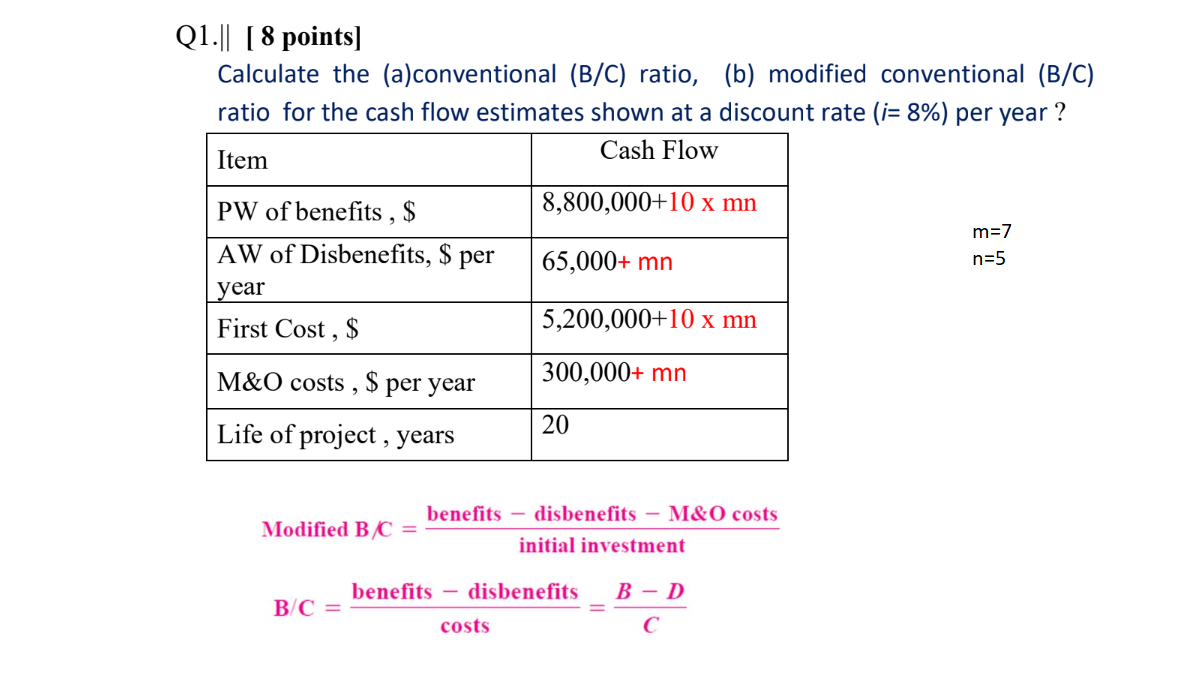
Data Summary:
- First Cost (Initial Investment): $120,000
- Annual M&O: $20,000
- Project Life: 10 years
- MARR: 10%
- PV of Benefits: $450,000
- AW of Disbenefits: $15,000
- You will need the Present Worth factor for a uniform series: .
Show answer
-
Denominator (PV of Initial Investment):
The First Cost is the initial investment. -
Numerator (PV of Net Benefits):
We need to subtract the present value of both the Disbenefits and the M&O costs from the PV of Benefits.- PV of Disbenefits = Annual Disbenefits × (P/A, 10%, 10)
- PV of M&O = Annual M&O × (P/A, 10%, 10)
- Numerator = PV(Benefits) - PV(Disbenefits) - PV(M&O)
- PV of Disbenefits = Annual Disbenefits × (P/A, 10%, 10)
-
Modified B/C Ratio:
The modified B/C ratio for this project is approximately 1.96.
Conclusion
Today we added the modified B/C ratio to our analytical toolkit. While it leads to the same accept/reject decision as the conventional ratio for a single project, its true value lies in its ability to measure and compare the efficiency of capital investment across different proposals.
- Key Takeaways:
- The modified B/C ratio separates initial capital costs from ongoing operational costs.
- The formula is: (PV Benefits - PV Ongoing Costs) / PV Initial Investment.
- It measures capital efficiency—the net operating return generated per dollar of initial capital invested.
- This makes it a powerful tool for ranking and prioritizing mutually exclusive projects, especially when operating under a fixed capital budget.
Preview of the Next Lesson
We have now learned to calculate both the conventional and modified B/C ratios. In our next lesson, we will put these skills to the test by applying them to a more holistic technology adoption case study. This will challenge us to move from simple, pre-defined numbers to analyzing a realistic scenario where we must first identify and classify the costs and benefits ourselves before performing the calculations.