Hello! Welcome back to our series on Benefit-Cost Analysis.
In our previous lessons, you mastered calculating both the conventional and modified benefit-cost (B/C) ratios. You learned that the conventional ratio assesses overall project value, while the modified ratio provides a powerful measure of capital efficiency.
Today, we'll put these skills into practice. Our goal is to apply benefit-cost analysis to evaluate a specific technology adoption case study. We will move beyond abstract numbers and analyze a real-world scenario that you, with your background in software development and management, will find highly relevant: the decision to migrate a company's IT infrastructure from an on-premise data center to the cloud. This type of analysis is fundamental for justifying major technology investments and making strategic business decisions.
1. Framing the Decision: Cloud vs. On-Premise
Before we can analyze any numbers, we must first understand the problem. A company running its own IT on-premise faces a strategic choice: continue maintaining its own servers, software, and infrastructure, or migrate these services to a cloud provider?
This decision involves a fundamental trade-off:
- On-Premise: High initial capital expenditure (CapEx) for hardware and facilities, with ongoing operational expenditures (OpEx) for maintenance, power, and staff.
- Cloud: Low or no initial CapEx, with costs shifted entirely to a pay-as-you-go OpEx model based on usage.
To understand the components of this decision, let's start with a resource that provides a framework for comparing these two alternatives.
The following chapter, 'Cloud Computing economics' by Stamatia Bibi et al., provides an excellent overview of the economic factors at play when deciding between cloud and on-premise solutions. It will help us build a mental model of the costs we need to consider.
Please read the 'INTRODUCTION' to understand the core problem. Then, skip to the section 'CHOOSE THE RIGHT DEPLOYMENT MODEL' and read through 'Cloud Utilities' (sub-sections A, B, and C). Focus on understanding the three main service models (IaaS, PaaS, SaaS) and how they are billed.
As you read, you'll see that the cloud offers different service layers. For our case study, we will focus on Infrastructure-as-a-Service (IaaS), where a company essentially rents server capacity, storage, and networking from a provider. This is the most direct replacement for an on-premise data center.
2. Identifying the Costs and Benefits
A benefit-cost analysis is only as good as the data you feed it. The most critical step is to correctly identify and categorize all the costs and benefits associated with the project.
In a migration project like this, the "Benefit" is primarily the cost savings achieved by shutting down the old system.
Let's use the resource you just read to build our lists.
On-Premise Costs (The "Status Quo" or "Do-Nothing" Alternative)
These are the ongoing costs that the company avoids if it migrates to the cloud. Therefore, the present value of these avoided costs becomes the "Benefit" in our B/C ratio.
- Hardware Costs: Servers, networking gear (routers, switches), maintenance contracts, and periodic replacement.
- Software Costs: Licenses for operating systems, databases, and other system software.
- Facility Costs: Power and cooling for the data center, plus physical floor space.
- Personnel Costs: Salaries for IT operations staff who manage and maintain the infrastructure.
Cloud Migration Project Costs
These are the costs associated with the new solution.
- Initial Investment (Denominator of Modified B/C):
- Labor costs for planning the migration.
- Engineering costs for "porting" or adapting applications to run in the cloud.
- Testing and validation to ensure everything works correctly.
- Ongoing M&O Costs (Subtracted from Numerator of Modified B/C):
- Usage fees paid to the cloud provider (e.g., per-server-hour, per-gigabyte-of-storage).
- Data transfer fees.
This image shows a simplified, tabular layout for a cost-benefit analysis, which is a useful way to organize your findings.

3. Case Study: The Economics of Cloud Computing
Now, let's apply this framework to a detailed case study. The following paper from Booz Allen Hamilton analyzes the economic case for migrating a "representative" 1,000-server data center to different types of cloud environments.
This analysis is a perfect real-world application of the B/C ratio. It was originally prepared for government agencies, but the principles are identical for a private corporation of similar scale.
The Economics of Cloud Computing
This paper, 'The Economics of Cloud Computing' by David Repczynski, quantifies the costs and benefits of cloud migration. We'll use its findings to perform our benefit-cost analysis.
Please read the sections titled 'Economic Implications' and 'Economic Analysis'. Pay close attention to: The three scenarios defined (Public, Hybrid, Private Cloud). The cost categories included in the model (server hardware, O&S, etc.). The economic metrics used (NPV, BCR, DPP). Most importantly, study the results in Exhibit 1.
4. Analyzing the Results from Exhibit 1
Let's dissect the findings for the Scenario 1: Public Cloud alternative, as it represents the most direct shift from a CapEx to an OpEx model.
Here are the key figures from Exhibit 1 in the paper:
- Status Quo O&S Costs: $77.3M
- Public Cloud Investment Costs: $3.0M
- Public Cloud O&S Costs: $22.5M
- BCR (Benefit-Cost Ratio): 15.4
- DPP (Discounted Payback Period): 2.7 Years
How do we interpret this?
The paper calculates the B/C ratio as Discounted Net Benefits / Discounted Investment Costs. "Net Benefits" are the savings from the new cloud O&S costs relative to the old Status Quo O&S costs. This is exactly the modified B/C ratio we studied in the last lesson!
- Numerator (Net Benefits): The present value of savings is .
- Denominator (Investment): The present value of the investment is .
A BCR of 15.4 means that for every $1 of initial capital invested in the migration, the project is expected to return $15.40 in net operating savings over its lifecycle. This is an extremely strong justification for the project.
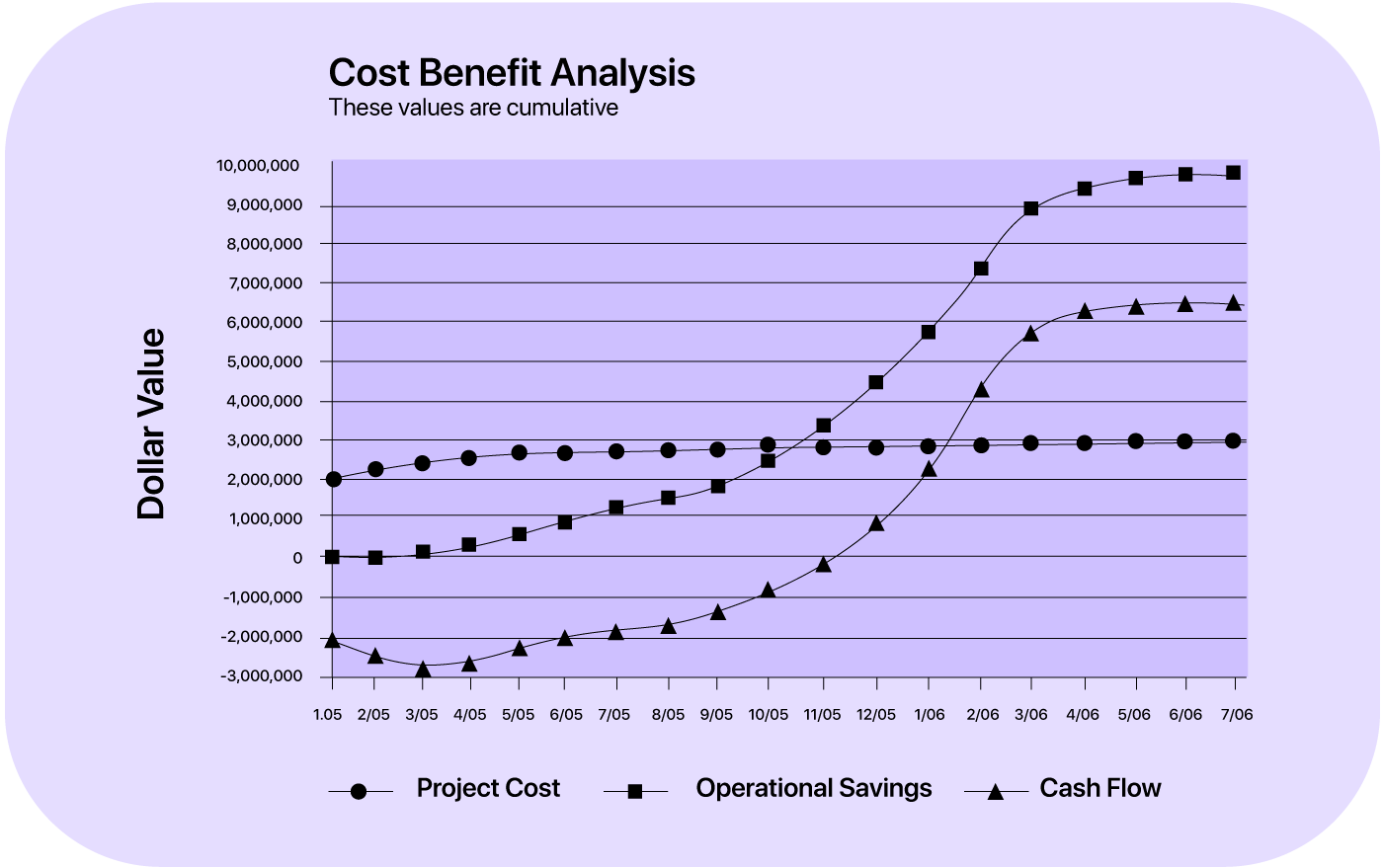
The Discounted Payback Period of 2.7 years tells us how long it takes for the project's cumulative savings to repay the initial investment, considering the time value of money. For a manager, this is a crucial metric—it shows how quickly the investment will start generating positive cash flow.
The graph below visualizes this payback concept. The "Cash Flow" line starts negative due to the initial investment, then crosses the zero-axis at the payback point, and grows as savings accumulate.
Test your understanding!
Looking at Exhibit 1 from "The Economics of Cloud Computing" paper, consider Scenario 3: Private Cloud. The investment cost is $7.0M and the BCR is 5.7.
In your own words, what does the BCR of 5.7 tell a manager about this specific project option? How does it compare to the Public Cloud option?
Show answer
A BCR of 5.7 means that for every $1 invested to build the private cloud, the company can expect to receive $5.70 in net operating savings over the project's life.
While this is still a very good investment (since 5.7 > 1.0), it is significantly less capital-efficient than the Public Cloud option, which returns $15.40 for every dollar invested. If the primary goal is to maximize the return on the initial capital outlay, the Public Cloud is the superior choice.
Conclusion
In this lesson, you successfully applied benefit-cost analysis to a complex technology decision. You moved from theory to practice, using a real-world case study to evaluate a cloud migration project.
- Key Takeaways:
- B/C analysis for technology adoption often frames the "Benefit" as the cost avoided by decommissioning an old system.
- The first step is always to meticulously identify and categorize all investment costs, ongoing costs, and benefits (savings).
- The modified B/C ratio is particularly useful in these scenarios as it highlights the efficiency of the initial capital investment.
- Metrics like the B/C ratio and Discounted Payback Period provide a robust, quantitative foundation for making and defending major strategic technology decisions.
Preview of the Next Lesson
The cloud migration case study was powerful because the benefits (cost savings) were easily quantifiable. However, many technology projects, especially in software, generate benefits that are difficult to put a price on—like improved customer satisfaction, enhanced security, or greater team morale. In our next lesson, we will explore how to handle these crucial intangible benefits and externalities in our project evaluations.