Introduction
Welcome back. In our last lesson, we established a critical framework for hypertrophy: training a muscle not just with any exercise, but with specific movements that challenge it at both its fully lengthened and fully shortened positions. We applied this to the latissimus dorsi, contrasting stretch-focused pullovers with contraction-focused pulldowns.
Today, we apply this same rigorous analysis to the muscles that build back thickness and postural integrity: the trapezius and the rhomboids. Your learning outcome is to explain the lengthened and shortened positions of the trapezius divisions and rhomboids, and select exercises to target each.
Just as with the lats, understanding this concept allows you to move beyond simply "doing rows" and into the realm of precisely engineering a stimulus for comprehensive development of the entire upper and middle back.
1. A Quick Anatomy Refresher
Before we can stretch or shorten these muscles, we must remember how their fibers are arranged. The trapezius isn't one muscle, but three distinct regions with different lines of pull.
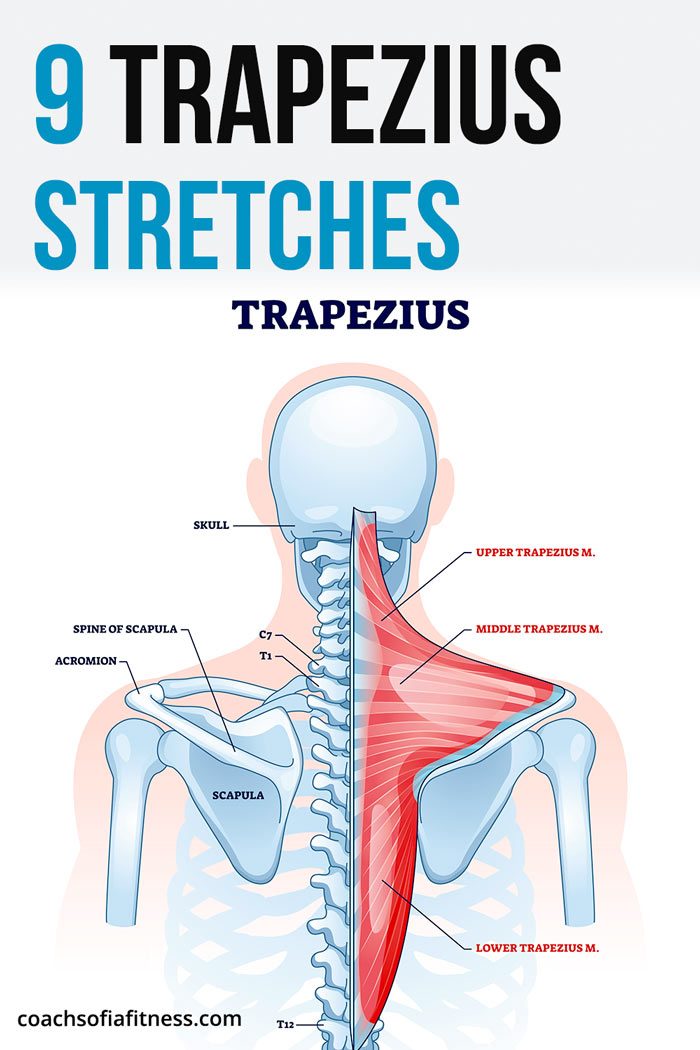
The rhomboids lie underneath the middle trapezius, running diagonally from the spine down to the shoulder blade.
- Upper Trapezius: Primarily elevates the scapula (shrugging).
- Middle Trapezius: Primarily retracts the scapula (pulling shoulder blades together).
- Rhomboids: Retracts and downwardly rotates the scapula. They are a key synergist to the middle trapezius in retraction.
- Lower Trapezius: Primarily depresses the scapula (pulling shoulder blades down).
Now, let's target each of these actions and regions with our lengthened/shortened framework.
2. Middle Trapezius and Rhomboids: The Engine of Retraction
We'll analyze these two together, as their primary function in most gym movements is scapular retraction.
- Shortened Position: Achieved via maximum scapular retraction. This is the "squeezed" position at the end of a row when your shoulder blades are pulled as close to your spine as possible.
- Lengthened Position: Achieved via maximum scapular protraction. This is the "stretch" position when you allow your shoulder blades to wrap around your ribcage, as if reaching forward.

Exercise Selection: Beyond the Standard Row
Most row variations (barbell, dumbbell, cable) are excellent for training the shortened position. The resistance is highest as you complete the pull and squeeze your scapulae together. However, just like a free-weight pullover for the lats, the resistance in a standard row drops off significantly at the bottom, providing little challenge to the muscles in their most lengthened, protracted state.
So, how do we load that stretched position effectively? For this, we turn to a more nuanced analysis.
Grow Your Upper Back | Learn Biomechanics
The following video from coach Ben Yanes provides a brilliant biomechanical breakdown. He explains why standard rows are limited and introduces a specific exercise to solve the problem.
Watch two key segments. First, from 02:09 to 03:55, he explains a 'retraction emphasis row' which targets the shortened position. Second, and most importantly for this lesson, watch from 03:55 to 05:50, where he introduces an exercise called a 'Kelso Shrug' (or straight-arm retraction) designed specifically to load the mid-traps and rhomboids in their lengthened, protracted state.
This video introduces a critical concept: if you want to train the lengthened position, you need an exercise that isolates that function.
- Shortened-Bias Exercise: Retraction-Emphasis Row. By using a wide arm path and focusing on the peak squeeze, you maximally challenge the mid-traps and rhomboids in their shortened range.
- Lengthened-Bias Exercise: Straight-Arm Retraction ("Kelso Shrug"). By keeping the arms relatively straight and focusing only on the movement of the shoulder blades from protraction to retraction, you apply maximum load where a traditional row is weakest. This is the direct analog to doing a pullover for the lats.
3. Upper and Lower Trapezius: Controlling Vertical Scapular Position
The upper and lower traps primarily control the vertical movement and rotation of the scapula.
Upper Trapezius
- Action: Scapular Elevation.
- Shortened Position: Maximum elevation (shrugging your shoulders to your ears).
- Lengthened Position: Maximum depression (letting your shoulders be pulled down, the opposite of a shrug).
Exercise Selection:
- Shortened-Bias: Shrugs. This is self-evident. The barbell or dumbbell shrug directly trains scapular elevation, moving the muscle into its most shortened state against a load. The goal is simply to elevate the scapula as high as possible.
- Lengthened-Bias: Training the upper traps in a lengthened position is less about a specific movement and more about resisting depression. The Pre-Script article LINK notes that you can train the upper traps with "movements that resist shoulder upward rotation and elevation like presses and overhead carries." When holding a heavy weight overhead, the upper traps must work isometrically to keep the scapula elevated and stable. A dead hang from a pull-up bar also places the upper traps into a deep, loaded stretch.
Lower Trapezius
- Action: Scapular Depression and Upward Rotation.
- Shortened Position: Scapula pulled down and back.
- Lengthened Position: Scapula elevated and slightly forward. This occurs naturally when your arms are fully overhead.
Exercise Selection:
The key is to find exercises that challenge the muscle to pull the scapula down from an overhead (lengthened) position.
The Best Science-Based Trap Workout for Growth
In his video on trap training, Jeremy Ethier demonstrates the classic exercise for the lower traps that perfectly illustrates training from a lengthened position.
Watch from 06:37 to 07:34. He discusses the 'Prone Y' exercise. Notice how the starting position is with the arms overhead in a 'Y' shape, which places the lower traps in their lengthened position. The movement consists of contracting the lower traps to lift the arms, moving them toward their shortened state.
- Lengthened-Bias: Prone "Y" Raise. This is the quintessential lengthened-position exercise for the lower traps. The setup forces you to initiate the contraction from a full stretch.
- Shortened-Bias: Straight-Arm Pulldown. While also a great lat exercise, the final few inches of a straight-arm pulldown, where you actively depress the scapula and bring the bar to your thighs, heavily involves the lower traps in their shortened range. Similarly, the Pre-Script article LINK astutely points out that weighted dips challenge the lower traps to resist downward rotation and depression, training them in their shortened range.
4. Summary Table and Programming
Let's organize this into a practical guide.
| Muscle/Division | Primary Action | Lengthened Position | Shortened Position | Lengthened-Bias Exercise | Shortened-Bias Exercise |
|---|---|---|---|---|---|
| Middle Trapezius | Scapular Retraction | Full Scapular Protraction | Full Scapular Retraction | Straight-Arm Retraction (Kelso Shrug) | Wide-Grip Row (Retraction Emphasis) |
| Rhomboids | Scapular Retraction | Full Scapular Protraction | Full Scapular Retraction | Straight-Arm Retraction (Kelso Shrug) | Row with Scapular Depression |
| Upper Trapezius | Scapular Elevation | Full Scapular Depression | Full Scapular Elevation | Overhead Carry / Dead Hang | Barbell/Dumbbell Shrug |
| Lower Trapezius | Scapular Depression | Full Scapular Elevation (Arms Overhead) | Full Scapular Depression | Prone "Y" Raise | Straight-Arm Pulldown / Weighted Dip |
Coach's Corner: Nuance and Application
-
Programming: A logical approach is to pair a heavy, shortened-bias exercise with a lighter, lengthened-bias exercise.
- Example: Perform 3 sets of heavy Barbell Rows focusing on a powerful contraction, followed by 3 sets of Chest-Supported Straight-Arm Retractions (Kelso Shrugs) focusing on the deep stretch and protraction.
- Example: After overhead pressing, perform 3 sets of Y-Raises to specifically target the lower traps through their full range.
-
Cueing for Rhomboids vs. Mid-Traps: The LINK resource provides an expert-level distinction. During rows:
- To bias the rhomboids, focus on actively depressing the scapula as you retract. Think "pull shoulder blades down and back."
- To bias the middle trapezius, a slight natural elevation of the scapula is acceptable and even advantageous. Think "pull shoulder blades straight back."
-
The "Armpit" Cue: In his video (LINK), Ben Yanes provides a fantastic cue for retraction movements: "imagine you have a point in your armpit and you're kind of pulling your armpits back". This helps integrate the movement and prevents you from just pulling with your arms.
Conclusion
You have now applied the lengthened/shortened position framework to the entire upper and mid-back. This systematic approach transforms your exercise selection from a guessing game into a targeted, anatomical strategy.
Key Takeaways:
- The middle trapezius and rhomboids are lengthened by scapular protraction and shortened by retraction. Standard rows train the shortened position well, while straight-arm retractions are needed to effectively load the lengthened position.
- The upper trapezius is lengthened by depression and shortened by elevation. Shrugs target the shortened position, while overhead carries challenge it isometrically.
- The lower trapezius is lengthened by elevation (arms overhead) and shortened by depression. Y-Raises are a classic lengthened-bias movement, while the bottom of dips or pulldowns targets the shortened state.
- A complete back program intelligently selects exercises to challenge these muscles across their full contractile range.
Preview for the Next Lesson
We have now analyzed the lats, traps, and rhomboids in detail. In the next lesson, we will zoom out and compare the two fundamental patterns of back training. We will contrast the biomechanics of vertical pulling (shoulder adduction) vs. horizontal rowing (scapular retraction, shoulder extension) and their primary muscle targets. This will help you structure a complete back workout based on movement patterns.