Introduction
Welcome back. In our first lesson on the back, we mapped out the anatomy of the latissimus dorsi—its vast origins, insertion on the humerus, and primary actions of shoulder extension and adduction. In the subsequent lessons, we did the same for the trapezius and rhomboids. Now, we begin the crucial process of translating this anatomical knowledge into practical exercise selection.
Today's lesson focuses on a core concept in advanced hypertrophy training: training a muscle through its full contractile range. We will specifically focus on the latissimus dorsi. Your goal is to be able to explain the lengthened and shortened positions of the latissimus dorsi and select exercises that emphasize each (e.g., pullovers vs. pulldowns).
This isn't just about collecting more exercises. It's about understanding that different movements load a muscle differently at various points in its range of motion. For an engineer, this is analogous to testing a system not just at its nominal operating point, but at its extremes to ensure robustness and full-spectrum performance. For a muscle, this means stimulating growth across its entire length.
1. Defining Lengthened and Shortened Positions
The terms "lengthened" and "shortened" refer to the distance between a muscle's origin and insertion.
- Lengthened Position: The point in an exercise's range of motion where the muscle's origin and insertion are furthest apart. This is often called the "stretched" position. For the lats, which originate on the spine, pelvis, and ribs and insert on the upper arm (humerus), this occurs when you raise your arm fully overhead (shoulder flexion).
- Shortened Position: The point where the origin and insertion are closest together. For the lats, this is when your arm is pulled down and back, close to your torso (peak shoulder extension and adduction). This is often called the "peak contraction."
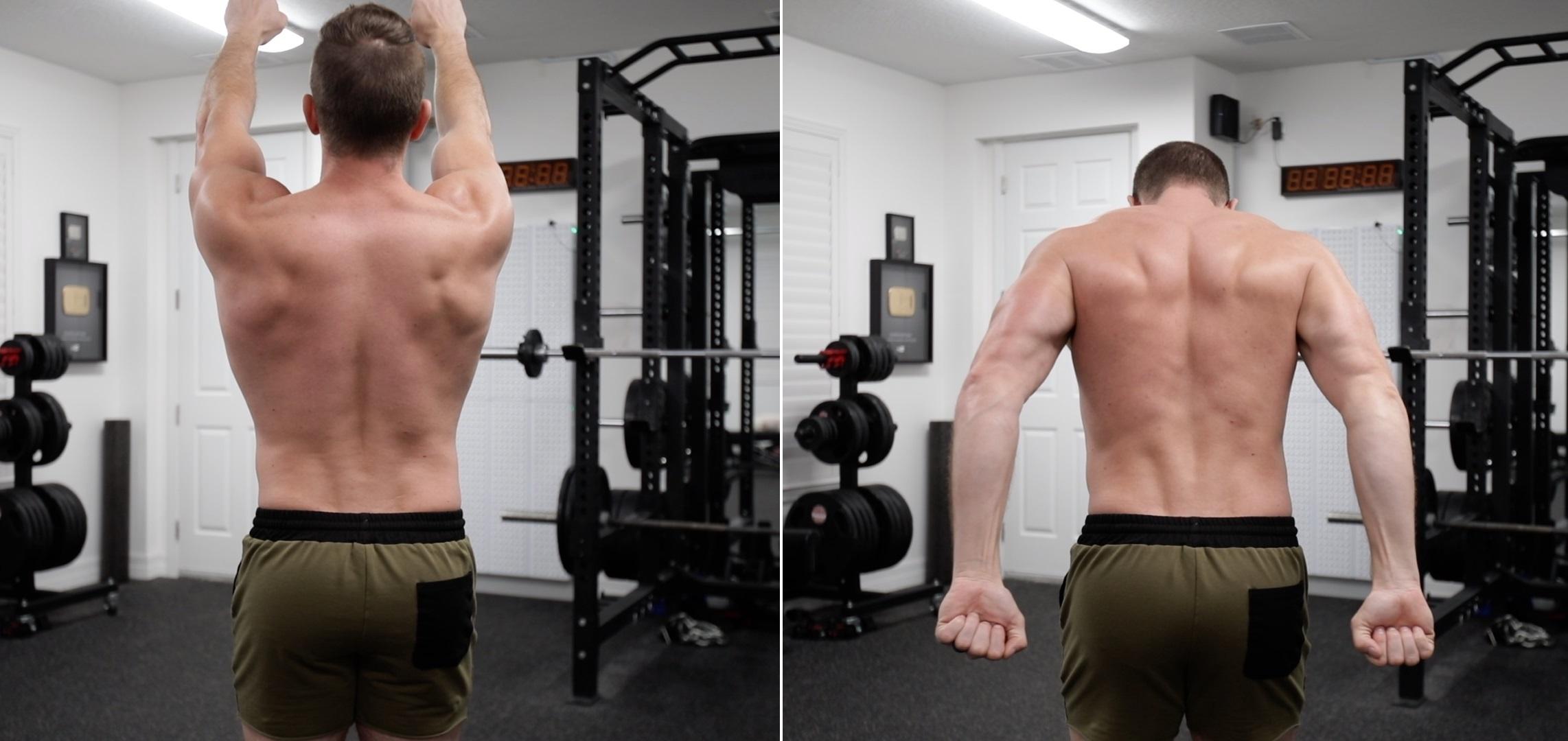
Why does this matter? As you'll recall from our discussion on the length-tension relationship, a muscle's force-producing capacity changes with its length. More importantly for hypertrophy, research increasingly shows that placing high tension on a muscle while it's in a lengthened state—a concept called stretch-mediated hypertrophy—is a uniquely powerful stimulus for growth.
Therefore, to fully develop the lats, we need to select exercises that don't just feel hard at the peak contraction but also challenge the lats when they are fully stretched.
2. Exercises Emphasizing the Lengthened Position
These are movements that apply the greatest resistance when your arms are overhead and the lats are maximally stretched.
The Classic Example: The Pullover
The pullover is the quintessential lengthened-position exercise for the lats. The movement involves lying on a bench and lowering a weight behind your head, creating a massive stretch through the lats.
To understand the mechanics and the debate surrounding this exercise, the following article provides an excellent, commonsense analysis.
Is the Pullover a Back or Chest Exercise? - T-Nation
This article from T-Nation, 'Is the Pullover a Back or Chest Exercise?', dives into the biomechanics of the pullover. It directly addresses why the stretch it provides is so important.
Please read three key parts: 1. Start at 'What’s The Bottom Line for Commonsense Thinkers?'. This explains why feeling a stretch is a reliable indicator of muscle involvement. 2. Continue to the end of that section. The key sentence is: 'Muscles that are lengthened in the end position of an exercise and are then shortened as the load is lifted are undeniably trained by the exercise.' 3. Finally, read the section 'What About Stretch-Mediated Hypertrophy?'. This directly links the pullover's deep stretch to the mechanisms of muscle growth.
As the article highlights, the deep stretch under load is what makes the pullover so effective. While a simple dumbbell pullover is a great start, its resistance profile is suboptimal—it's very difficult at the bottom (lengthened position) but offers almost no resistance at the top.
The following video discusses how different pullover variations (free weight, cable, machine) alter this resistance profile. Given your background, you'll appreciate this analysis of optimizing a system (the exercise) for a better output (muscle stimulus).
How to Build Your LATS: The ULTIMATE Guide (36 Studies)
The video 'How to Build Your LATS: The ULTIMATE Guide (36 Studies)' from House of Hypertrophy provides a deep, science-based analysis of lat training. This segment critically evaluates different types of pullovers.
Watch the segment on pullovers from 16:42 to 21:44. Pay close attention to the explanation of why free-weight pullovers are challenging at the point where the lats have poor leverage, and how cable and machine variations 'fix' this by providing more consistent tension throughout the range of motion.
Key Takeaways on Lengthened-Position Training:
- Dumbbell Pullovers: Excellent for introducing a deep, loaded stretch. The tension is highest at the most lengthened point.
- Cable/Machine Pullovers: Superior for hypertrophy as they maintain tension not only in the deepest stretch but also through a larger portion of the range of motion. An exercise called a "Lat Prayer," which you can see in the LINK resource, is an advanced variation designed to maximize this effect by having you move your torso to maintain tension from full stretch to full contraction.
3. Exercises Emphasizing the Shortened Position
These movements are typically most challenging when the lats are in their mid-to-shortened range, i.e., as your elbows approach your torso. This is where you achieve peak muscular contraction. The primary examples are vertical pulls (pulldowns) and horizontal pulls (rows).

While these exercises move the lats through a long range of motion, the mechanics of leverage and resistance mean the stimulus is biased away from the fully stretched position. Let's return to the House of Hypertrophy video to understand why.
How to Build Your LATS: The ULTIMATE Guide (36 Studies)
This segment of the same video analyzes the biomechanics of vertical and horizontal pulls.
Watch from 01:36 to 07:21 to understand vertical pulls (like pulldowns), and then watch the analysis of horizontal pulls (rows) from 07:21 to 08:40. The key concept to grasp is that while these movements stretch the lats, the point of maximum challenge (peak resistance) occurs when the lats are already partially or fully contracted, not at the point of maximum stretch. Finally, watch from 08:40 to 10:36, which discusses why a larger range of motion isn't always better if the lengthened position isn't challenging.
Key Takeaways on Shortened-Position Training:
- Lat Pulldowns/Pull-ups: These are primarily shoulder adduction (wide grip) or extension (close/neutral grip) movements. They are excellent for overloading the lats with heavy weight and focusing on a powerful contraction, biasing the mid and lower lat fibers (wide grip) or upper fibers (close grip).
- Rows: Close-grip rows are effective lat builders, working through shoulder extension. They are most difficult at the peak contraction when the elbows are pulled back alongside the body.
Coach's Corner: Practical Application
An intelligent hypertrophy program for the lats doesn't choose one type of exercise over the other; it strategically includes both.
- Exercise Selection: A complete lat workout should feature at least one exercise from each category.
- Lengthened-Bias: Dumbbell Pullover, Cable Pullover, Machine Pullover, Lat Prayer.
- Shortened-Bias: Wide-Grip Pulldown, Neutral-Grip Pulldown, Close-Grip Seated Row, Dumbbell Row.
- Programming Logic: A common and effective strategy is to perform your heavy, shortened-position compound movement first (e.g., Weighted Pull-ups or Heavy Pulldowns). This targets the lats when you are fresh and can produce the most force. Follow this with a lengthened-position isolation movement (e.g., Cable Pullovers) for higher reps to accumulate metabolic stress and specifically target stretch-mediated hypertrophy.
- Anatomical Cueing:
- For Pulldowns/Rows (Shortened Focus): The primary intent is peak contraction. Cue yourself to "drive your elbows down into your back pockets" or "try to put your elbows in your hips."
- For Pullovers (Lengthened Focus): The primary intent is the stretch. As you lower the weight, think about "reaching back as far as possible" and "feeling a stretch from your pinky finger all the way down to your waist." This maximizes tension in the lengthened state. Jeff Nippard notes in his video (LINK) that this stretched portion is "most likely the most anabolic part of the range of motion."
Conclusion
Today, you've moved from static anatomy to dynamic application. You now understand that building a complete muscle requires training it through its entire functional range.
Key Takeaways:
- The lengthened position for the lats is with the arms overhead (shoulder flexion), where the origin and insertion are furthest apart.
- The shortened position is with the arms down by the sides (shoulder extension/adduction), where the origin and insertion are closest.
- Pullovers and their variations are the primary tools for loading the lats in the highly anabolic lengthened position, driving stretch-mediated hypertrophy.
- Pulldowns and rows are superior for loading the lats in the mid-to-shortened range, allowing for heavy loads and a powerful peak contraction.
- A comprehensive lat training program should include exercises that challenge the muscle in both its lengthened and shortened states.
Preview for the Next Lesson
We will continue with this powerful analytical framework in our next lesson. The focus will shift to the upper back as we aim to: Explain the lengthened and shortened positions of the trapezius divisions and rhomboids, and select exercises to target each. This will complete your understanding of how to program for a completely developed back.