Hello! Welcome back to your course on Sports Anatomy.
In our last lesson, we explored how the body's major joints—hinge and ball-and-socket—are structured to allow movement in specific anatomical planes. We established that a joint's architecture is the blueprint for its potential actions. Now, we'll introduce the "engines" that drive these actions: the skeletal muscles.
Today's lesson focuses on the three fundamental properties of any muscle's architecture: its origin, insertion, and fiber direction. Think of this as learning to read the blueprint of a muscle. If you understand these three elements, you can deduce a muscle's primary function without memorizing lists of actions. This analytical approach, much like understanding a system's components to predict its output, will be the cornerstone of your ability to select the perfect exercise for any hypertrophy goal.
By the end of this lesson, you will be able to define origin, insertion, and fiber direction and explain why they are critical for understanding muscle function.
1. Muscle Attachments: Origin and Insertion
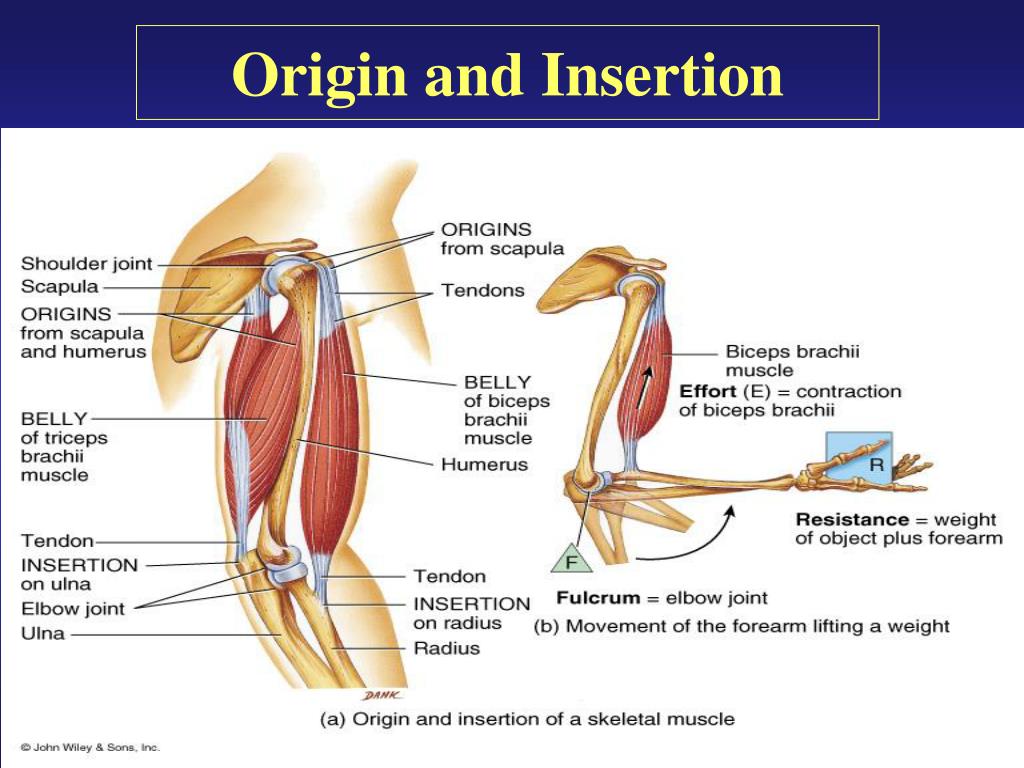
A skeletal muscle must cross at least one joint and attach to two different points (usually bones via tendons) to create movement. We call these attachment points the origin and insertion.
- Origin: The attachment site that is conventionally considered the more stable or fixed anchor of the muscle. In the limbs, this is typically the proximal attachment (closer to the center of the body).
- Insertion: The attachment site that is considered the more movable end. During a contraction, the insertion is pulled towards the origin. In the limbs, this is typically the distal attachment (further from the center of thebody).
Let's begin with a video that clearly defines these terms.
Muscle Anatomy & Biomechanics | Exercise Selection for Hypertrophy Training
This video from Flow High Performance introduces the core concepts of origin, insertion, and fiber orientation in the context of hypertrophy training. It provides a great starting point for our discussion.
Watch from 00:16 to 01:35. Pay attention to how the narrator defines origin as the attachment closer to the midline and insertion as the one further from the midline.
To solidify these definitions, let's turn to a concise written resource.
Anatomy Lecture Notes Section 3: Skeletal Muscle
This PDF from San Diego Miramar College provides clear, textbook definitions of skeletal muscle attachments. It reinforces the concepts from the video.
Read the first page, focusing on the paragraph that begins 'When examining skeletal muscles in anatomy...'. It clearly defines origin and insertion and their roles.
A Deeper Look: The Relativity of Attachments
The conventional definitions of a "fixed" origin and "mobile" insertion are useful starting points, but they aren't absolute. A muscle's attachment points can switch roles depending on which end is stabilized.
- Open-Chain Movement: In an exercise like a dumbbell bicep curl, your torso is stable and your hand moves. The forearm (insertion) moves towards the shoulder (origin). This is the classic model.
- Closed-Chain Movement: In an exercise like a chin-up, your hands are fixed to the bar. Your body moves. Here, your forearm is the stable point, and your torso (and the biceps' origin) is pulled up towards it.
This is why some anatomists prefer the terms proximal attachment (closer to the trunk) and distal attachment (further from thetrunk). These terms are more objective as they describe location without assuming which end will move.
The following short video brilliantly illustrates this concept. Given your background in logical systems, you will appreciate how the function depends on which variable is "fixed."
This animation from The Noted Anatomist clearly demonstrates how the 'origin' and 'insertion' can effectively reverse roles depending on the movement.
Watch the entire video (it's short!). Notice how the gluteus medius muscle can either move the leg (femur) or stabilize the pelvis, depending on which bone is anchored. This demonstrates the limitation of the fixed-origin/mobile-insertion terminology and introduces the value of 'proximal' and 'distal' attachments.
2. Fiber Direction: The Line of Pull
Knowing a muscle's start and end points isn't enough. We also need to know the path between them. This is the fiber direction, or muscle architecture. Muscle fibers can only contract in a straight line, so the orientation of the fibers dictates the precise direction of force, or its line of pull.
Muscle fibers are bundled into groups called fascicles. The arrangement of these fascicles determines the muscle's overall shape and function. There are several key patterns:

- Parallel/Fusiform: Fibers run parallel to the long axis of the muscle (e.g., biceps brachii). These muscles are built for a large range of motion.
- Convergent (Fan-shaped): Fibers spread out from a broad origin and converge to a narrow insertion (e.g., pectoralis major). This allows different sections of the muscle to pull at slightly different angles, giving the muscle functional subdivisions.
- Pennate (Feather-like): Fibers are short and attach to a central tendon at an angle. This architecture allows more muscle fibers to be packed into a given volume, which significantly increases force production. This is a classic trade-off: sacrificing range of motion for power.
- Unipennate: Fibers attach to one side of the tendon.
- Bipennate: Fibers attach to both sides of the tendon (e.g., rectus femoris in the quadriceps).
- Multipennate: Fibers are arranged like many feathers side-by-side (e.g., the deltoid).
Let's dive into a resource that details these arrangements.
Anatomy Lecture Notes Section 3: Skeletal Muscle
Returning to the 'Anatomy Lecture Notes' PDF, this section provides an excellent breakdown of the different fascicle arrangements and their functional implications.
Read the section titled 'V. Classification of Skeletal Muscles by Organization of Muscle Fascicles'. Focus on the descriptions of Parallel, Convergent, and Pennate arrangements and their impact on range of motion versus power.
For hypertrophy, understanding pennation is particularly important. A highly pennate muscle like the soleus (in the calf) can generate immense force but has a short range of motion. A parallel muscle like the sartorius (on the thigh) has a huge range of motion but is less powerful. This architecture directly informs how we should train them.
3. Putting It All Together: From Anatomy to Action
The fundamental principle is this: A muscle contracts to pull its insertion toward its origin along the line of its fibers.
By knowing these three things, you can predict a muscle's function.
Example: The Biceps Brachii
- Proximal Attachment (Origin): Top of the scapula.
- Distal Attachment (Insertion): Radius bone in the forearm.
- Fiber Direction: Parallel, running down the front of the upper arm.
- Prediction: When it contracts, it will pull the radius towards the scapula. Since it crosses the elbow, it will powerfully flex the elbow. Since it also crosses the front of the shoulder, it will weakly assist in flexing the shoulder.
The video we watched earlier does an excellent job of demonstrating this link between anatomy and exercise selection.
Muscle Anatomy & Biomechanics | Exercise Selection for Hypertrophy Training
Let's revisit the Flow High Performance video to see how these concepts are applied to select exercises.
Watch from 01:57 to the end (05:28). Observe how the anatomy of the biceps (parallel fibers) leads to flexion exercises like curls, while the fan-shape of the pectoralis major (convergent fibers) explains why it contributes to multiple movements.
Coach's Corner: The "Why" Behind Exercise Selection
This knowledge is your superpower as a coach. Instead of just telling a client "do incline presses for your upper chest," you can understand why it works. The clavicular (upper) head of the pectoralis major has fibers that run diagonally upward from the clavicle to the humerus. An incline press aligns your arm to pull directly against that line of pull, maximizing tension on those specific fibers. This is the first step toward understanding regional hypertrophy—the ability to preferentially grow different parts of the same muscle.
Conclusion
This lesson provided the foundational tools for analyzing any muscle. You now have a systematic way to look at a muscle's structure and predict its function.
Key Takeaways:
- A muscle's attachment points are its origin (the more stable/proximal anchor) and insertion (the more mobile/distal end). However, these roles can reverse, so proximal and distal attachment are more precise terms.
- Fiber direction dictates the muscle's line of pull. Key arrangements include parallel (range of motion), convergent (versatility), and pennate (force production).
- By combining knowledge of attachments and fiber direction, you can deduce a muscle's primary action(s) at the joint(s) it crosses. This principle is the basis for logical, effective exercise selection.
In our next lesson, we will build on this by exploring how muscles work together. Rarely does one muscle act alone. We will define the different roles a muscle can play during a movement: prime mover (agonist), synergist, antagonist, and stabilizer. Your understanding of origin, insertion, and fiber direction will be essential for identifying which role a muscle is playing in any given exercise.