Welcome to the third lesson in our Foundations of Musculoskeletal Anatomy module.
In our previous lessons, we established the body's coordinate system with directional terms and then defined the three planes of motion (sagittal, frontal, transverse) that movements occur in. You learned to classify exercises like squats and lat pulldowns based on their primary plane of motion.
Now, we will explore how the body's structure permits these movements. The link between anatomical structure and function is the core of this course. This lesson will focus on the joints—the articulations where movement happens. Specifically, we'll examine the two most important types for a personal trainer: hinge joints and ball-and-socket joints. Understanding their design is crucial because a joint's structure dictates the planes in which it can move, and therefore, which exercises are possible and effective.
By the end of this lesson, you will be able to distinguish between hinge and ball-and-socket joints and provide practical examples of each from the gym.
1. Synovial Joints: The Body's Moving Connections
The joints we are interested in for resistance training are a specific category called synovial joints. These are the most common and most mobile joints in the body. Their defining feature is a joint capsule containing synovial fluid, which lubricates the joint, allowing for smooth, low-friction movement—essential for everything from walking to lifting heavy weights.
To get a quick overview of the key features of a synovial joint, please watch the beginning of this video.
This video from Dr. Matt & Dr. Mike provides a concise introduction to the anatomy of a typical synovial joint. It also introduces the concept of classifying these joints by their axes of movement (uniaxial, biaxial, multiaxial), which is a perfect bridge from our last lesson on planes of motion.
Watch from the beginning to 02:55. Focus on the key components (cartilage, capsule, synovial fluid) and the classification of joints by the number of axes they move around.
As the video explains, there are six types of synovial joints, but for our purposes in hypertrophy training, the hinge joint and the ball-and-socket joint are the most fundamental to understand, as they are responsible for the vast majority of large-scale movements in the gym.
2. The Hinge Joint: Movement in a Single Plane
The hinge joint is perhaps the easiest to conceptualize. Its structure and function are analogous to a door hinge.
- Structure: A convex (rounded) surface of one bone fits into a concave (hollowed) surface of another bone.
- Function: This structure constrains movement to a single axis, making it uniaxial.
- Connection to Planes of Motion: Because it moves around one axis, a hinge joint primarily permits motion in one plane—the sagittal plane. The movements it allows are flexion and extension.

For a clear walkthrough of the hinge joint, let's return to the video.
Dr. Mike explains the hinge joint using the door analogy and the elbow as the primary example.
Watch the segment from 05:33 to 06:24.
Practical Examples:
- Elbow Joint: Allows flexion (bicep curls) and extension (triceps pushdowns).
- Knee Joint: Allows flexion (hamstring curls) and extension (leg extensions, squats).
- Ankle Joint (Talocrural): Allows dorsiflexion (toes up) and plantarflexion (toes down), as seen in calf raises.
Coach's Corner: Stability of Hinge Joints
Because they are designed for stable movement in a single plane, hinge joints are very effective at transferring force. However, they are vulnerable to forces from other planes. For example, when a client's knee caves inward during a squat (knee valgus), that is an unwanted frontal plane movement at a joint designed for the sagittal plane. This misalignment can place significant stress on the ligaments of the knee. As a coach, a key part of your job is to teach clients how to control their movements to prevent these deviations.
3. The Ball-and-Socket Joint: Freedom in All Three Planes
In contrast to the restrictive hinge joint, the ball-and-socket joint offers the greatest freedom of movement.
- Structure: A spherical "ball" at the end of one bone fits into a cup-like "socket" of another.
- Function: This design allows for movement around multiple axes, making it multiaxial (or polyaxial).
- Connection to Planes of Motion: It is the only joint type that permits movement in all three anatomical planes.
- Sagittal Plane: Flexion and extension (e.g., swinging your arm forward and back).
- Frontal Plane: Abduction and adduction (e.g., lifting your arm out to the side and bringing it back down).
- Transverse Plane: Internal and external rotation (e.g., rotating your arm inward and outward), as well as horizontal abduction and adduction.
Let's watch a detailed explanation of this joint type.
Types of joints in the human body - Anatomy & Examples | Kenhub
This video from Kenhub provides an excellent, detailed look at the ball-and-socket joint, clearly listing the movements it allows in each plane.
Watch the segment from 06:29 to 07:22. Pay close attention to how it links specific movements (flexion, abduction, rotation) to the joint's structure.
Practical Examples:
- Shoulder Joint (Glenohumeral): The most mobile joint in the body. It allows for overhead presses, lateral raises, bench presses, pull-ups, and rows. Its incredible range of motion is what allows for such a wide variety of upper body exercises.
- Hip Joint: A powerful and stable joint that allows for deep squats, lunges, hip thrusts, and hip abduction movements.
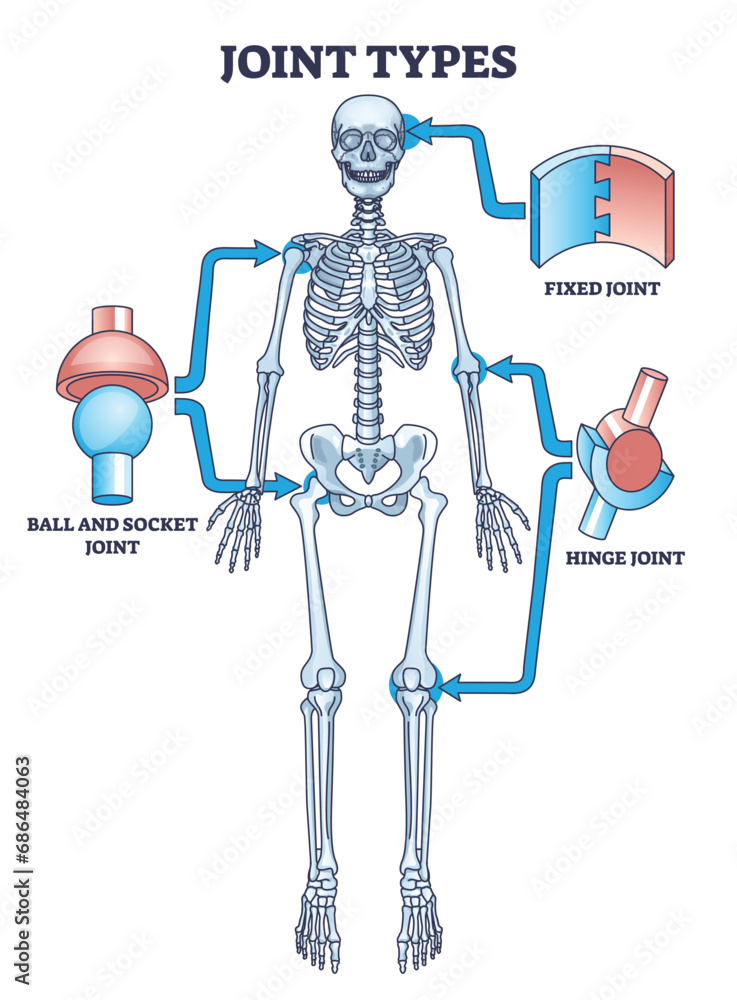
Coach's Corner: The Mobility vs. Stability Trade-off
The freedom of ball-and-socket joints comes at a cost. The shoulder, with its shallow socket, has immense mobility but is inherently less stable, relying heavily on surrounding muscles (like the rotator cuff) for support. The hip, with its deep socket, sacrifices some range of motion for greater inherent stability. This trade-off is critical to understand for exercise selection and injury prevention. A client with poor shoulder stability may need to start with more controlled exercises before attempting highly demanding overhead movements.
4. Summary and Review
To consolidate your understanding, please read the following brief sections from two excellent resources. They summarize the definitions and provide clear examples that reinforce what we've covered.
The Brookbush Institute article provides very clear, coach-oriented definitions. Focus on how it directly links joint type to the planes of motion.
Read the bullet points for 'Hinge Joint' and 'Ball and Socket Joint'.
This text from the National Center for Biotechnology Information (NCBI) offers a more clinical, but highly precise, definition. Notice its excellent point about the difference in stability between the shoulder and hip.
Read the subsections titled 'Hinge' and 'Ball-and-socket'.
Let's put it all into a comparative table for quick reference.
| Feature | Hinge Joint | Ball-and-Socket Joint |
|---|---|---|
| Structure | Convex surface into a concave surface | Spherical head into a cup-like socket |
| Axes of Motion | Uniaxial (one axis) | Multiaxial (many axes) |
| Planes of Motion | One Plane (primarily Sagittal) | Three Planes (Sagittal, Frontal, Transverse) |
| Primary Actions | Flexion & Extension | Flexion, Extension, Abduction, Adduction, Rotation |
| Gym Examples | Elbow: Curls, Pushdowns Knee: Squats, Leg Extensions |
Shoulder: Presses, Raises, Rows Hip: Squats, Hinges |
| Coaching Implication | Provides stable, powerful movement in one direction. | Offers versatility but requires greater muscular control and stabilization. |
Conclusion
In this lesson, you learned to distinguish between the two most important joint types for resistance training by connecting their structure to their function.
Key Takeaways:
- Hinge joints (e.g., knee, elbow) are uniaxial, allowing movement primarily in the sagittal plane (flexion and extension). They are built for stability in one direction.
- Ball-and-socket joints (e.g., shoulder, hip) are multiaxial, allowing movement in all three planes. They are built for versatility and freedom of motion.
- A joint's structure is the blueprint for its potential movement. This principle is the first step in understanding why certain exercises train certain muscles.
We've now covered our anatomical map, the directions of travel (planes), and the types of intersections (joints). The logical next step is to meet the "drivers"—the muscles themselves. In our next lesson, we will define a muscle's origin, insertion, and fiber direction, and explain how these three properties dictate exactly how a muscle pulls on a bone to create movement at these joints.