Hello! Welcome back.
In our last lesson, we established a powerful principle: by knowing a muscle's origin, insertion, and fiber direction, you can predict its primary action. This is the anatomical blueprint for movement.
Today, we expand on that by acknowledging that muscles, much like components in a complex software system, rarely operate in isolation. Any given exercise involves a coordinated effort—a "team" of muscles working together, each playing a distinct role. Understanding this team dynamic is crucial for effective coaching and programming.
This lesson focuses on differentiating between the roles of prime mover (agonist), synergist, antagonist, and stabilizer. By the end of our session, you'll be able to analyze a common gym exercise and assign these roles to the key muscles involved, giving you a complete picture of the movement.
1. The Four Functional Roles of a Muscle
Every time you perform an exercise, the muscles involved can be classified into four primary roles. To get a clear and concise introduction to these roles, let's start with a short video.
What Is A Prime Mover Muscle: 4 Roles that muscles play when we exercise
This video from Parallel Coaching provides a straightforward overview of the four key muscle roles. It will establish our core vocabulary for this lesson.
Watch the segment from 01:05 to 05:23. Focus on the definitions provided for prime mover, antagonist, synergist, and fixator (which we'll classify as a type of stabilizer).
Now, let's formalize those definitions and add some important nuances.
-
Prime Mover (or Agonist): This is the muscle most responsible for causing the desired joint action. It generates the largest proportion of the force. For example, in a bicep curl, the biceps brachii is the prime mover for elbow flexion.
-
Antagonist: This muscle performs the opposite action of the prime mover. For the movement to occur smoothly, the antagonist must relax and lengthen. This neurological phenomenon is called reciprocal inhibition—when the central nervous system sends a signal for the prime mover to contract, it also sends an inhibitory signal to the antagonist, causing it to relax. In a bicep curl, the triceps brachii (which extends the elbow) is the antagonist.
-
Synergist: A synergist is a "helper" muscle. It assists the prime mover in producing the main action. Synergists might contribute additional force, stabilize the joint in a way that optimizes the prime mover's line of pull, or cancel out an unwanted secondary motion of the prime mover.
-
Stabilizer: A stabilizer muscle contracts, typically isometrically (without changing length), to hold a bone or body segment stationary. This provides a stable base for other muscles to pull against. Stabilizers are the unsung heroes of movement; without them, force cannot be efficiently transferred. A specific type of stabilizer is a fixator, which immobilizes the origin bone of the prime mover.
To reinforce these concepts, the following short article provides another clear set of definitions.
This article from RDL Fitness offers concise definitions and introduces the key concept of reciprocal inhibition, which is crucial for understanding the role of the antagonist.
Read the sections titled 'Agonists', 'Antagonists', 'Synergists', and 'Stabilizers'. Pay close attention to the explanation of reciprocal inhibition and the examples given for stabilizers.
A Note on Terminology: Agonist vs. Prime Mover
You'll see the terms "agonist" and "prime mover" used interchangeably, and for most practical purposes, that's fine. However, to be precise (which aligns with your computer engineering background), there's a subtle difference. "Prime mover" typically refers to the single muscle most responsible for an action. "Agonist" can technically refer to all muscles that contribute to that action (the prime mover and its synergists). For this course, we will use prime mover for the main muscle and synergist for the helpers to maintain clarity.
2. A Simple Case Study: The Bicep Curl
Let's apply this framework to a simple isolation exercise: the dumbbell bicep curl. The image below breaks down the muscle roles visually.
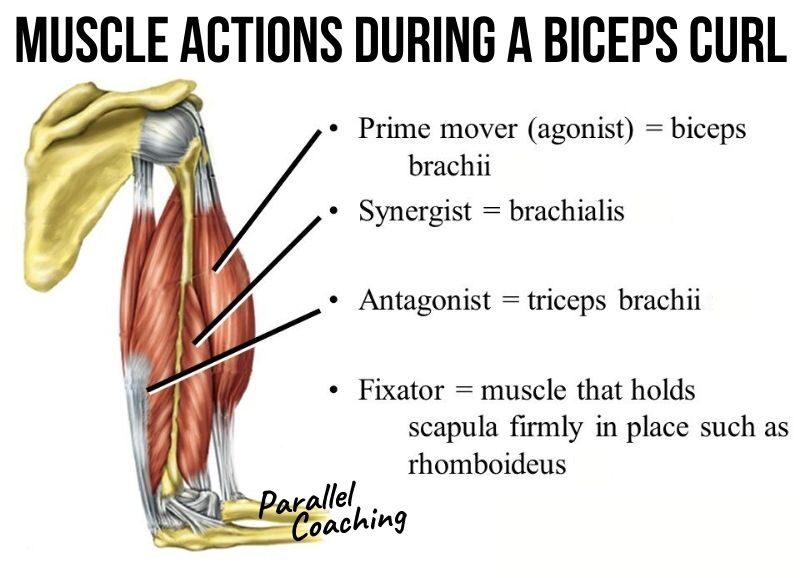
Let's break it down:
- Prime Mover (Agonist): Biceps brachii. It crosses the elbow and its contraction produces the primary force for elbow flexion.
- Synergist: Brachialis. This muscle lies underneath the biceps and also flexes the elbow. It assists the biceps.
- Antagonist: Triceps brachii. This muscle on the back of the arm is the prime mover for elbow extension. It must relax and lengthen to allow the curl to happen.
- Stabilizers/Fixators: Rotator cuff, deltoids, and muscles of the upper back (like the rhomboids and trapezius). These muscles contract to keep your shoulder and scapula locked in place, preventing you from using momentum or "swinging" the weight up. They create the stable platform from which the biceps can efficiently pull.
3. A Complex Case Study: The Bench Press
Now, let's analyze a compound movement where the interplay of muscle roles becomes more intricate. The bench press (shoulder horizontal adduction) is a perfect example.
The following video provides a highly analytical breakdown. The instructor introduces two more specific terms:
- Neutralizer: A type of synergist that contracts to prevent an unwanted secondary motion of the prime mover.
- Fixator: A type of stabilizer that specifically immobilizes the origin of the prime mover.
This level of detail is exactly what allows a coach to move from basic instruction to precise troubleshooting.
Functional Roles of Muscles (Prime Mover, Synergist, Antagonist, Neutralizer, Stabilizer & Fixator)
This video from the Brookbush Institute provides a graduate-level analysis of a compound movement. It demonstrates how to systematically identify all the muscle roles, including the more specific categories of neutralizers and fixators.
Watch the section from 10:28 to 16:18, which focuses on shoulder horizontal adduction (the primary joint action in a bench press or fly). Pay close attention to how the instructor deduces each muscle's role based on its known anatomical functions.
Let's summarize the analysis from the video in a table for clarity.
Analysis of the Bench Press (Shoulder Horizontal Adduction)
| Role | Muscle(s) Involved | Rationale |
|---|---|---|
| Prime Mover | Pectoralis Major | The largest, most powerful muscle positioned to perform horizontal adduction. |
| Synergist | Anterior Deltoid | Assists the pectoralis major in horizontal adduction and shoulder flexion. |
| Antagonist | Posterior Deltoid, Middle Trapezius, Rhomboids | These muscles perform the opposite actions: horizontal abduction and scapular retraction. |
| Neutralizer | Infraspinatus, Teres Minor | The pec major also internally rotates the shoulder. These external rotators contract to neutralize that unwanted rotation, keeping the arm path stable. |
| Stabilizer | Rotator Cuff (SITS muscles) | These muscles dynamically stabilize the head of the humerus within the shoulder socket (glenohumeral joint). |
| Fixator | Serratus Anterior, Trapezius, Rhomboids | These muscles contract to lock the scapula (the origin of the pec major) against the ribcage, creating a solid base of support. |
Coach's Corner: Why This Framework Is Your Diagnostic Tool
Thinking in terms of muscle roles transforms you from someone who just knows exercises into a movement problem-solver.
- Explaining Common Pains: When a client says, "I only feel bench presses in my shoulders," you can now hypothesize why. Their synergist (anterior deltoid) may be overactive, or their stabilizers (rotator cuff) may be weak, causing the deltoid to take on a stabilizing role it's not designed for.
- Improving Cues: Instead of saying "push the bar up," you can give a cue based on stabilizing the system: "Imagine screwing your hands into the bar to engage your external rotators" (a neutralizer cue) or "Pinch your shoulder blades together to lock in your upper back" (a fixator cue).
- Smarter Programming: Understanding that the anterior deltoids and triceps are major synergists in a bench press helps you manage volume. You know that after heavy pressing, those muscles are already fatigued. This prevents you from programming excessive, redundant isolation work and allows for better recovery.
- Injury Prevention: If a client's core stabilizers are weak, their lower back might hyperextend during a standing overhead press. You'd recognize this as a failure of the stabilizing system and address it with specific core exercises, rather than just lowering the weight.
Conclusion
Today, we've added a crucial layer to our analytical model. We've moved beyond single-muscle actions to see how the entire musculoskeletal system collaborates to create movement.
Key Takeaways:
- Muscles work in teams, adopting one of four primary roles: Prime Mover (main actor), Antagonist (opposing muscle), Synergist (helper), and Stabilizer (support).
- For a movement to be efficient and safe, the prime mover must be dominant, the antagonist must relax (reciprocal inhibition), and the synergists and stabilizers must do their jobs correctly.
- Analyzing an exercise using this framework allows you to understand the entire system, leading to better exercise selection, cueing, and troubleshooting.
In our next lesson, we will zoom in on the prime mover itself. We will define the three types of muscle contractions—concentric, eccentric, and isometric—and explore how each phase of a lift contributes uniquely to the stimulus for hypertrophy.