Hello! Welcome to your fourth lesson in the module on Muscle Physiology and Mechanisms of Hypertrophy.
In our last lesson, we contrasted the different muscle fiber types. We established that while Type II fibers have the greatest hypertrophy potential, taking sets close to failure stimulates growth across the entire spectrum of fibers by ensuring all are recruited and fatigued.
Now, we move from the components of the muscle to the signals that command them to grow. If training to failure is the instruction, what is the underlying language that the muscle cells understand? Today's learning outcome is to identify and explain the three primary mechanisms of muscle hypertrophy: mechanical tension, metabolic stress, and muscle damage.
Understanding these mechanisms is the critical link between the exercises you perform in the gym and the physiological adaptations that result in muscle growth. It provides the "why" behind different training styles, from heavy, low-rep lifting to high-rep "pump" work.
1. The "Big Three" Signals for Growth
In a landmark 2010 research review, Dr. Brad Schoenfeld proposed a framework that organizes the stimuli for muscle growth into three distinct, though interrelated, mechanisms. Let's get a clear overview of these three pillars from the outset.
The Mechanisms of Muscle Hypertrophy | What Stimulates Muscle Growth?
This video, 'The Mechanisms of Muscle Hypertrophy' from Flow High Performance, provides a concise and accurate introduction to Schoenfeld's model. It clearly defines each mechanism and establishes their relative importance.
Please watch from the beginning to 04:22. Pay close attention to how the video introduces and defines each of the three mechanisms: Mechanical Tension Metabolic Stress Muscle Damage Notice the distinction it makes between a direct driver of growth and an indirect contributor or potential side effect.
As the video explained, while all three mechanisms are part of the conversation, they are not considered equal partners. The current scientific consensus is that one of them is the undisputed primary driver of muscle hypertrophy.

Let's now dissect each of these mechanisms, starting with the king.
2. Mechanical Tension: The Primary Driver
Mechanical tension is the force exerted on muscle fibers when they are stretched and contracted under load. You can conceptualize this as the physical "pulling" experienced by the contractile proteins (actin and myosin) and the structural components of the muscle cell.
This tension is detected by specialized mechanoreceptors within the muscle cells. When a sufficient threshold of tension is sensed, it triggers a cascade of biochemical signals—a process called mechanotransduction.
The six best strength training techniques to increase mechanisms of muscle hypertrophy
The article 'The six best strength training techniques to increase mechanisms of muscle hypertrophy' from Human Kinetics clearly explains the role of mechanical tension as the primary force for growth.
Please read the first section, '1. CREATE A HIGH MECHANICAL TENSION'. Focus on the terms 'mechanotransduction' and 'mTOR'. mTOR is a key protein kinase that acts as a master regulator for cell growth and protein synthesis.
So, how do we generate high mechanical tension? This ties directly back to our previous lesson on muscle fiber recruitment (Henneman's Size Principle). High tension is a direct function of recruiting and activating a large number of motor units, particularly the high-threshold, fast-twitch units.
This can be achieved in two main ways, as illustrated by the flowchart below.
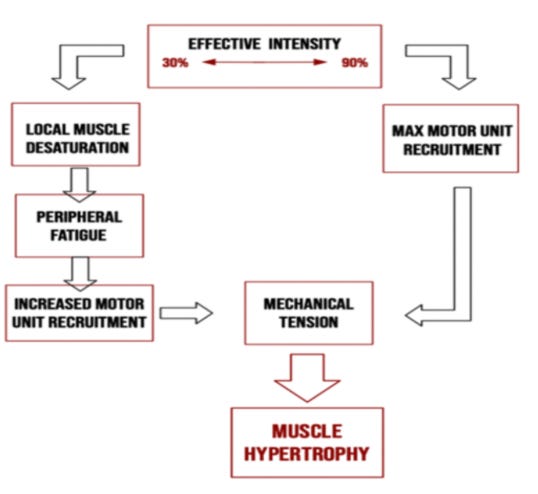
Your experience with optimization algorithms provides a useful analogy. Muscle hypertrophy is the objective function we want to maximize. Mechanical tension is the primary variable. We can arrive at a high value for this variable through different operational paths—either by demanding maximal output from the start (heavy load) or by running the system to its operational limits until all resources are engaged (light load to failure).
3. The Supporting Cast: Metabolic Stress & Muscle Damage
While mechanical tension is the star of the show, the other two mechanisms play important, albeit debated, supporting roles.
Metabolic Stress
Metabolic stress is the buildup of metabolic byproducts, or metabolites (like lactate, hydrogen ions, and inorganic phosphate), that occurs during intense exercise using anaerobic glycolysis for energy. This is what causes the "burn" and "pump" (cell swelling) you feel during a high-rep set.
The key question is: does this "pump" directly cause growth, or is it a means to an end?
The modern view, as highlighted in the first video, is that metabolic stress is primarily an indirect contributor. By causing rapid fatigue within the muscle fibers, it forces the nervous system to recruit more motor units to continue the set. This, in turn, increases the total mechanical tension experienced by the muscle as a whole.
Let's explore the science behind metabolic stress in more detail with Dr. Mike from the 'Science of Muscle Hypertrophy' video. He provides a deeper look into the physiological effects.
Watch from 13:24 to 15:47. Dr. Mike explains how lifting in the moderate rep range (which generates significant metabolic stress) relies on glycolysis, leading to lactate production. Note his points on how lactate can cause cell swelling and influence anabolic hormones.
Key roles of metabolic stress:
- Increases Motor Unit Recruitment: As discussed, it fatigues fibers, forcing the recruitment of more powerful ones.
- Cell Swelling: The accumulation of metabolites draws water into the muscle cells, causing them to swell. This "pump" can place a mechanical stress on the cell membrane, which is thought to be an anabolic signal in itself (a perceived threat to the cell's integrity).
- Hormonal Milieu: May promote the release of local and systemic growth factors.
Muscle Damage
Muscle damage refers to the microscopic tears in muscle fibers (myotrauma) that occur during and after strenuous exercise, especially with movements that emphasize the eccentric (lowering) phase or when introducing a novel stimulus. The soreness you feel a day or two after a hard workout (DOMS) is a symptom of this damage and the subsequent inflammatory response.
The traditional theory was that the process of repairing this damage led to a "super-compensation" where the muscle was rebuilt bigger and stronger than before.
However, this view is now being challenged.
The Science of Muscle Hypertrophy: A Guide for Trainers and ...
The article 'The Science of Muscle Hypertrophy: A Guide for Trainers and ...' presents a more modern, critical perspective on muscle damage.
Read the section 'The Mechanism of Muscle Hypertrophy'. Pay particular attention to the paragraph on muscle damage. It highlights that the cellular resources used for repair are the same ones used for growth, suggesting excessive damage might be counterproductive.
Coach's Note: Damage is a Side Effect, Not the Goal
The current evidence suggests that muscle damage is more of a correlate or byproduct of effective training, not the direct cause of growth. You can experience significant hypertrophy with training protocols that cause very little soreness, and you can get incredibly sore from activities that produce no growth (like running downhill for the first time).
Therefore, as a coach, your objective is not to design workouts that make your client as sore as possible. The goal is to impose a sufficient and progressive mechanical tension. The resulting muscle damage is simply part of the adaptive process, not the target itself. Chasing extreme soreness often leads to excessive fatigue that compromises subsequent training sessions, ultimately hindering long-term progress.
Conclusion
Today, we've unpacked the three key signals that stimulate muscle growth. You now have a hierarchical framework for understanding why resistance training works.
Key Takeaways:
- The three primary mechanisms of hypertrophy are mechanical tension, metabolic stress, and muscle damage.
- Mechanical tension is the direct, primary driver of muscle growth. It is the physical force on the muscle fibers that initiates the anabolic signaling cascade (mechanotransduction).
- Metabolic stress (the "pump" and "burn") contributes indirectly by enhancing muscle fiber recruitment, thus increasing overall mechanical tension, especially during higher-rep training.
- Muscle damage is likely a side effect of effective training, particularly from novel stimuli or eccentric overload. It is not a mechanism to be actively pursued, as excessive damage can hinder recovery and growth.
In our next lesson, we will explore the length-tension relationship. We will see how a muscle's ability to generate tension—and thus its potential to be stimulated for growth—changes dramatically depending on whether it's in a stretched or contracted position. This concept is fundamental to intelligent exercise selection.