Hello! Welcome to your third lesson in our module on muscle physiology.
In our last lesson, we explored the sliding filament theory—the universal "algorithm" of muscle contraction. We saw how actin and myosin filaments interact through the cross-bridge cycle, powered by ATP and triggered by calcium, to generate force.
Today, we build on that foundation. While all muscle fibers use the same fundamental sliding mechanism, they are not all created equal. Nature has developed different types of muscle fibers specialized for different tasks. Our learning outcome is to compare Type I and Type II muscle fibers in terms of force production, fatigue resistance, and hypertrophy potential.
Understanding these differences is not just academic; it's a cornerstone of effective coaching. It explains why some people are naturally better sprinters and others better marathon runners, and it provides the scientific rationale for why a complete hypertrophy program should include different training styles.
1. The Two Extremes: The Sprinter and The Marathon Runner
Imagine two elite athletes: a 100-meter sprinter and a marathon runner. Their physiques and abilities are vastly different, and a primary reason for this lies in the predominant type of muscle fibers their training has developed. These represent the two ends of the muscle fiber spectrum.
- Type I (Slow-Twitch) Fibers: The marathon runner's engine.
- Type II (Fast-Twitch) Fibers: The sprinter's powerhouse.
Let's begin with a video that vividly illustrates the characteristics of these two main categories.
How Your Muscle Fibers Change With Exercise
This excellent video from the Institute of Human Anatomy, 'How Your Muscle Fibers Change With Exercise', breaks down the distinct properties of each fiber type. We'll start by focusing on the two primary, opposing types.
Please watch the sections on slow-twitch (Type I) and fast-twitch (Type IIX) fibers. Watch from 03:09 to 05:31 for the breakdown of Slow Oxidative (Type I) fibers. Then, watch from 05:31 to 07:36 for the breakdown of Fast Glycolytic (Type IIX) fibers. As you watch, focus on the 'why': how do factors like mitochondria, blood supply, and energy systems dictate whether a fiber is built for endurance or for power?
As the video explained, the characteristics of these fibers are a direct result of their metabolic machinery. Given your background in engineering, you can think of this as two different types of engines optimized for different performance profiles.
Type I (Slow-Twitch / Slow Oxidative): The Endurance Engine
- Energy System: Primarily uses the aerobic (oxidative) system. It "burns" fats and carbohydrates with oxygen to produce ATP.
- Infrastructure: Packed with mitochondria (the cell's power plants), a dense network of capillaries (for oxygen delivery), and high levels of myoglobin (an oxygen-storing protein), which gives them a red color.
- Performance Profile:
- Force Production: Low. They contract slowly and with less force.
- Fatigue Resistance: Extremely high. Their efficient, oxygen-based energy system allows them to sustain activity for long periods.
- Primary Use: Postural control, walking, jogging, and any prolonged, low-intensity activity.
Type IIX (Fast-Twitch / Fast Glycolytic): The Power Engine
- Energy System: Primarily uses the anaerobic (glycolytic) system. It rapidly breaks down stored glucose (glycogen) without oxygen to produce ATP very quickly.
- Infrastructure: Fewer mitochondria and capillaries, and less myoglobin (giving them a pale or "white" appearance). They have large stores of glycogen.
- Performance Profile:
- Force Production: Very high. They contract rapidly and forcefully.
- Fatigue Resistance: Very low. The anaerobic system produces ATP quickly but is inefficient and produces byproducts that contribute to fatigue, so they burn out fast.
- Primary Use: Sprinting, jumping, lifting very heavy weights—any short, maximal-effort burst.
2. The Hybrid Fiber and the Complete Picture
The distinction isn't just black and white. There's an important intermediate fiber type that bridges the gap between the two extremes.
- Type IIA (Fast-Twitch / Fast Oxidative-Glycolytic): The Hybrid Engine
Let's return to the same video to learn about this versatile fiber type.
How Your Muscle Fibers Change With Exercise
Now, let's watch the section on the intermediate Type IIA fibers to complete our understanding of the spectrum.
Watch from 07:36 to 09:34. Notice how this fiber type borrows characteristics from both Type I and Type IIX fibers.
Type IIA fibers are true hybrids. They are powerful like Type IIX fibers but also have a significant aerobic capacity, making them more fatigue-resistant. They are crucial for activities that require both strength and some endurance, like playing a game of basketball or lifting weights for sets of 8-15 repetitions.
The following table from the academic paper by Dr. Jason Karp provides a concise, structured comparison of all three fiber types. It's a fantastic reference for a coach.
[PDF] Muscle Fiber Types and Training - Dr. Jason Karp
This document, 'Muscle Fiber Types and Training', contains a summary table that perfectly organizes the characteristics of each fiber type.
Please study Table 1: Characteristics of the Three Main Muscle Fiber Types. You don't need to read the full text yet, just focus on absorbing the side-by-side comparison in the table. Note that 'Type IIB' in this older text is functionally equivalent to what is more commonly called 'Type IIX' today.
To synthesize this information, let's use a clear visual summary.
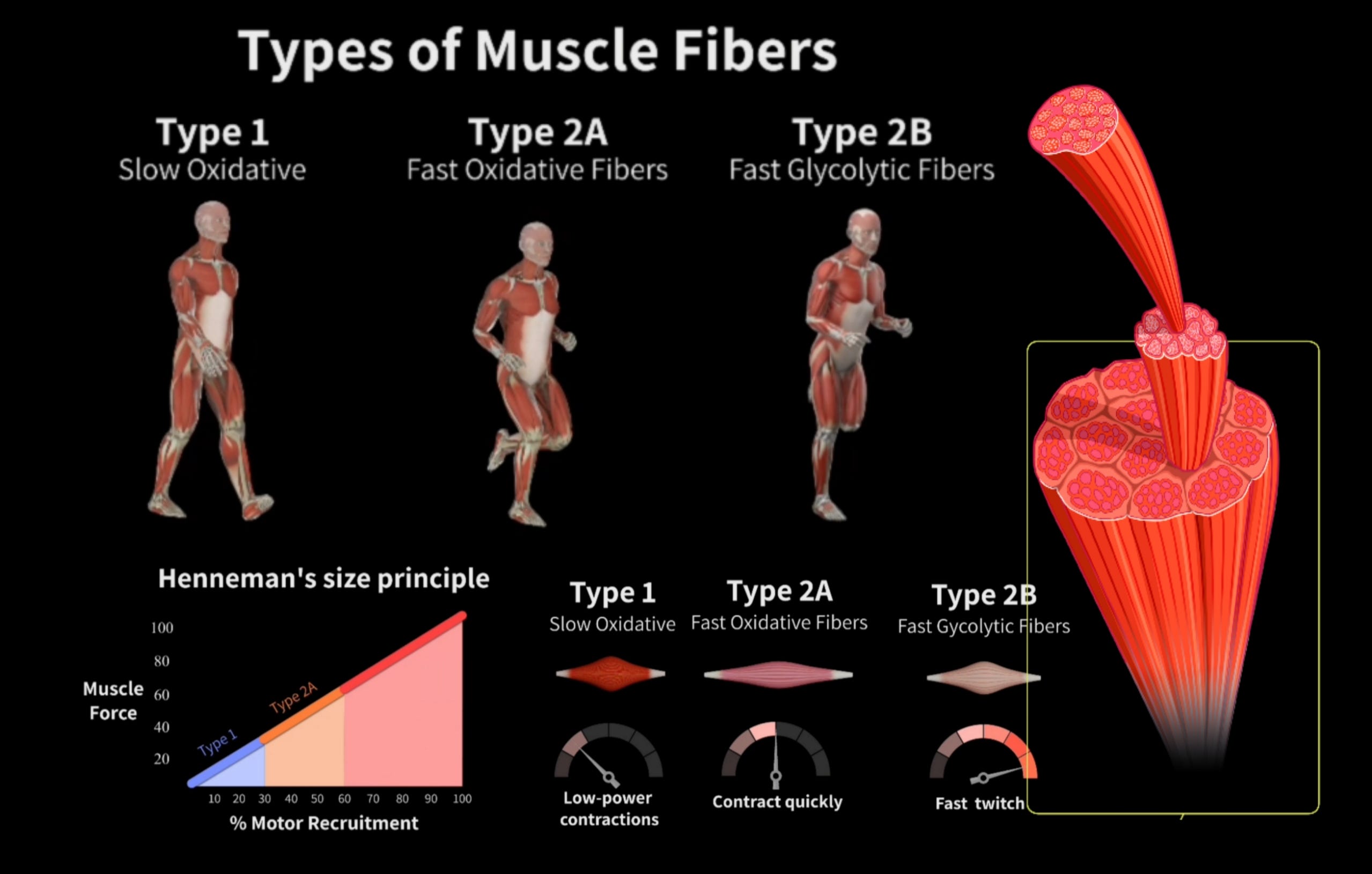
Here is a summary table focused on our learning outcome:
| Characteristic | Type I (Slow-Twitch) | Type IIA (Fast-Twitch) | Type IIX (Fast-Twitch) |
|---|---|---|---|
| Contraction Speed | Slow | Fast | Very Fast |
| Force Production | Low | High | Very High |
| Fatigue Resistance | High | Intermediate | Low |
| Hypertrophy Potential | Lower | High | Highest |
| Primary Fuel Source | Fat, Carbohydrates (with O₂) | CP, Glycogen, Fat | CP, Glycogen |
3. Hypertrophy Potential: Which Fibers Grow Best?
Now for the most important question for our purposes: which fibers contribute most to muscle growth?
The general consensus, supported by decades of research, is that Type II fibers have a significantly greater potential for hypertrophy than Type I fibers. They are naturally larger and respond more robustly to the stimulus of resistance training. This is why training with heavy loads, which preferentially recruits Type II fibers, is a cornerstone of building muscle mass.
However, this doesn't mean Type I fibers don't grow or are unimportant for a muscular physique. They can and do hypertrophy, and since they can make up roughly 50% of a muscle's fibers, their growth contributes to the muscle's overall size.
The key question for coaches has been: Do we need different training styles to target the growth of different fiber types?
The traditional thinking was:
- Heavy weight, low reps (e.g., 1-5 reps) for Type II fiber growth.
- Light weight, high reps (e.g., 15-30 reps) for Type I fiber growth.
Let's see what the modern evidence suggests.
Training Based On Muscle Fiber Type: Are You Missing Out?
The article 'Training Based On Muscle Fiber Type' from Stronger by Science provides a nuanced, evidence-based look at this exact question. It challenges simplistic assumptions and presents a more complete picture.
Read the section titled 'It’s still unclear whether Type 1 and Type 2 fibers respond better or worse to different types of training.' Focus on the conclusion that the overall picture is murky but that both fiber types seem to grow from a variety of challenging training.
Coach's Note: The Unified Theory of Hypertrophy
As Greg Nuckols points out in the Stronger by Science article, while the evidence slightly favors heavy training for Type II and lighter for Type I, the most robust finding is that both fiber types grow when sets are taken to, or close to, muscular failure, regardless of the load.
Why? Think back to the recruitment principle shown in the infographic (Henneman's Size Principle).
- When you lift a heavy weight, you immediately recruit all fiber types, including the high-growth-potential Type II fibers, to move the load.
- When you lift a light weight for high reps, you initially only use Type I fibers. As they fatigue, your nervous system recruits the Type IIA fibers to assist. As they fatigue, your body is forced to recruit the most powerful Type IIX fibers to continue the set.
By the time you reach muscular failure with a lighter load, you have effectively fatigued and stimulated the entire pool of fibers.
The Practical Takeaway for Hypertrophy Coaching:
A comprehensive hypertrophy program should likely incorporate a variety of repetition ranges (e.g., 5-10, 10-20, 20-30). This approach ensures that you are creating a maximal stimulus for all fiber types through different pathways, leaving no stone unturned in the quest for muscle growth.
Conclusion
Today, we've dissected the different "personalities" of muscle fibers. You now understand the fundamental trade-off between force production and fatigue resistance that defines them.
Key Takeaways:
- Type I (Slow-Twitch) fibers are endurance specialists. They produce low force but are highly resistant to fatigue. Their hypertrophy potential is limited.
- Type II (Fast-Twitch) fibers are power specialists. They produce high force but fatigue quickly. They have the greatest potential for hypertrophy.
- Type IIA fibers are hybrids, possessing both power and moderate endurance capabilities.
- While Type II fibers are the primary drivers of muscle size, both Type I and Type II fibers can be stimulated to grow by training with a variety of rep ranges, as long as sets are performed with high effort and taken close to muscular failure.
In our next lesson, we will delve into the length-tension relationship. We will explore how a muscle's ability to produce force—using all these fiber types—changes dramatically depending on whether it is in a stretched, mid-range, or shortened position. This is a critical biomechanical concept that directly influences exercise selection.