Hello! Welcome to the fifth lesson in our module on Muscle Physiology and Mechanisms of Hypertrophy.
In our last lesson, we established the three primary mechanisms of muscle growth, concluding that mechanical tension is the undisputed primary driver. This sets up a critical question: is a muscle's ability to generate tension consistent throughout a movement? If you've ever done a bicep curl, you know the answer is no—the middle of the lift feels hardest, and the top and bottom feel easier.
Today, we'll explore the physiological reason for this. Our learning outcome is to explain the length-tension relationship and why a muscle's force-producing capacity changes throughout its range of motion.
This concept is the bedrock of intelligent exercise selection. Understanding it will allow you to analyze movements not just by what muscle they target, but by how they challenge that muscle at different lengths, which is a crucial factor for optimizing hypertrophy.
1. The Length-Tension Relationship: An Overview
At its core, the length-tension relationship describes how the length of a muscle fiber influences its ability to produce force. To begin, let's get a clear, high-level overview of this principle.
Tension Curves for Hypertrophy Training | Implications for Exercise Selection
This video, 'Tension Curves for Hypertrophy Training' from Flow High Performance, provides an excellent and concise introduction to the key factors that influence a muscle's strength throughout a lift. We'll focus on the part that defines the length-tension relationship.
Please watch from 02:04 to 02:59. This section explains how the overlap of actin and myosin filaments changes at shortened, moderate, and lengthened muscle positions, and how this directly affects force production.
The video introduced the fundamental idea: force production is all about the interaction between the contractile proteins, actin and myosin. This force, or tension, can be broken down into two types: active and passive.
2. Active vs. Passive Tension
To fully grasp the length-tension curve, we need to distinguish between the two sources of tension within a muscle.
The Biceps Length-Tension Relationship
The article 'The Biceps Length-Tension Relationship' from House of Hypertrophy offers a very clear and simple definition of these two components.
Please read the initial sections, starting from 'Understanding The Length-Tension Relationship' down to just before 'The Length-Tension Relationship' diagram. Focus on the definitions of Active Tension (the force from actin-myosin interaction) and Passive Tension (the recoil force from stretch, like a rubber band).
- Active Tension: Generated by the conscious, ATP-dependent process of myosin heads pulling on actin filaments. This is the force you generate when you voluntarily contract a muscle.
- Passive Tension: Generated by the non-contractile, elastic components of the muscle (like the protein titin and connective tissue) as they are stretched. This is a recoil force that does not require active contraction.
The total force a muscle can produce at any given length is the sum of these two forces. Let's now explore each in more detail.
3. Active Tension and Sarcomere Overlap
Active tension is where the "magic" of contraction happens. Its relationship with muscle length is dictated entirely by the degree of overlap between actin and myosin filaments within the sarcomere.
Length - Tension Relationship (Video 2.6) - PhysioStasis
This next video, 'Length - Tension Relationship' from Prof. Roofs, MD, provides a brilliant animated breakdown of how sarcomere overlap changes with length and directly impacts the number of force-producing cross-bridges. Your computer science background will appreciate this clear, almost algorithmic, visualization.
Watch from 04:57 to 10:30. Follow the animation closely. The narrator counts the number of active myosin heads at different sarcomere lengths, providing a step-by-step demonstration of why force production changes. Don't worry about memorizing the exact numbers; focus on the principle.
That detailed animation perfectly illustrates the concept. We can summarize this relationship with a graph.
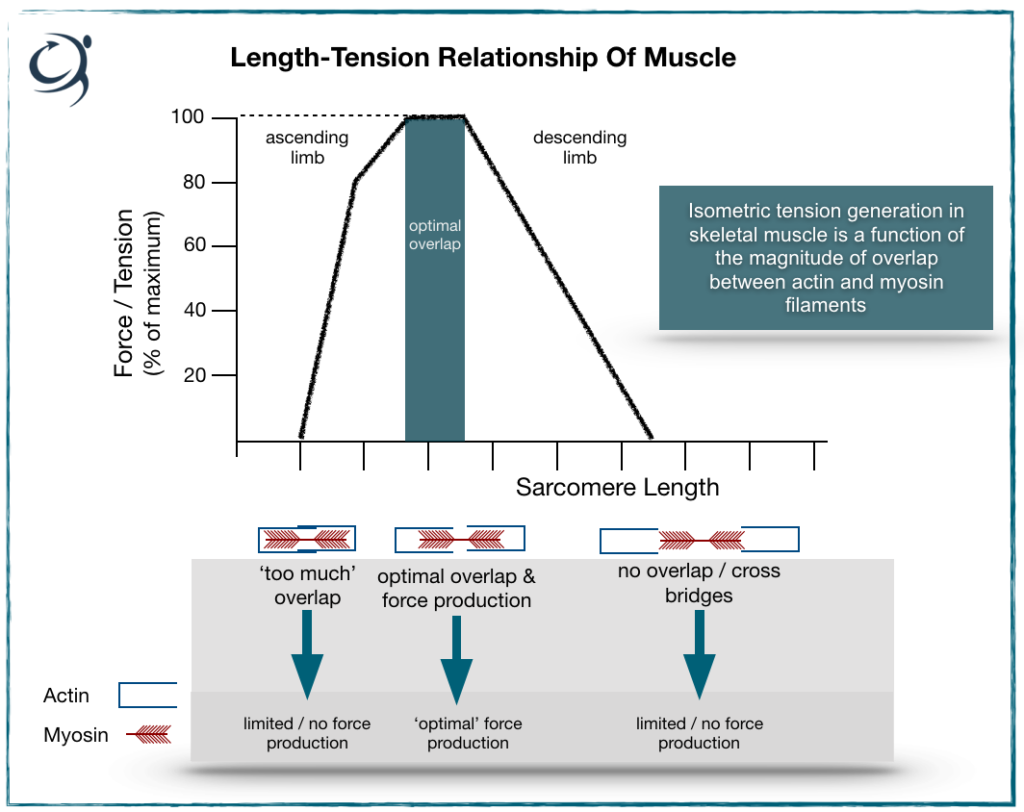
This graph shows three key regions for active tension:
- Ascending Limb (Shortened Muscle): When the muscle is very short, the actin filaments from opposite ends of the sarcomere begin to interfere with each other, and the Z-discs get too close to the myosin filaments. This "crowding" limits the number of effective cross-bridges that can form, reducing force output.
- Plateau (Optimal Length): At a moderate, or "resting," length, there is an ideal overlap between actin and myosin. This allows for the maximum number of cross-bridges to form simultaneously, resulting in peak active tension.
- Descending Limb (Lengthened Muscle): As the muscle is stretched past its optimal length, the actin and myosin filaments are pulled apart. Fewer and fewer myosin heads can reach the actin filaments, so the number of cross-bridges decreases, and active tension drops off significantly.
4. The Role of Passive Tension
If active tension drops off as a muscle gets very stretched, why can we still feel so much tension and produce force in a stretched position? The answer is passive tension.
Let's return to the PhysioStasis video to see how passive tension is generated and how it combines with active tension.
Length - Tension Relationship (Video 2.6) - PhysioStasis
We will now watch two short clips from the same 'Length - Tension Relationship' video. The first explains passive tension, and the second shows how it's added to active tension to create the total tension curve.
First, watch from 03:39 to 04:57 for a clear explanation of passive tension. Then, watch from 11:24 to 12:20 to see how the total tension curve is derived by summing the active and passive components.
This combination of active and passive tension gives us the complete picture of a muscle's force-producing potential across its entire range of motion.

This explains why a muscle's force-producing capacity changes throughout a lift. The total tension you can generate is a dynamic interplay between the active force from cross-bridges and the passive recoil force from stretch.
5. A Practical Conundrum: Is More Tension Always Better?
The concept of total tension leads to a logical question: if we want to maximize mechanical tension for hypertrophy, should we always train at the longest muscle lengths where total tension might be highest?
The answer is more nuanced and reveals a fascinating aspect of muscle physiology.
Longer and Stronger: Range of Motion and Muscle Lengths
To explore this, we'll turn to an in-depth article by Greg Nuckols and Milo Wolf at Stronger by Science. This piece delves into the complexities of this topic. We'll read a specific section that challenges the simple idea that total tension is the only thing that matters.
Please read the section titled 'Why Does Training at Longer Muscle Lengths Result in Greater Hypertrophy?', specifically the sub-section 'Greater Total Muscle Tension?'. Focus on the key example comparing overhead triceps extensions to pushdowns. It demonstrates a scenario where training with lower total tension at a longer muscle length led to more hypertrophy.
Coach's Note: The Potency of Lengthened-Position Tension
The Stronger by Science article highlights a critical, high-level concept: training at long muscle lengths can cause greater hypertrophy even when the total mechanical tension is lower.
This suggests that tension itself has different "flavors." The mechanical tension experienced by a muscle in a stretched position appears to be a uniquely powerful signal for growth. The leading hypothesis for this involves a giant protein inside the muscle fiber called titin. Titin has mechanosensitive properties, meaning it can sense both tension and changes in fiber length. It's thought that when a muscle is under tension at long lengths, both the primary mechanoreceptors (costameres) on the muscle surface and the internal titin proteins are activated, creating a powerful, additive signal for growth. This phenomenon is often called "stretch-mediated hypertrophy."
Conclusion
Today we have moved from the signal for growth (mechanical tension) to the physics of how that signal is generated and modulated by muscle length.
Key Takeaways:
- A muscle's force-producing capacity is described by the length-tension relationship.
- Active tension, from actin-myosin cross-bridges, peaks at an optimal muscle length and decreases when the muscle is too short or too long.
- Passive tension, from the stretching of elastic tissues, increases exponentially at long muscle lengths.
- Total tension is the sum of active and passive tension, and its curve varies depending on the muscle's specific properties.
- Critically, research suggests that tension experienced at long muscle lengths is a particularly potent hypertrophic stimulus, even if the absolute total tension isn't at its peak.
In our next lesson, we will build directly on this foundation. We will formally define the shortened and lengthened positions of a muscle and explore the practical significance of stretch-mediated hypertrophy for exercise selection. You'll learn how to choose exercises that deliberately challenge a muscle in its stretched position to maximize this powerful growth stimulus.