Introduction
Welcome to our next lesson on quadriceps training. In our previous session, we established a critical principle: because the rectus femoris is biarticular (crossing the hip and knee) and the vasti muscles are uniarticular (crossing only the knee), they require separate training strategies. We learned that compound movements like squats are fantastic for the vasti but poor for the rectus femoris due to Lombard's Paradox.
Today, we will build directly on that knowledge. It's not enough to know which exercises to do; we must know how to perform them for maximal benefit. This lesson will focus on a key driver of hypertrophy: training a muscle in its lengthened position.
By the end of this lesson, you will be able to distinguish the unique lengthened positions of the vasti muscles versus the rectus femoris and select specific exercises that apply maximum tension in those stretched states. This will unlock a more precise and effective approach to quadriceps development.
1. The Lengthened Position of the Vasti Muscles
Let's start with the three vasti muscles: vastus lateralis, vastus medialis, and vastus intermedius.
As a reminder, these muscles originate on the femur (thigh bone) and insert on the tibia (shin bone) via the patellar tendon. They only cross one joint: the knee. Their sole function is knee extension (straightening the leg).
To place a muscle in a lengthened or stretched position, you must perform the opposite of its concentric action. Therefore, to lengthen the vasti, you must perform deep knee flexion (bending the knee as much as possible).
Because they don't cross the hip, the position of your hip is irrelevant for lengthening the vasti. The entire game is about achieving the greatest degree of knee flexion under load.
This is the anatomical reason why deep squats, leg presses, and hack squats are so effective for building the "sweep" and "teardrop" of the quads. The deepest part of the repetition, when your hamstrings are close to your calves, is where the vasti are most stretched and receive a powerful hypertrophic stimulus.
How To Grow Your Quads (2 BEST Exercises + Leg Extension & VMO Myth Busting)
The team at E3 Rehab explains this concept perfectly. Watch this segment to see how to apply this principle to compound exercises.
Watch from 01:50 to 02:50. Pay close attention to the two guidelines for quad hypertrophy: 1) maintain an upright posture and 2) aim for as much knee flexion as possible. The video explicitly states this ensures you are 'loading the quads, specifically the three vasti muscles, in their lengthened position'.
The scientific literature confirms this. A highly detailed paper in the International Journal of Sports Physical Therapy explains that the vasti muscles operate on the plateau-to-descending limb of the length-tension curve. This means they are capable of producing significant force even at very long muscle lengths (i.e., in deep knee flexion). Training in these deep ranges (e.g., beyond 90 degrees of knee flexion) is what facilitates hypertrophy, particularly in the lower portions of the muscles.
2. The Lengthened Position of the Rectus Femoris
Now for the rectus femoris. This is where your anatomical understanding becomes a real coaching advantage.
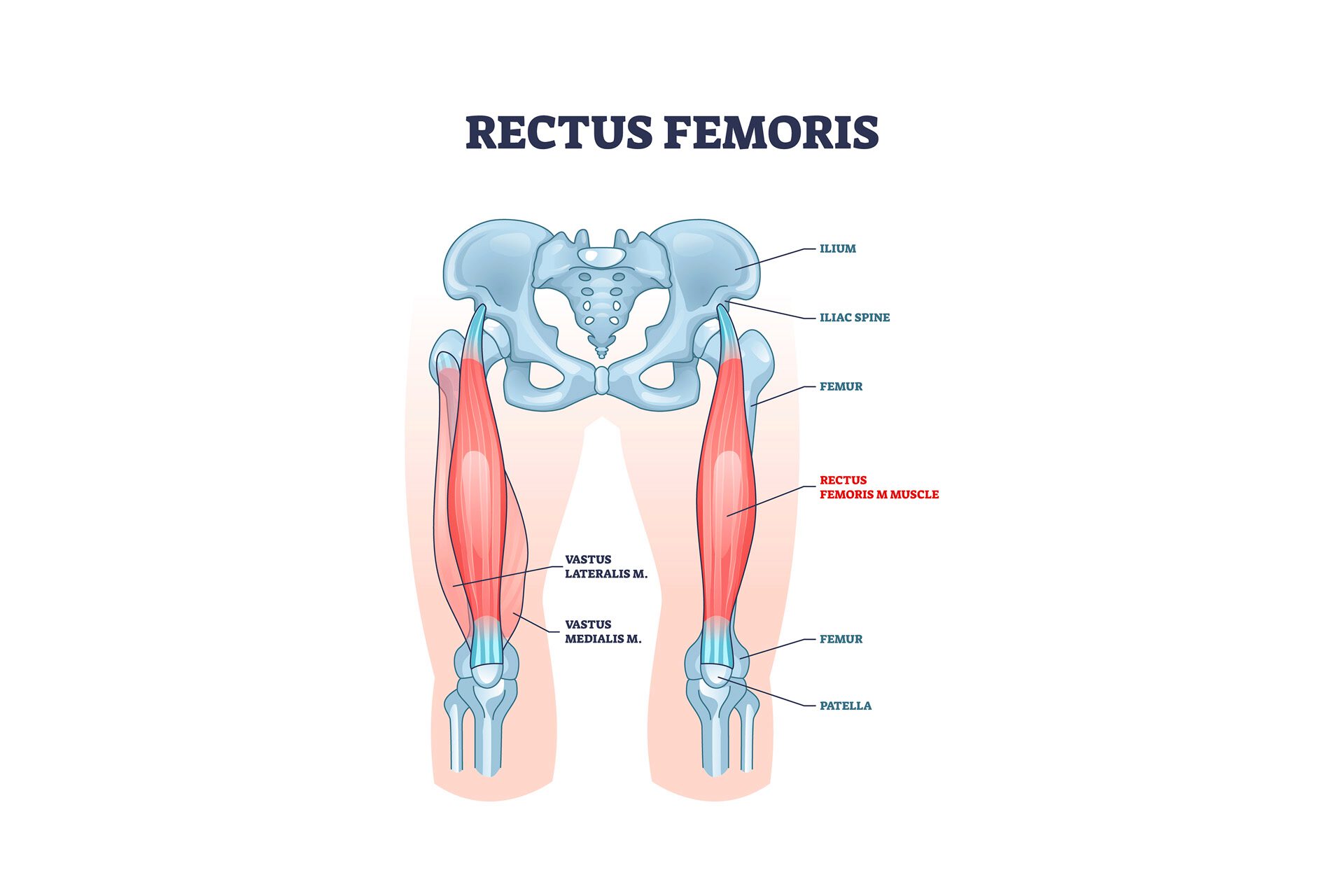
The rectus femoris has two actions:
- Knee Extension
- Hip Flexion
To place this biarticular muscle in its most lengthened position, you must do the opposite of both actions simultaneously. This means you need:
- Knee Flexion (bending the knee)
- Hip Extension (moving the thigh behind the body)
This is the most critical distinction of this lesson. A deep squat does not effectively lengthen the rectus femoris. While a deep squat involves deep knee flexion (which is one half of the equation), it also involves deep hip flexion, which shortens the rectus femoris at the hip. The shortening at one end counteracts the lengthening at the other.
To truly stretch the rectus femoris, you must find a way to bend the knee while the hip is neutral or extended.
3. Exercise Selection for a Deep Stretch
Now let's translate this anatomical theory into practical exercise selection.
Targeting the Vasti in the Lengthened Position
Your goal is simple: maximize knee flexion.
- Primary Exercises: High-bar Squats, Front Squats, Hack Squats, Leg Presses (with feet lower on the platform), and any Split Squat variation.
- Technique Focus: Prioritize depth. Using a heel elevation (e.g., with weightlifting shoes or a wedge) can help you achieve greater knee flexion with a more upright torso, which further biases the vasti. The goal is to get your "hamstrings to cover your calves."
Targeting the Rectus Femoris in the Lengthened Position
This is more nuanced. We need exercises that promote knee flexion while the hip is extended.
Option 1: The "Good Enough" - Modifying the Leg Extension
The standard seated leg extension is a great rectus femoris builder, but it's not optimal from a lengthened-position standpoint. You have knee flexion, but your hips are also flexed at 90 degrees.

The simple fix? Lean back.
Research has shown that performing a leg extension while leaning back (increasing the hip angle towards extension) produces significantly more rectus femoris growth than sitting upright.
How To Grow Your Quads - E3 Rehab
Let's review the evidence and practical application for modifying the leg extension in this article from E3 Rehab.
Navigate to the section 'Isolation Exercises For The Quads'. Read the part discussing the study by Larsen et al. It explains that hypertrophy was greater with 40° of hip flexion compared to 90°, precisely because it trains the rectus femoris in a more lengthened position. The article's advice to 'try moving the seat back and leaning back' is a direct application of this principle.
Option 2: The "Optimal" - True Lengthened-Position Exercises
To hit the rectus femoris in a truly stretched state, we need exercises that combine knee flexion with hip extension.
- Sissy Squats: In this movement, you keep your hips locked in extension (a straight line from knee to shoulder) and lean back, creating immense stretch on the quads by only flexing at the knee.
- Reverse Nordics: Similar to the sissy squat, you start from a kneeling position and lean your torso back, forcing the rectus femoris to control the movement from a position of hip extension and increasing knee flexion.
- Standing Cable Leg Extension: By facing away from a cable stack with a cuff around your ankle, you extend your knee while your hip is in a neutral or slightly extended position. This perfectly matches the anatomical requirements.
Leg Extension Variations for Complete Quad Development
These exercises can feel awkward at first, but they are biomechanically superior for targeting a stretched rectus femoris. This video demonstrates and explains several of these variations.
Watch the following three segments: Standing Cable Knee Extension (02:11 - 02:54): Notice how the working leg starts behind the body (hip extension). Sissy Squats (03:25 - 04:28): Observe how the lifter maintains a straight line from knee to shoulder, preventing hip flexion. Nordic Leg Extensions (04:28 - 05:53): This is the same as a Reverse Nordic. Note the description of the 'intense stretch on your quads in the bottom position'.
Summary Table: Lengthened Position Training for Quads
This table synthesizes the key concepts of today's lesson.
| Muscle Group | Lengthened Position Anatomy | How to Achieve It | Primary Exercises |
|---|---|---|---|
| Vasti Muscles | Uniarticular (crosses knee only) | Maximize knee flexion. | Deep Squats, Leg Press (low feet), Hack Squats, Split Squats |
| Rectus Femoris | Biarticular (crosses hip & knee) | Combine knee flexion with hip extension. | Reverse Nordics, Sissy Squats, Standing Cable Leg Extensions, Leaning-Back Leg Extensions |
Conclusion
You have now moved beyond simply categorizing exercises and into the realm of optimizing them based on deep anatomical principles. Understanding the lengthened position is a cornerstone of intelligent hypertrophy training.
Key Takeaways:
- To lengthen the vasti muscles, you need deep knee flexion. The deepest point of a squat or leg press is where the magic happens for them.
- To lengthen the rectus femoris, you need a combination of knee flexion and hip extension. This is why exercises like Reverse Nordics and Sissy Squats are so uniquely effective.
- Standard squats are poor at lengthening the rectus femoris because the hip flexion involved counteracts the stretch from knee flexion.
- You can significantly improve the stimulus from a standard leg extension simply by leaning your torso back.
Preview of the Next Lesson
We have distinguished between the vasti and rectus femoris and learned how to place each in a stretched, growth-promoting state. In our next lesson, we will zoom in even further. We will explore the concept of regional hypertrophy within the quadriceps, investigating whether stance and foot position can preferentially target different parts of the muscle, such as the vastus medialis (the "teardrop") versus the vastus lateralis (the "sweep").