Introduction
Welcome back. In our last lesson, we established the fundamental anatomy of the quadriceps, identifying the three uniarticular vasti muscles and the one biarticular muscle: the rectus femoris. We concluded by highlighting that this distinction—crossing one joint versus two—is not just an anatomical detail, but the very reason why effective quad training requires a multi-faceted approach.
Today's lesson answers the crucial question: Why does the biarticular rectus femoris require different training strategies than the vasti muscles?
We will move from pure anatomy into functional biomechanics. You will learn about two critical concepts, active insufficiency and Lombard's Paradox, that explain why popular compound exercises like squats are excellent for three of the four quad heads, but surprisingly ineffective for the fourth. By the end of this lesson, you will understand the precise mechanical reasons for programming both compound and isolation movements for complete quadriceps development.
1. The Biarticular Dilemma: Active Insufficiency
As a recap, the vasti muscles originate on the femur and insert on the tibia (via the patellar ligament), crossing only the knee joint. The rectus femoris, however, originates on the pelvis (hip bone) and also inserts on the tibia, crossing both the hip and knee joints.
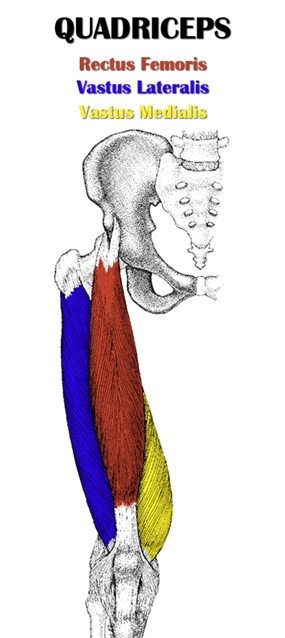
This dual-joint nature creates a unique challenge known as active insufficiency. This principle states that a biarticular muscle cannot generate maximal force when it is asked to shorten across both joints simultaneously. For the rectus femoris, this occurs when you try to perform hip flexion (bringing your knee to your chest) and knee extension (straightening your leg) at the same time. In this "cramped" position, the muscle's actin and myosin filaments have overlapped so much that their ability to form further cross-bridges is significantly reduced.
A highly technical paper from the International Journal of Sports Physical Therapy provides a detailed explanation of this phenomenon from a physiological perspective.
Oh, My Quad: A Clinical Commentary And Evidence-Based ... - PMC
To understand the deep science behind this, let's look at the paper 'Oh, My Quad: A Clinical Commentary And Evidence-Based...'. This will explain how the rectus femoris's force production is limited by its position.
Read the section titled 'Quadriceps Length-Tension'. Pay close attention to the sentences explaining that the rectus femoris 'operates within the ascending limb of the length-tension curve' and how this can lead to 'active insufficiency and impaired force-output'.
As the paper notes, the vasti muscles do not suffer from this issue because they only cross the knee. Their force production is determined solely by the knee angle. This is our first major clue: the position of the hip is irrelevant for the vasti, but it is critically important for the rectus femoris.
2. The Squat Conundrum: Lombard's Paradox
This brings us to a paradox. The squat is the undisputed "king" of leg exercises. It involves powerful knee extension, which is the primary function of the quadriceps. So, why does research consistently show that squats produce significant growth in the vasti muscles, but minimal to no growth in the rectus femoris?
The answer lies in a fascinating biomechanical phenomenon called Lombard's Paradox.
During a squat, you perform simultaneous hip extension (driving your hips forward and up) and knee extension (straightening your legs).
- The rectus femoris wants to extend the knee and flex the hip.
- The hamstrings (also biarticular) want to extend the hip and flex the knee.
Notice how their actions at each joint are antagonistic. Lombard's Paradox describes how, during movements like standing up from a squat, these two opposing biarticular muscles co-contract. Instead of acting as primary movers to create torque at the joints, they essentially act as rigid "straps" that transfer energy produced by the powerful single-joint muscles—the gluteus maximus (a hip extensor) and the vasti muscles (knee extensors).
Think of it like an energy-transfer algorithm:
- The vasti muscles contract to generate a knee extension force.
- The hamstrings, acting as a strap, transfer some of this force "up" the chain to help the glutes produce hip extension.
- Simultaneously, the glutes contract powerfully to generate a hip extension force.
- The rectus femoris, acting as a strap, transfers this force "down" the chain to help the vasti produce knee extension.
The net effect is that the rectus femoris doesn't shorten significantly during a squat; it maintains a relatively constant length as both the hip and knee extend, acting more as a force conduit than a force generator.
The following video from Squat University provides an excellent conceptual explanation of this paradox.
Is Your Squat 'Quad or Hamstring Dominant?' |#AskSquatU Show Ep. 13|
Let's watch a segment from Dr. Aaron Horschig of Squat University. He breaks down Lombard's Paradox in a very intuitive way.
Watch from 10:19 to 12:10. Focus on the core idea that biarticular muscles like the rectus femoris can act to 'transfer energy from one joint to the other' rather than creating movement themselves.
3. The Evidence: Theory Meets Practice
The theoretical models of active insufficiency and Lombard's Paradox are confirmed by practical, evidence-based research. Multiple studies have measured muscle growth in response to different training programs, and the results are consistent.
Let's examine the evidence presented in this article from E3 Rehab, a respected evidence-based physical therapy and coaching group.
How To Grow Your Quads - E3 Rehab
This article summarizes the key research findings that directly support the need for a two-part training strategy.
Read the section 'How To Maximize Growth & Strength of Quads'. Note the specific research findings cited: squats lead to no growth of the rectus femoris, while seated leg extensions cause its preferential hypertrophy.
This evidence solidifies our understanding. Because the rectus femoris contributes very little to compound movements involving simultaneous hip and knee extension, relying on squats and leg presses alone will leave a significant portion of your quadriceps underdeveloped.
4. The Solution: A Two-Pronged Strategy
Based on this anatomical and biomechanical analysis, the logical conclusion is that we need two distinct strategies to train the quadriceps comprehensively.
Strategy 1: Train the Vasti with Compound Movements
- Exercises: Squats (all variations), Leg Presses, Lunges, Split Squats.
- Mechanism: These movements involve deep knee flexion, which places a significant stretch and mechanical tension on the three vasti muscles. Lombard's Paradox shows that the vasti are primary force producers here. To maximize vasti involvement, an upright torso and deep knee flexion are ideal, as this biases the movement toward being knee-dominant rather than hip-dominant.
Strategy 2: Train the Rectus Femoris with Isolation Movements
- Exercises: Seated Leg Extensions, Reverse Nordics, Sissy Squats.
- Mechanism: These movements isolate knee extension while the hip is held in a fixed (and often neutral or even slightly extended) position. This prevents Lombard's Paradox from occurring and bypasses the problem of active insufficiency. By pinning the hip, you force the rectus femoris to act as a primary mover at the knee, creating the mechanical tension needed for hypertrophy.
Let's watch a final clip that summarizes this two-pronged approach.
How To Grow Your Quads (2 BEST Exercises + Leg Extension & VMO Myth Busting)
The E3 Rehab team summarizes these concepts perfectly in their video.
Watch from 00:49 to 01:50 and then from 17:16 to 18:13. This will recap the research and tie together the need for both multi-joint and single-joint exercises for complete quad development.
Conclusion
Today, we've connected anatomy to function, explaining precisely why the rectus femoris demands a different training approach from its neighbors, the vasti muscles.
Key Takeaways:
- The rectus femoris is biarticular (crossing the hip and knee), while the vasti muscles are uniarticular (crossing only the knee).
- During compound movements like squats, Lombard's Paradox explains how the rectus femoris acts as an energy-transferring strap rather than a prime mover, resulting in a poor stimulus for growth.
- During isolated knee extension where the hip is also flexed, the rectus femoris can experience active insufficiency, limiting its force output.
- Therefore, a complete quadriceps program must include:
- Compound movements (e.g., squats, leg presses) to target the vasti muscles.
- Isolation movements (e.g., leg extensions) to specifically target the rectus femoris.
Preview of the Next Lesson
We have now established what types of movements are needed. The next logical step is to determine how to perform them for maximal effect. In the next lesson, we will distinguish between the lengthened and shortened positions of the vasti and the rectus femoris. We will analyze how to select and modify exercises to apply tension when these muscles are in a deep stretch, a concept known as stretch-mediated hypertrophy, which is a potent driver of muscle growth.