Introduction
Welcome to our next lesson. In our last session, we drew a clear line between the uniarticular vasti muscles and the biarticular rectus femoris, establishing why they need different training strategies focused on their unique lengthened positions. We determined that deep squats are for the vasti, while movements combining hip extension and knee flexion, like sissy squats, are for the rectus femoris.
Today, we're going to zoom in even further. We'll explore the fascinating concept of regional hypertrophy, asking a question central to bodybuilding and aesthetic training: can we selectively grow different parts of the quadriceps? Specifically, can we use techniques like changing our stance or foot position to build the vastus medialis (the "teardrop" muscle on the inner thigh) or the vastus lateralis (the "sweep" on the outer thigh)?
By the end of this lesson, you will be able to explain the principle of regional hypertrophy and critically evaluate how stance and other biomechanical factors can—and cannot—be used to influence the development of the vastus medialis versus the vastus lateralis. This will add another layer of precision to your coaching toolkit.
1. What is Regional Hypertrophy?
Before we dive into specific techniques, we must first understand the underlying principle. Regional hypertrophy (also called non-uniform hypertrophy) is the phenomenon where different regions of a single muscle grow at different rates in response to specific types of training. A muscle is not a single, uniform block that grows evenly. Instead, based on the exercise chosen, one part of it might grow significantly more than another.
Inner Quad / Teardrop / VMO Regional Hypertrophy NEW Science & Lifts (Build Your Vastus Medialis!)
To start, let's get a clear definition of this concept. The creator of the Dr. Gains channel provides an excellent, data-driven introduction to regional hypertrophy specifically within the quadriceps.
Watch the first 49 seconds of the video (from 00:00 to 00:49). The key takeaway is that the differences in growth can be substantial—up to 3-5 times more in one part of a muscle versus another from the same exercise.
This concept is the foundation for our entire discussion today. If muscles grow uniformly, then trying to bias a specific region is pointless. But since they don't, the logical next question is how we can exploit this.
2. The Traditional Bodybuilding Approach: Stance and Foot Position
For decades, the common wisdom in gyms has been that you can target the inner or outer quads simply by changing your foot placement and rotation during exercises like the leg press and squat.

The theory generally goes as follows:
- Narrow Stance / Toes Pointing In: Targets the vastus lateralis (outer quad sweep).
- Wide Stance / Toes Pointing Out: Targets the vastus medialis (inner quad teardrop).
This seems intuitive. However, given your background in logical systems, you know that intuition must be tested against evidence.
3. A Critical Look at the Evidence
Let's examine what scientific research says about this traditional advice. The most direct way to measure which muscles are working during an exercise is with electromyography (EMG), which records the electrical activity produced by skeletal muscles.
Foot positioning doesn’t affect muscle activation in the leg press
This article from Stronger by Science, a highly respected evidence-based fitness publication, directly addresses this question. It summarizes the key research on foot positioning for the leg press.
Read the sections that review two key studies on the topic. Start from 'I looked at the research...' and continue to the end of the article. Focus on this key finding: In trained subjects performing the leg press, changing stance width (hip width vs. 2x hip width) and foot angle (straight ahead vs. turned out) resulted in no significant differences in the activation of the vastus medialis or vastus lateralis.
Furthermore, a 2022 study on squat training provides longitudinal data (measuring actual growth over time).
Does Back Squat Exercise Lead to Regional Hypertrophy among Quadriceps?
Let's look at the abstract and conclusion of a study that tracked quad growth from squatting.
Read the 'Abstract' and '5. Conclusions' sections. The study found that a standard parallel squat induced equivalent growth across all four quadriceps heads (RF, VI, VM, and VL).
What can we conclude from this evidence?
For standard compound movements like squats and leg presses, the idea that you can meaningfully bias the vastus medialis or lateralis with simple changes in foot position is likely overstated. While a very wide "sumo" stance will bring in more adductors (inner thigh muscles), the effect on the quadriceps themselves appears to be minimal.
This doesn't mean regional hypertrophy isn't possible. It just means our method needs to be more sophisticated than just pointing our toes differently.
4. An Anatomy-Driven Approach to Biasing the Quads
If simple stance changes aren't the answer, what is? We must look deeper at the specific anatomy and function of the vastus medialis (VM) and vastus lateralis (VL).
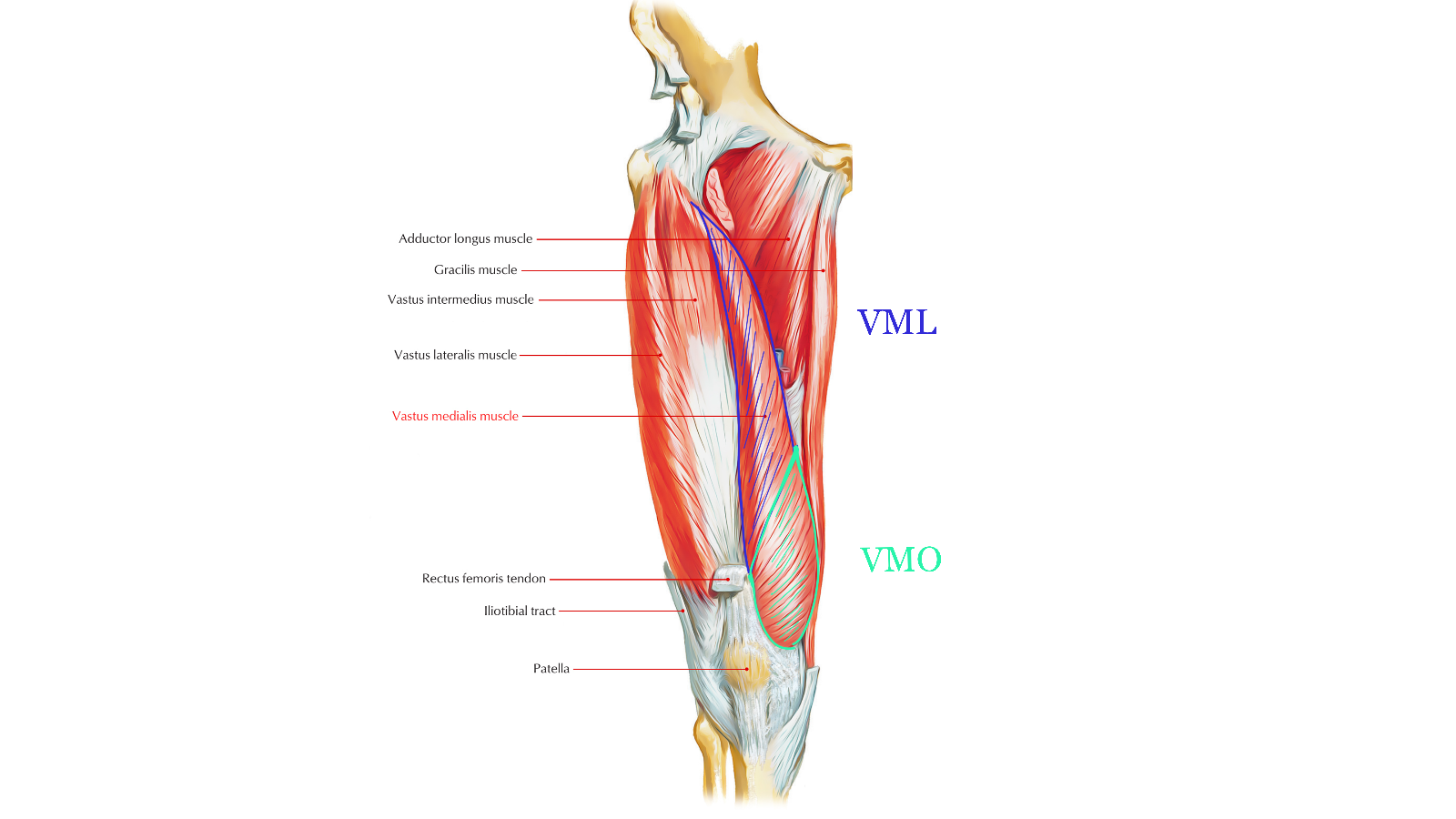
The VMO's fibers run at a more oblique (angled) orientation compared to the rest of the quads. This gives them a crucial role in the final degrees of knee extension (terminal extension) and in stabilizing the patella by pulling it medially (inward).
Conversely, the vastus lateralis pulls the patella laterally (outward).
To bias these regions, we need to choose movements that preferentially challenge these unique functions.
Inner Quad / Teardrop / VMO Regional Hypertrophy NEW Science & Lifts (Build Your Vastus Medialis!)
This is where we get into the advanced application. Let's return to the Dr. Gains video, which outlines specific, science-based techniques to target the inner and outer quads based on their unique biomechanics.
Watch the segment from 01:05 to 06:23. This is a dense section, so focus on the overarching principles for targeting the VMO (the 'teardrop'): Terminal Knee Extension: Focusing on the last 15-30 degrees of straightening the knee. Hip Adduction: Actively squeezing the knees inward against an object (like a ball). External Rotation: Turning the leg outward from the hip.
12 Outer Quad Regional Hypertrophy / Vastus Lateralis / Quad Sweep Techniques! (Science-Based RHT)
Now, let's look at the opposite: targeting the vastus lateralis for that outer quad 'sweep'.
Watch from 01:40 to 05:34. Again, focus on the core strategies for biasing the vastus lateralis: Shortened Range of Motion: Emphasizing the top half of knee extension. Internal Rotation: Turning the leg inward from the hip. Hip Abduction: Pushing the knees outward, especially against a band.
5. Practical Application and Summary
Let's synthesize this into a clear, actionable framework that moves beyond the outdated "toes in/toes out" model.
| Goal | Outdated Cue | Anatomy-Driven Strategy | Example Application |
|---|---|---|---|
| Bias Vastus Medialis (VM) | "Point your toes out." | Challenge its role in patellar stability and terminal extension by adding hip adduction and focusing on the final degrees of knee extension. | Partial Squats with Ball Squeeze: Place a small ball or foam roller between your knees. Perform squats in the top half/quarter of the range of motion, actively squeezing the ball throughout the set. |
| Bias Vastus Lateralis (VL) | "Point your toes in." | Challenge its role in lateral stabilization by adding hip abduction resistance and focusing on the top half of the range of motion. | Banded Leg Press/Squat: Place a resistance band around your knees. Perform the exercise with a narrow stance, actively pushing your knees out against the band's tension. |
| Overall Quad Growth | N/A | Train the vasti through a full range of motion with deep knee flexion to maximize mechanical tension. | Deep Squats, Hack Squats, Leg Press: These remain the cornerstone movements for building the main mass of the quadriceps. Regional bias techniques are for specialization. |
Conclusion
Today, we've tackled one of the most debated topics in hypertrophy training. By moving from simple cues to an evidence-based, anatomical approach, you can now program with much greater precision.
Key Takeaways:
- Regional hypertrophy in the quads is a real phenomenon, but influencing it is complex.
- The traditional bodybuilding advice to simply change foot rotation to bias the inner or outer quads is not well-supported by scientific literature for standard compound lifts.
- A more effective method for biasing the vastus medialis involves incorporating hip adduction (squeezing in) and focusing on terminal knee extension.
- To bias the vastus lateralis, the strategy involves incorporating hip abduction (pushing out) and working in the more shortened (top half) range of motion.
- The foundation of quad training remains deep, full range-of-motion compound exercises, which effectively grow all heads of the quadriceps.
Preview of the Next Lesson
We have now covered the "why" and "how" of training the different quadriceps muscles and their regions. In the next lesson, we will synthesize all this knowledge into a practical guide. We will map specific, common gym exercises (e.g., squat variations, leg press, sissy squat, leg extension) to their primary quadriceps targets, creating a definitive playbook for quad exercise selection based on your anatomical understanding.