Introduction
Welcome back to our study of the shoulder complex. In the previous lesson, we established the fundamental anatomy of the deltoid muscle. You learned to identify the distinct origin points of the anterior, lateral, and posterior heads on the clavicle and scapula, their respective fiber directions, and their common insertion on the deltoid tuberosity of the humerus.
This lesson builds directly on that structural knowledge. Our goal now is to answer the question: "How does this anatomy translate into movement?" We will identify the specific joint actions of each deltoid head and classify their roles as prime movers, synergists, and stabilizers across a variety of common exercises. Understanding these functions is the crucial link between knowing anatomy and applying it to create effective, targeted training.
From Structure to Function: Predicting Motion
A muscle's primary function can be predicted by its line of pull. Since you now know where each deltoid head originates and where it inserts, you can visualize its action. Think of the humerus (upper arm bone) as a lever. Each deltoid head is like a rope attached to that lever, pulling from a different anchor point.
- The anterior head pulls from the front.
- The lateral head pulls from the side.
- The posterior head pulls from the back.
This simple model is the key to understanding everything that follows.
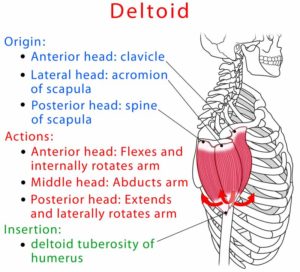
The Primary Joint Actions of Each Deltoid Head
Let's dissect the specific movements produced by each head. The following video provides a concise and clear anatomical explanation of these actions.
Deltoid Muscle Anatomy | AnatomyZone
This video from AnatomyZone breaks down the primary movements created by each of the three deltoid heads. As you watch, connect the action you see on screen to the fiber direction of the muscle part being discussed.
Watch the segment from 01:54 to 02:49. Pay close attention to the specific terms used: flexion and medial rotation (anterior), abduction (lateral), and extension and lateral rotation (posterior).
Building on that video, let's detail these actions and introduce a few more that are critical for training.
1. Anterior Deltoid
As its origin is on the clavicle (front of the body), the anterior deltoid pulls the arm forward and across the body.
- Shoulder Flexion: Lifting the arm straight up in front of you (e.g., a front raise).
- Horizontal Adduction (or Horizontal Flexion): Moving the arm across the chest in the horizontal plane (e.g., the top of a dumbbell fly movement).
- Medial (Internal) Rotation: Turning the humerus inward toward the body's midline.
- Role: The anterior deltoid is a prime mover in shoulder flexion and a powerful synergist to the pectoralis major in horizontal adduction (like in a bench press).
2. Lateral Deltoid
With its origin on the acromion (the bony point at the top/side of the shoulder), this head has the most direct line of pull for moving the arm away from the body.
- Shoulder Abduction: Lifting the arm straight out to the side (e.g., a lateral raise).
- Role: The lateral deltoid is the prime mover for shoulder abduction, especially after the first 15 degrees of motion (which is initiated by a rotator cuff muscle, the supraspinatus). It is the muscle most responsible for creating shoulder width.
3. Posterior Deltoid
Originating on the spine of the scapula (back of the shoulder blade), this head pulls the arm backward.
- Shoulder Extension: Pulling the arm backward from a flexed position (e.g., the pulling motion in rowing).
- Horizontal Abduction (or Horizontal Extension): Moving the arm away from the chest in the horizontal plane (e.g., a reverse pec-deck or bent-over raise).
- Lateral (External) Rotation: Turning the humerus outward, away from the body's midline.
- Role: The posterior deltoid is a prime mover in horizontal abduction and a key synergist to the latissimus dorsi and other back muscles during shoulder extension (pulling/rowing movements).
For a slightly different perspective that reinforces these concepts, especially the horizontal plane movements, the following video is helpful.
Shoulders Hypertrophy Training Fundamentals
The Flow High Performance channel provides another excellent breakdown, using slightly different terminology ('horizontal flexion' and 'horizontal extension') that is common in coaching.
Watch from 01:10 to 02:21. Notice how this explanation clearly separates movements in the sagittal plane (flexion/extension) from those in the transverse plane (horizontal flexion/extension).
Classifying Deltoid Roles in Compound Exercises
Understanding the primary actions allows us to analyze how the deltoids function during complex, multi-joint exercises. A muscle's role can change from prime mover to synergist to stabilizer depending on the movement.
This article from the National Federation of Personal Trainers (NFPT) provides an excellent breakdown of how the deltoid heads contribute to common push and pull exercises. It's a great resource for connecting anatomical theory to gym application.
First, read the section 'What About Push-Ups?' to see a clear analysis of each deltoid head's role in a basic bodyweight movement. Then, read the section 'When to Train Shoulders: Push Day versus Pull Day' for a summary of how each head contributes to broader categories of pushing and pulling exercises.
Let's synthesize this information into a quick-reference table for common lifts:
| Exercise | Anterior Deltoid Role | Lateral Deltoid Role | Posterior Deltoid Role |
|---|---|---|---|
| Overhead Press | Prime Mover (Flexion) | Prime Mover (Abduction) | Stabilizer |
| Bench/Incline Press | Synergist (Horizontal Adduction) | Stabilizer | Stabilizer |
| Push-Up | Synergist (Horizontal Adduction) | Stabilizer | Stabilizer |
| Bent-Over Row | Stabilizer | Stabilizer | Synergist (Shoulder Extension) |
| Lateral Raise | Synergist/Stabilizer | Prime Mover (Abduction) | Synergist/Stabilizer |
| Face Pull | Stabilizer | Synergist (Abduction) | Prime Mover (Horiz. Abduction, Ext. Rotation) |
As you can see, no deltoid head ever truly works in isolation. In virtually every upper body movement, all three heads are active to some degree to move and stabilize the highly mobile glenohumeral joint.
Advanced Concept: The Impact of Humeral Rotation
Given your background in analyzing complex systems, you'll appreciate that our model has another variable: humeral rotation. Rotating your upper arm (either internally or externally) changes the line of pull of the muscle fibers relative to the direction of force, thereby altering which head is biased.
This is a subtle but critical concept for precise coaching and exercise selection.
Shoulders Hypertrophy Training Fundamentals
Let's return to the Flow High Performance video, which does an excellent job demonstrating this principle in action.
Watch the segment from 02:10 to 02:53. Pay close attention to the examples given. Notice how simply rotating the hand from 'palms down' to 'palms forward' during a lateral raise shifts the emphasis from the lateral deltoid to the anterior deltoid.
Here's the logical breakdown:
- External Rotation (palms forward/thumb up) moves the insertion point of the anterior deltoid into a more favorable line of pull for abduction.
- Internal Rotation (palms backward/thumb down) moves the insertion point of the posterior deltoid into a more favorable line of pull for abduction.
Practical Application for Coaching:
- To bias the lateral deltoid during a lateral raise: Keep the humerus in a neutral or slightly internally rotated position (imagine pouring a jug of water).
- To bias the anterior deltoid during a raise: Use a more supinated grip (palms forward) or perform the raise in the "scapular plane" (about 30 degrees in front of the torso).
- To bias the posterior deltoid during a reverse fly: Keep the humerus in a neutral or slightly internally rotated position. Excessive external rotation can shift some of the work to the lateral deltoid and other external rotators of the rotator cuff.
Conclusion
In this lesson, you bridged the gap between anatomical structure and muscular function. You can now confidently identify how each deltoid head moves the shoulder joint and how they work together during compound exercises.
Key Takeaways:
- A muscle's action is a direct result of its line of pull, which is determined by its origin, insertion, and fiber direction.
- Anterior Deltoid: Prime mover for shoulder flexion and horizontal adduction.
- Lateral Deltoid: Prime mover for shoulder abduction.
- Posterior Deltoid: Prime mover for shoulder extension and horizontal abduction.
- In compound movements, deltoid heads take on different roles: prime mover, synergist, or stabilizer.
- Subtle changes in humeral rotation can significantly alter which deltoid head is preferentially targeted during an exercise.
Preview for the Next Lesson
We have now defined the structure and actions of the deltoids. The next logical question for a hypertrophy-focused coach is: "How do we best load these actions to cause growth?" In the next lesson, we will explore the lengthened and shortened positions of each deltoid head. This will allow us to understand why certain exercises create more tension on specific parts of the muscle, a key principle for intelligent exercise selection and maximizing growth.