¡Hola! Welcome back.
In our last two lessons, we discovered the power of cognates for quickly building your English vocabulary. You learned to identify perfect cognates (like animal) and near-perfect cognates (like nación -> nation).
Today, we focus on a topic you've expressed interest in: pronunciation. While recognizing these words in writing is a huge advantage, understanding and using them in conversation requires another step. Our goal is to recognize that even identically spelled cognates often have different pronunciation in English. We will explore some common and predictable differences, especially in syllable stress, that will help you sound more natural and better understand spoken English.
Spelling is Not Sound
The most important rule to learn today is that identical spelling does not mean identical pronunciation. In Spanish, the way a word is spelled tells you almost exactly how to say it. In English, this is not always true.
For perfect cognates, the letters are the same, but the sounds and rhythm are different. Let's see and hear this in action.
¡YA SABES INGLÉS! | 250 COGNADOS entre INGLÉS y ESPAÑOL | Superholly
The YouTuber Superholly provides a fantastic demonstration of this concept. In this clip, she lists many perfect cognates and pronounces them clearly in English. Listen carefully to how different they sound from their Spanish counterparts.
Watch the video from 02:05 to 03:56. You don't need to memorize every word. Just listen to the rhythm and sounds of the English words. Notice how words like 'animal', 'control', 'general', and 'local' are pronounced.
As you heard, even a simple word like animal sounds quite different. Why is that? The two main reasons are syllable stress and different vowel and consonant sounds.
The Stress Shift: Finding the Rhythm of a Word
One of the biggest differences between Spanish and English pronunciation is syllable stress (la sílaba tónica). In Spanish, for words ending in a consonant (except -n or -s), the stress is usually on the last syllable. In English, the stress is often on the first or second syllable.
This creates a different rhythm. Let's look at a very common pattern.
100 Words That Are Identical in Spanish and English
The article '100 Words That Are Identical in Spanish and English' from Yabla Spanish explains this concept very clearly. It points out a specific, useful pattern for words ending in '-or'.
Read the introduction and the section titled 'Words ending in ‘or’'. Pay close attention to the sentence that describes the difference in stress between the Spanish and English words.
The article highlights a fantastic rule of thumb: For many cognates ending in -or, the Spanish stress is on the final syllable, while the English stress is on the first.
Let's break down the examples from the article:
actor(Spanish: ac-TOR) → English: AC-torcolor(Spanish: co-LOR) → English: CO-lordoctor(Spanish: doc-TOR) → English: DOC-torerror(Spanish: e-RROR) → English: E-rror
This stress shift is a fundamental pattern. Applying it will immediately make your pronunciation of these words much closer to a native English speaker's.
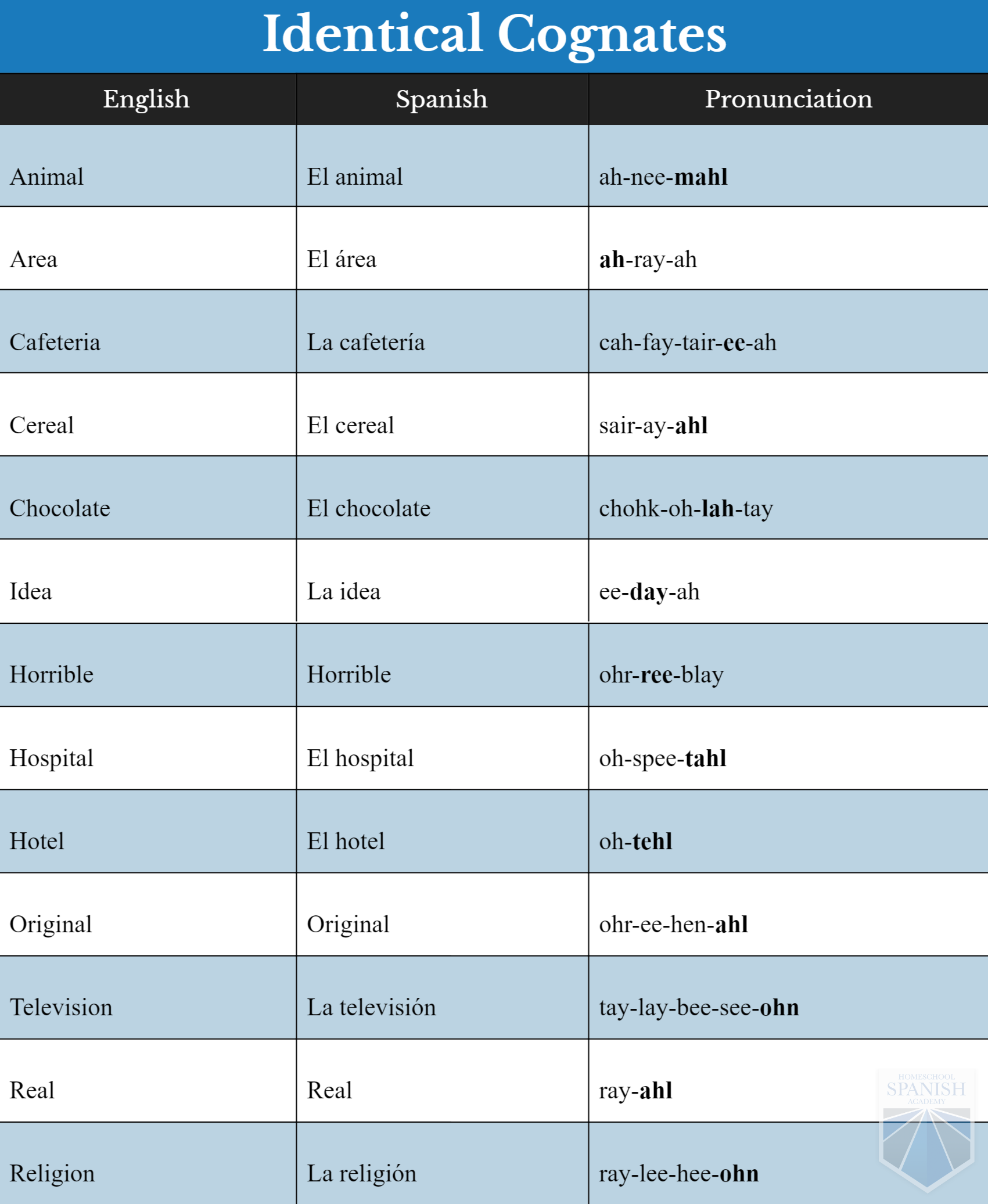
The table below shows more examples of perfect cognates. Notice the "Pronunciation" column, where the stressed syllable is in bold. You can see this pattern in words like AN-i-mal and HOS-pi-tal.
Test your understanding!
Based on the pattern we just discussed for words ending in -or, where would you expect the stress to be in the English pronunciation of the following words?
motorhorrorsector
Show answer
You should expect the stress to be on the first syllable for all of them:
- MO-tor
- HO-rror
- SEC-tor
Common Changes in Letter Sounds
Besides stress, the actual sounds of the letters change. Here are a few key differences to listen for.
Vowel Sounds
Spanish vowels are pure and consistent (a, e, i, o, u). English vowel sounds are more varied. For example:
- The 'a' in the Spanish word
animalis a pure /a/ sound. - The 'a' in the English word
animalis an /æ/ sound, like in the wordcat.
You don't need to learn phonetic symbols right now. The important thing is to listen for the difference and try to imitate it.
Consonant Sounds
Some consonants also change significantly.
- The letter 'h': In Spanish, the 'h' is silent (e.g.,
hotel,horror,hospital). In English, it is pronounced with a puff of air at the beginning of the word. - The letter 'r': The Spanish 'r' is often tapped or rolled. The English 'r' is softer and made with the back of the tongue. Listen to the difference between
real(Spanish) andreal(English). - The letters 'l' and 'll': In Spanish, 'l' is one sound and 'll' is another. In English, both 'l' and 'll' are pronounced the same, as in
legalandillegal.
Let's watch one more short video that demonstrates these pronunciation differences with perfect cognates.
EL ESPAÑOL ES INGLÉS: palabras cognadas entre inglés y español
This clip from 'Inglés con el Güero' reinforces the idea that pronunciation is different. He gives clear examples of words you've already seen, like 'animal' and 'normal', allowing you to hear the differences again.
Watch the clip from 01:39 to 02:40. He discusses words ending in '-al' and '-ble'. Listen to his pronunciation of 'animal', 'principal', 'normal', and 'probable'.
Conclusion
You have made excellent progress today in moving from simply recognizing cognates to understanding how to pronounce them.
Key Takeaways:
- Identical spelling does not mean identical pronunciation. This is the most important rule.
- The main differences are in syllable stress and the sounds of individual vowels and consonants.
- You learned a common pattern: For many cognates ending in
-or, the stress shifts from the last syllable in Spanish to the first in English (e.g.,doc-TOR→DOC-tor). - Key consonant sounds change, especially the pronounced 'h' in English.
In our next lesson, we will tackle an exciting and important challenge: false friends (falsos amigos). These are words that look like cognates but have very different meanings. Learning to spot them is crucial for avoiding common and sometimes embarrassing mistakes.