¡Hola! Welcome back to our course on English-Spanish cognates.
In our last lesson, we learned that cognates are a fantastic shortcut for building your English vocabulary. We focused on "perfect cognates"—words that are spelled exactly the same in both languages, like animal and doctor.
Today, we're going to expand this concept. Our goal is to differentiate between perfect cognates and near-perfect cognates. You will learn to recognize words that are not identical but have very small and predictable spelling changes. Mastering this distinction will open up thousands more English words to you.
Review: Perfect Cognates
Let's quickly refresh our memory. Perfect cognates are words that have identical spelling in both English and Spanish. The only minor difference might be an accent mark in Spanish (like región vs. region), but the letters are the same. Their meaning is also the same, though the pronunciation is different.
Here is a great visual summary of some common perfect cognates. Notice the identical spellings.
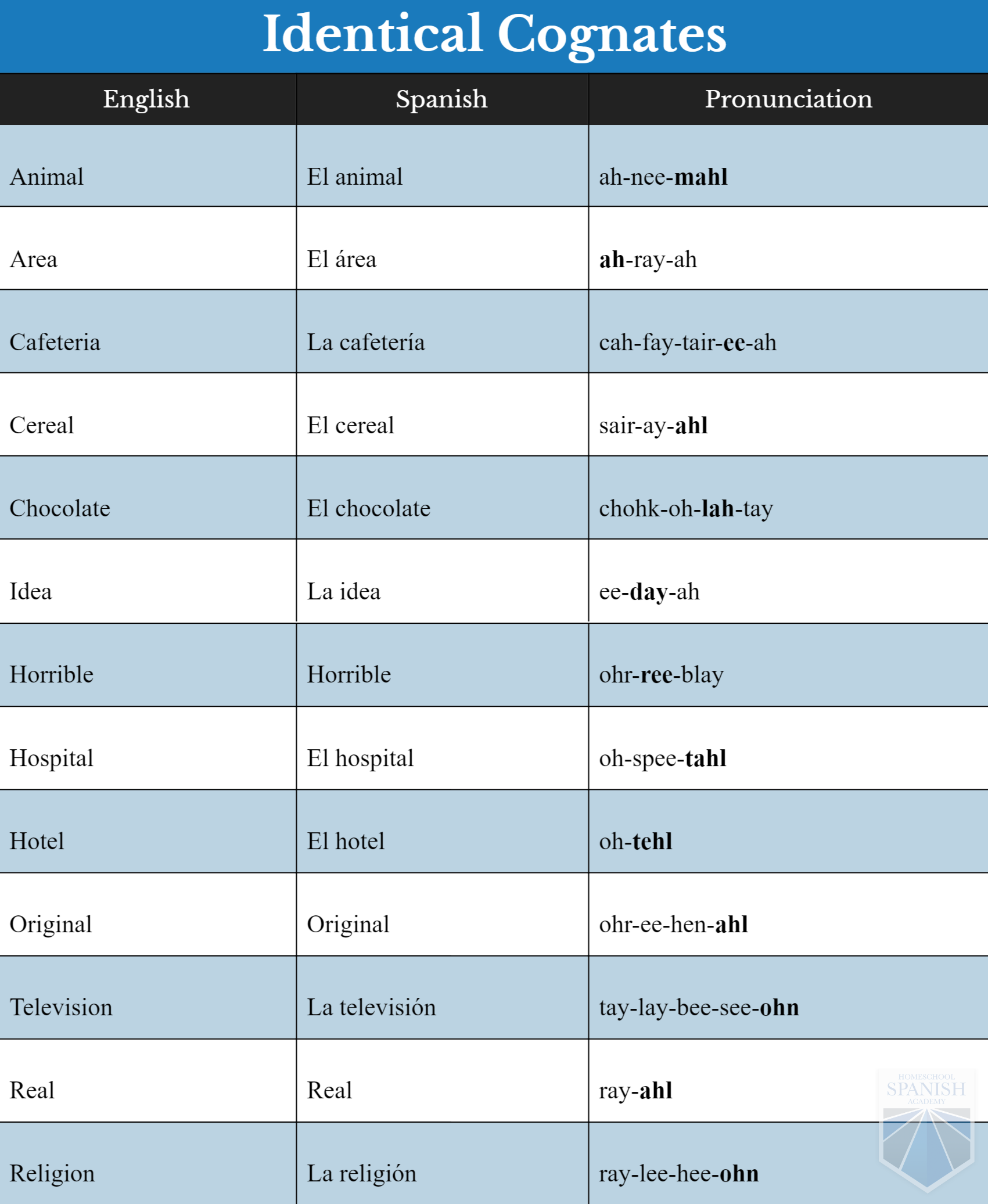
To see just how many of these there are, let's explore a more extensive list.
1001 Spanish Words You Already Know – A Guide To English-Spanish Cognates
The article '1001 Spanish Words You Already Know' from Real Fast Spanish provides a very clear definition and a long list of perfect cognates. Seeing the length of this list will help you appreciate how much vocabulary you already have access to.
Please read the section titled 'Perfect Cognates'. Don't worry about memorizing every word. Just scan the list and notice how many familiar words you see. Pay attention to examples like 'animal', 'chocolate', 'hotel', and 'idea'.
Introducing Near-Perfect Cognates
Now, let's move on to the main topic of today's lesson. What happens when a word looks very similar, but isn't exactly the same? These are called near-perfect cognates.
A simple way to define them is:
Near-perfect cognates are words that look and mean the same thing but have a small spelling difference, usually involving just one to three letters.
Crucially, these differences are not random. They often follow predictable patterns based on word endings (suffixes). If you learn the pattern, you can predict the English word from the Spanish one.
The article from Preply provides a good introduction to this idea.
130 cognados en español con PDF y ejemplos claros
This article from Preply clearly separates perfect cognates from 'casi perfectos' (almost perfect). It's a great resource for seeing the two types side-by-side.
Read the section titled 'Lista de cognados casi perfectos en español'. Look at the tables that show how Spanish endings like '-cto' or '-ico' correspond to English endings like '-ct' and '-ic'.
Unlocking the Patterns of Near-Perfect Cognates
The real power of near-perfect cognates comes from learning the patterns. Once you know a pattern, you can apply it to many words. Let's explore a few of the most common ones.
Pattern 1: Spanish -ción becomes English -tion
This is one of the most useful patterns. Thousands of Spanish nouns ending in -ción have an English cognate ending in -tion.
atención→ attentionnación→ nationinformación→ information
The following video clip gives many more examples. Listen to the English pronunciation of the "-tion" ending, which sounds like "shun".
¡YA SABES INGLÉS! | 250 COGNADOS entre INGLÉS y ESPAÑOL | Superholly
In this video, Superholly provides an excellent list of cognates following the -ción to -tion pattern. This will help you see just how common this transformation is.
Watch the section from 10:34 to 13:06. Pay close attention to how she pronounces the English words. Notice how consistently the pattern works.
Pattern 2: Spanish -dad becomes English -ty
This is another very common pattern for nouns.
universidad→ universityactividad→ activitycuriosidad→ curiosity
Notice that the pronunciation of "-ty" in American English often sounds like a soft "d" sound: /di/.
Pattern 3: Spanish adjective endings change slightly
Many adjectives also follow simple patterns. For example, you often just need to remove the final vowel.
- Adjectives ending in
-osooften become-ousin English:famoso→ famous - Adjectives ending in
-icooften become-icin English:clásico→ classic - Adjectives ending in
-ctooften become-ctin English:perfecto→ perfect
This next video clip demonstrates these and other patterns with many useful examples.
EL ESPAÑOL ES INGLÉS: palabras cognadas entre inglés y español
Let's watch this clip from 'Inglés con el Güero'. It covers several of these near-perfect cognate patterns in a very clear and direct way.
Watch from 03:45 to 08:35. Focus on the rules he explains for changing word endings, such as '-mento' to '-ment', '-ismo' to '-ism', '-oso' to '-ous', and '-dad' to '-ty'.
Visual Summary & Practice
This image provides a nice summary of a few near-perfect cognates and, importantly, includes pronunciation guides, which is something you're interested in.

Now, let's see if you can tell the difference between perfect and near-perfect cognates.
Test your understanding!
Look at the Spanish words below. For each one, decide if its English cognate is perfect (identical spelling) or near-perfect (small spelling change). If you think it's near-perfect, try to write the English word based on the patterns we've discussed.
horriblecondiciónpopularnecesariodiferente
Show answer
- Perfect. The English word is horrible.
- Near-perfect. The
-ciónending changes to-tion. The English word is condition. - Perfect. The English word is popular.
- Near-perfect. The
-arioending changes to-ary. The English word is necessary. - Near-perfect. The
-enteending changes to-ent. The English word is different.
Conclusion
Great work today! You've taken a big step in learning how to unlock English vocabulary.
Here are the key takeaways from this lesson:
- Perfect cognates have identical spelling in both languages (e.g.,
hotel,central). - Near-perfect cognates have minor, predictable spelling differences, often in the suffix (e.g.,
nación→nation,curiosidad→curiosity). - Learning the patterns of these changes is the key to identifying thousands of English words.
In our next lesson, we will focus on a crucial aspect you've already had a preview of: pronunciation. Even when words are spelled identically, they are pronounced differently in English. We will explore some common rules to help you pronounce cognates correctly and confidently.