¡Hola! Welcome to your first lesson.
In this lesson, we will begin our journey into the world of English-Spanish cognates. Our goal is to understand exactly what a cognate is and, most importantly, why cognates are an incredibly powerful tool for you to rapidly expand your English vocabulary. Think of this as learning a secret code that instantly unlocks thousands of English words you already know. This foundational knowledge will be the key to all the patterns and tricks we'll learn in the rest of the course.
What is a Cognate?
Let's start with a clear definition. A cognate is a word that has a similar spelling, pronunciation, and meaning in two different languages because they share a common origin. For Spanish and English, this common origin is often the Latin language.
To get a feel for this concept, let's watch a short video that introduces cognates and explains why they exist between our two languages.
EL ESPAÑOL ES INGLÉS: palabras cognadas entre inglés y español
The presenter in this video from the 'Inglés con el Güero' channel will explain what cognates (palabras cognadas) are and how they can help you build vocabulary very quickly. He also explains the shared Latin roots of English and Spanish.
Please watch from the beginning until timestamp 01:39. Pay attention to his definition of cognates and the explanation of why English and Spanish share so many similar words.
To reinforce this definition, here is a short text that explains the concept in writing.
Aprende que son los cognados en inglés
This article, 'Aprende que son los cognados en inglés' from Speak5, provides a clear, written definition of cognates and their historical context.
Read the section titled 'Qué son los cognados'. This will solidify your understanding of the term and the linguistic connection between English and Spanish.
In simple terms: if you see an English word that looks like a Spanish word you know, and it means the same thing, you've found a cognate!
The Practical Value: Your Vocabulary Shortcut
So, why are we focusing an entire course on this? The practical value is immense. Learning to recognize cognates is the single fastest way for a Spanish speaker to build a large base of English vocabulary.
How large? Some linguistic studies estimate that 30-40% of all words in English have a related word in Spanish. This means you already have a starting point for understanding almost half of the English language.
The following text details the specific benefits you'll gain by mastering cognates.
Aprende que son los cognados en inglés
Let's return to the Speak5 article to explore the practical benefits of using cognates.
Read the section titled '¿Cómo pueden los cognados ayudarme a aprender inglés más rápido?'. Focus on the five key benefits listed: vocabulary recognition, comprehension, confidence, pronunciation, and building connections.
As the article explains, by using cognates you can:
- Recognize vocabulary instantly without a dictionary.
- Improve your reading comprehension by guessing the meaning of words from context.
- Gain confidence by realizing how much English you can already understand.
Let's watch the end of the first video to hear this point emphasized once more. The presenter gives a statistic that powerfully illustrates this vocabulary-building shortcut.
EL ESPAÑOL ES INGLÉS: palabras cognadas entre inglés y español
The presenter from 'Inglés con el Güero' concludes by highlighting what percentage of English and Spanish consists of cognates.
Watch the clip from 11:02 to 11:31. Note the percentage he gives. While estimates vary, the main point is that the number is very large!
Seeing Cognates in Action: Perfect Cognates
The easiest cognates to spot are "perfect cognates"—words that are spelled exactly the same in both English and Spanish. The main difference is the pronunciation.
For example:
- animal (Spanish) -> animal (English)
- color (Spanish) -> color (English)
- doctor (Spanish) -> doctor (English)
The video below gives many more examples. As you watch, listen carefully to the English pronunciation. This is a theme we will return to again and again, as it's a key part of using cognates correctly.
¡YA SABES INGLÉS! | 250 COGNADOS entre INGLÉS y ESPAÑOL | Superholly
This video from Superholly provides a long list of perfect cognates. It's a great way to see just how many words are identical in spelling.
Watch the section from 01:35 to 03:56. You don't need to memorize every word. The goal is to see the pattern and hear the difference in pronunciation between the Spanish you know and the English version.
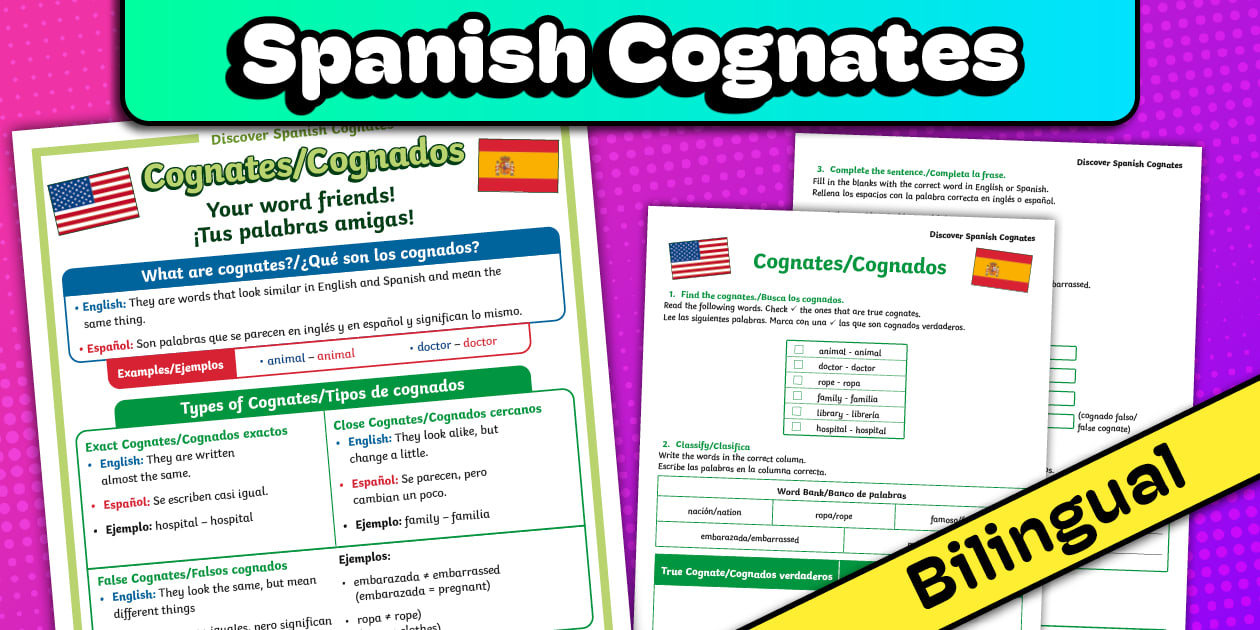
This image provides a nice visual summary of what we've just discussed, showing examples of "Exact Cognates."
Test your understanding!
Based on what you've just learned about perfect cognates, what is the English word for the following Spanish words?
naturalideatotalcentral
Show answer
Because these are all perfect cognates, the spelling is identical:
- natural
- idea
- total
- central
The key is to practice the English pronunciation for each one!
Conclusion
In this lesson, we established the foundation for our course. Here are the key takeaways:
- Cognates are words in English and Spanish that share a similar spelling and meaning due to a common linguistic root (often Latin).
- Their practical value is enormous: recognizing them can give you an instant vocabulary of thousands of words, boosting your comprehension and confidence.
- The simplest type is the perfect cognate, which is spelled identically in both languages (e.g.,
animal,doctor).
You now have the basic concept down. In our next lesson, we will build on this by exploring near-perfect cognates—words that have small but very predictable spelling changes. This is where we will start learning the patterns that truly unlock your vocabulary-building superpower.