¡Hola! Welcome to our next lesson.
In our previous lessons, we explored the helpful connection between Spanish and English through cognates—words that look similar and share the same meaning. We saw that even when words are spelled identically, their pronunciation often changes. This knowledge is a powerful tool for building your vocabulary.
Today, we will address a very important topic you were interested in: the tricky side of cognates. We'll focus on words that look like friends but are not. The learning goal for this lesson is to define 'false friends' (false cognates) and understand why they are a common pitfall for Spanish speakers. Mastering this concept is essential for avoiding confusion and communicating more accurately.
What Are "False Friends"?
While many similar-looking words are your friends (cognados verdaderos), some are "false friends" (falsos amigos or falsos cognados).
A false friend is a word that looks or sounds very similar in two languages but has a completely different meaning.
Relying on these words as if they were true cognates can lead to funny, and sometimes embarrassing, misunderstandings.
To begin, let's watch a short video where presenter Superholly introduces this idea in a very clear way.
¡Estas palabras son POSERS! | 10 FALSOS COGNADOS en INGLÉS
In this clip, Superholly explains the concept of 'false friends' or 'posers'—words that look like cognates but aren't. She explains that while true cognates make learning English easier, false cognates are traps you need to watch out for.
Watch the video from the beginning until 01:36. Pay attention to how she defines both true cognates (cognados reales) and false cognates (falsos amigos).
As she explains, both Spanish and English took many words from Latin. Over centuries, while the spellings remained similar, the meanings evolved differently in each language. This is the origin of false friends.
Why Are False Friends a Common Pitfall?
Understanding false friends is crucial for a few key reasons. Let's look at an article that explains why they are such a common problem for learners.
Spanish False Friends: Avoid These Errors English ...
This article, 'Spanish False Friends', clearly defines what false friends are and why they are important to learn early.
Please read the first three short sections: 'What Are False Friends?', 'Example', and 'Why False Friends Matter'.
The article highlights three main reasons why false friends are a significant challenge:
- They are common words. You will encounter them frequently in everyday conversation.
- They cause awkward mistakes. Using a false friend can change the meaning of your sentence entirely, leading to confusion.
- Learning them improves your credibility. When you use these words correctly, you show a deeper understanding of English.
High-Impact Examples: The Hall of Shame
Let's look at some of the most common and tricky false friends. The infographic below shows ten examples that often confuse Spanish speakers.
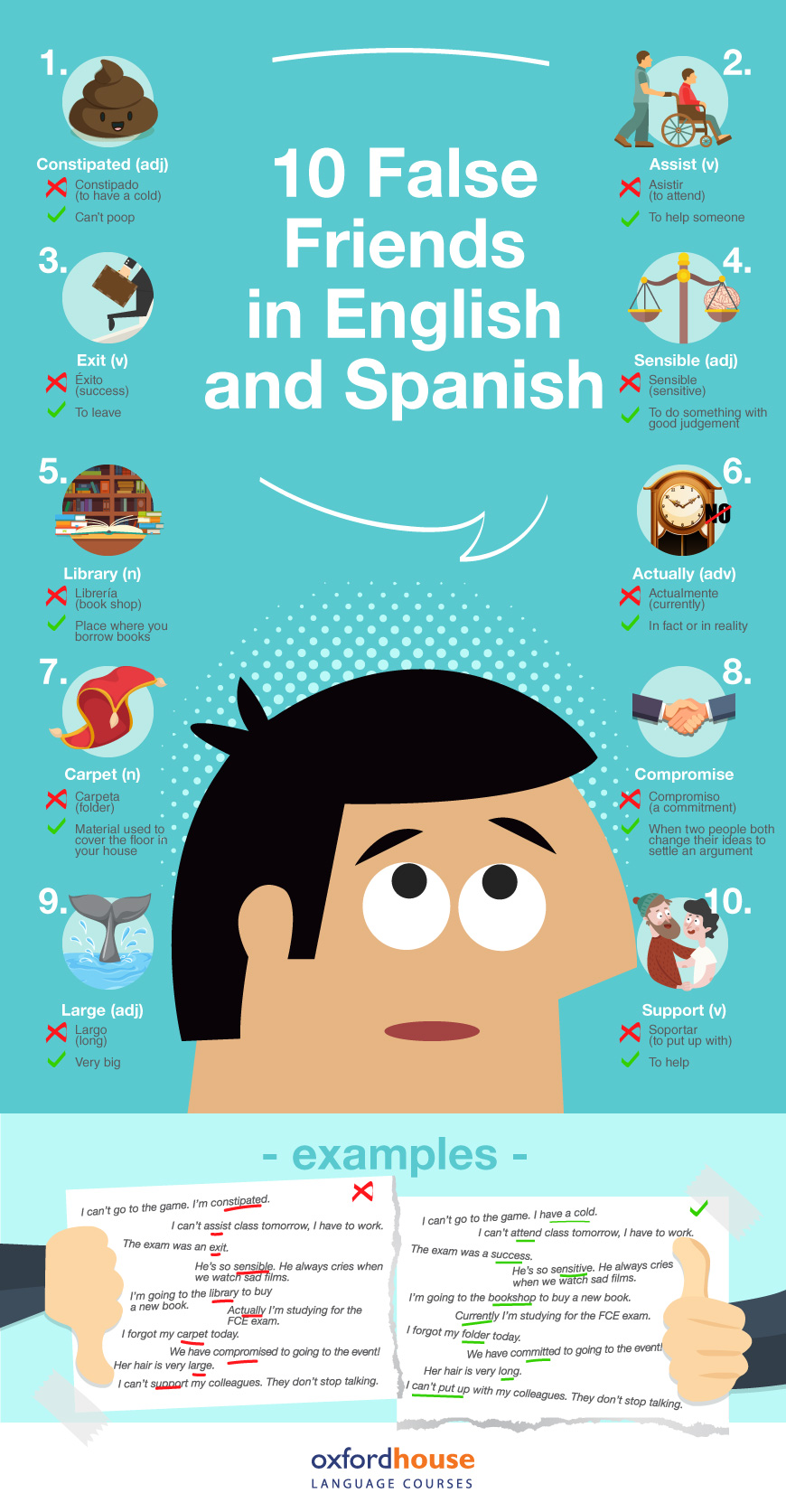
Let's discuss a few of these in more detail, as they are extremely common.
1. Embarrassed vs. Embarazada
This is perhaps the most famous false friend.
Embarrassed(English) means to feel ashamed or shy (avergonzado/a).- Example: "I was so embarrassed when I forgot his name."
Embarazada(Spanish) means pregnant. The English word ispregnant.- Example: "My sister is pregnant with her first child."
2. Actual vs. Actual
These words are spelled identically but have different meanings.
Actual(English) means real or in fact (real or de hecho).- Example: "The actual cost was higher than the estimate."
Actual(Spanish) means current or present-day. The English word iscurrent.- Example: "What is your current address?" (¿Cuál es tu dirección actual?)
3. Realize vs. Realizar
This pair often confuses learners because of the verb ending.
Realize(English) means to become aware of something (darse cuenta de algo).- Example: "I didn't realize it was so late."
Realizar(Spanish) means to carry out, do, or perform something. The English words areto carry outorto perform.- Example: "The scientists will perform an experiment." (Los científicos van a realizar un experimento.)
Test your understanding!
Imagine you are trying to translate the following Spanish sentences into English. Which English word is correct?
-
"Mi hermano se siente avergonzado por su error."
- a) embarrassed
- b) pregnant
-
"Voy a realizar mis tareas ahora."
- a) realize
- b) do
-
"El presidente actual dará un discurso."
- a) actual
- b) current
Show answer
- a) embarrassed
- b) do
- b) current
More Examples to Watch Out For
The list of false friends is long, but focusing on the most common ones will prevent the majority of mistakes. Let's watch one more video that presents some simple but very common examples you might encounter.
🔴 False friends in English: evita confusiones con palabras similares al español
In this video from Francisco Ochoa Inglés Fácil, you'll see more examples of common false friends that are very relevant for beginners.
Please watch two short clips from the video: From 03:37 to 04:07 to see the difference between large (grande) and largo (long). From 06:12 to 07:09 to understand the difference between parents (padres) and parientes (relatives).
As you can see, even simple words can be deceptive. The key is to be aware that this possibility exists. When you see a word in English that looks very familiar from Spanish, it's a good practice to pause and confirm its meaning, especially if the context seems strange.
Conclusion
Today you've learned about a critical concept for any Spanish speaker learning English. By understanding false friends, you can avoid common traps and build your vocabulary on a more solid foundation.
Key Takeaways:
- False friends (falsos amigos) are words in English and Spanish that look similar but have different meanings.
- They exist because the two languages borrowed from the same roots (like Latin), but the words' meanings changed over time.
- Relying on them is a common pitfall that can lead to confusion and embarrassing mistakes. We saw famous examples like
embarrassed/embarazada,actual/current, andparents/parientes.
In our next lesson, we will move on to the first module of "Noun Cognate Patterns." We'll start with a very reliable and useful pattern: how to convert Spanish nouns ending in -ción into English nouns ending in -tion (e.g., atención -> attention). This will give you a tool to correctly identify and use dozens of new English words.