¡Hola! Let's continue our journey into the world of cognates.
In our last lesson, we learned how to identify "false friends" (falsos amigos)—those tricky words that look like they should mean the same thing in English and Spanish, but don't. You learned to recognize that words like embarrassed and actually are not what they seem.
Today, we're taking the next crucial step. Our goal is to explain the correct English meaning of common false friends and their true Spanish equivalent. Instead of just knowing that actually is a trap, you'll learn that it means en realidad, and that the word for actualmente is currently. This will give you the confidence to understand these words correctly when you see them.
The Two-Way Street of False Friends
Mastering false friends is like learning a new traffic rule. For every pair, there are two directions of confusion. Let's take the example of library and librería:
- A Spanish speaker might see the English word
libraryand think it meanslibrería(a place to buy books). - An English speaker might see the Spanish word
libreríaand think it meanslibrary(a place to borrow books).
To avoid any confusion, you need to learn both correct translations:
- The English word
librarymeansbiblioteca. - The Spanish word
libreríameansbookstorein English.
By learning both sides, you protect yourself from misunderstanding no matter which language you are reading.
A Visual Guide to Common False Friends
Infographics can be a great way to see these differences clearly. The image below shows many common false friends and lays out their true meanings in both languages.
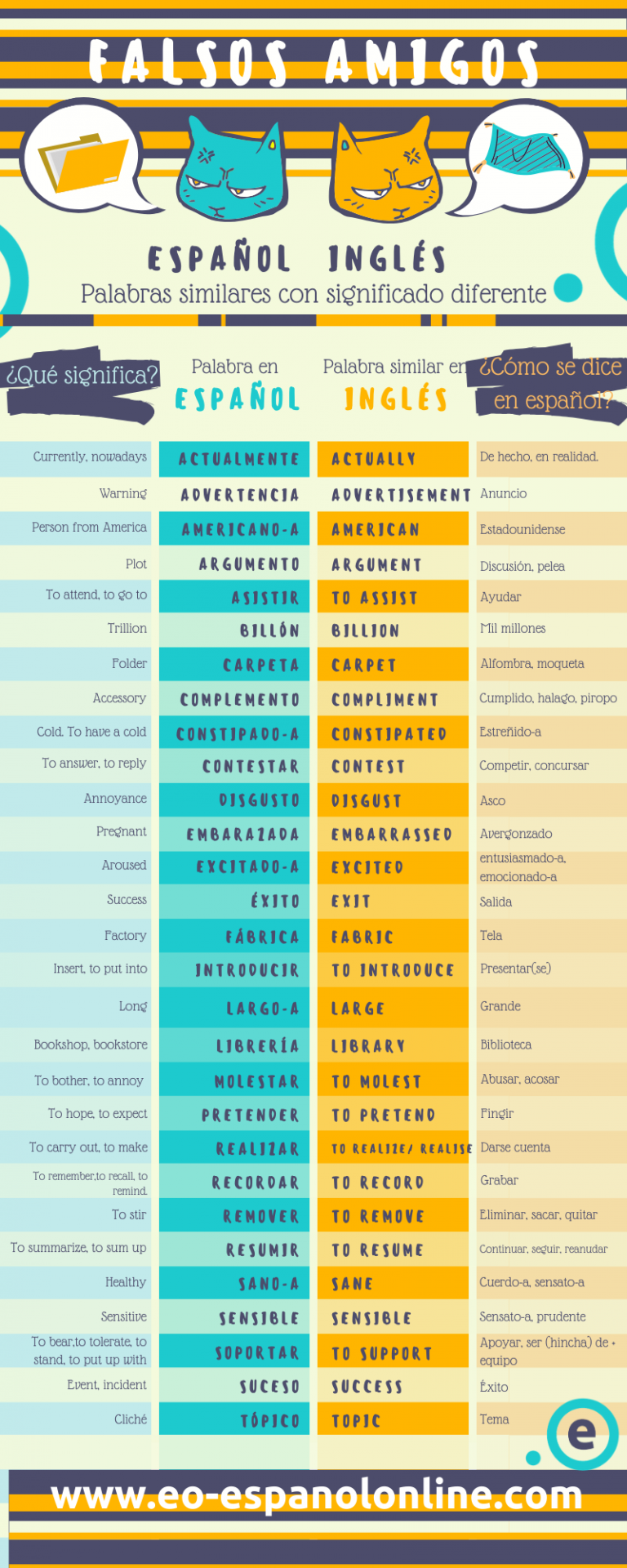
Take a moment to study a few pairs from the infographic, such as:
- Éxito (success) vs. Exit (salida)
- Soportar (to tolerate/stand) vs. Support (apoyar)
- Sensible (sensitive) vs. Sensible (sensato)
Notice how each word has a completely different partner in the other language.
Hearing the Explanations
Listening to explanations can help reinforce the new meanings in your mind. The following video was made for Spanish speakers learning English and explains some of the most important false friends very clearly.
VOCABULARIO EN INGLÉS: falsos amigos o falsos cognados
Let's watch a few clips from the video 'VOCABULARIO EN INGLÉS: falsos amigos o falsos cognados' by Inglés con el Güero. The presenter does an excellent job of explaining the confusion and giving correct examples.
Please watch the following short segments. Pay attention to the correct Spanish meaning for each English word and the example sentences he provides. embarrassed vs. embarazada (from 01:48 to 02:33) actually vs. actualmente (from 02:33 to 03:10) attend vs. assist (from 03:10 to 04:00) molest vs. molestar (from 05:04 to 06:08) - This is a very important one to know, as the mistake can be very serious.
As the video shows, some mistakes with false friends are just minor and a bit funny, but others, like with the word molest, can cause very serious misunderstandings. This is why learning them properly is so important.
Building Your Reference List
It would be impossible to memorize all false friends at once. A better approach is to study a list of the most common ones and use it as a reference.
The article below provides a fantastic, well-organized list.
100 False Friends In English And Spanish (With Examples)
The webpage '100 False Friends In English And Spanish' from Online Teachers UK has a comprehensive table that we will use. It shows the English word, its correct meaning, and an example sentence.
Please go to the section titled 'List of 100 English-Spanish False Friends'. Read the first 30 entries in the table, from 'Actually' down to 'Condescend'. For each one, notice the English word, the 'Correct meaning', and the example sentence. Don't worry about memorizing them all; the goal is to familiarize yourself with the true meanings of these common words.
This list is a tool you can return to whenever you encounter a word you're unsure about. The habit of checking is what will make you a more accurate reader of English.
Test your understanding!
Let's check your understanding of these two-way meanings. Fill in the blanks with the correct Spanish or English word.
- The English word
carpetmeans ______ in Spanish. The English word for the Spanishcarpetais ______. - The English word
realizemeans ______ in Spanish. The English word for the Spanishrealizar(to perform an action) is ______. - The English word
sensible(meaning reasonable orsensato) should not be confused with the Spanishsensible, which means ______ in English.
Show answer
- The English word
carpetmeansalfombrain Spanish. The English word for the Spanishcarpetaisfolder. - The English word
realizemeansdarse cuentain Spanish. The English word for the Spanishrealizaristo performorto carry out. - The English word
sensibleshould not be confused with the Spanishsensible, which meanssensitivein English.
Conclusion
Excellent work today! You have moved from simply identifying false friends to actively understanding their correct meanings in both English and Spanish. This is a critical skill for avoiding misunderstandings and building an accurate vocabulary.
Key Takeaways:
- Mastering false friends is a two-way process: you need to know both the true meaning of the English word and the correct English word for the similar-looking Spanish term.
- The most common false friends can cause big confusion. Remember these key pairs:
- Actually (
en realidad) vs. Currently (actualmente) - Embarrassed (
avergonzado/a) vs. Pregnant (embarazada) - Support (
apoyar) vs. Tolerate/Stand (soportar) - Library (
biblioteca) vs. Bookstore (librería)
- Actually (
- When in doubt, always check! Using a reference list is a smart strategy.
In our next lesson, we will put this knowledge into practice. You will learn to use context clues in a sentence to determine if a word you're reading is a true cognate or a potential false friend. This will help you apply what you've learned to real-world reading.