¡Hola! Welcome to your next lesson on navigating the tricky world of English and Spanish cognates.
In our last lesson, you learned to identify many common "false friends" and, crucially, to explain their correct English meanings and their true Spanish equivalents. For example, you now know that actually means en realidad, not actualmente.
Today, we will build on that knowledge. Our goal is to learn how to use context clues to differentiate between a true cognate and a potential false friend in a sentence. This is a very powerful skill. You won't always have a dictionary, and you can't memorize every false friend. Learning to use the context—the words around a word—will help you become a more confident and accurate reader.
What are Context Clues?
"Context" is simply the information surrounding a word in a sentence or paragraph. These surrounding words give you clues or hints about the word's meaning.
Think about the Spanish word banco. It can mean a bank (where you get money) or a bench (where you sit). How do you know which one it is? You use the context!
- Fui al banco para sacar dinero. (Here, "sacar dinero" tells you it's a bank).
- Me senté en un banco en el parque. (Here, "me senté" and "en el parque" tell you it's a bench).
We will use this same logic to figure out English false friends. When you see a word that looks familiar but might be a trap, you can ask yourself: "Does this meaning make sense in this sentence?"
Using Context to Uncover the Real Meaning
Let's practice this with a few common false friends. We will look at a sentence and use the clues to find the correct meaning.
1. Word: assist (looks like asistir)
- Sentence: "The nurse will assist the doctor during the surgery."
- Context Clues: The clues are "nurse," "doctor," and "surgery." In a surgery, a nurse helps the doctor.
- Analysis: Does it make sense for the nurse "to attend" (
asistir) the doctor? Not really. It makes perfect sense for the nurse "to help" (ayudar) the doctor. - Conclusion: In this context,
assistmeansayudar.
2. Word: sensible (looks like sensible)
- Sentence: "It is sensible to save money for the future."
- Context Clues: The clues are "save money" and "for the future." This describes a practical, logical action.
- Analysis: Is saving money an emotional or "sensitive" (
sensiblein Spanish) action? No. It's a reasonable or "wise" (sensato/razonable) action. - Conclusion: In this context,
sensiblemeanssensatoorrazonable.
Seeing it in Action
Watching someone explain this can be very helpful. The video below gives clear examples of how the sentence context reveals the true meaning of a false friend.
¡Estas palabras son POSERS! | 10 FALSOS COGNADOS en INGLÉS
Let's watch a few clips from the video '¡Estas palabras son POSERS! | 10 FALSOS COGNADOS en INGLÉS' by Superholly. Pay close attention to the full example sentences she uses. They provide the clues you need to understand the real meaning.
Please watch the following segments. For each false friend, notice how the sentence she uses makes the meaning clear. realize vs. realizar (from 03:12 to 03:58). Notice how the sentence 'I just realized I made a mistake' is about becoming aware of something (darse cuenta). assist vs. asistir (from 03:58 to 04:48). Her example, 'How can I assist you?', is a common way to offer help (ayudar). sensible vs. sensible (from 06:19 to 07:21). When she explains that in English, a sensible person is sensato, she's showing how it relates to being practical, not emotional.
Tips for Avoiding Mistakes
Learning to use context is a key strategy. The article below has some excellent advice for Spanish speakers learning English.
150 funny and common false cognates in Spanish and ...
Let's read a short section from the Berlitz article '150 funny and common false cognates in Spanish and...'. This section offers practical tips for how to handle potential false friends when you are reading.
Please find the section titled 'Spanish cognates: How to avoid mistakes' and read tips #1 and #2 ('Double-check meanings' and 'Learn in context'). This reinforces our main goal for today's lesson.
As the article states, learning new words "in context" is the best way to remember their true meaning.
Let's look at another visual example. The table below shows a word, its false meaning, and its true meaning, all within a complete sentence that provides the context.
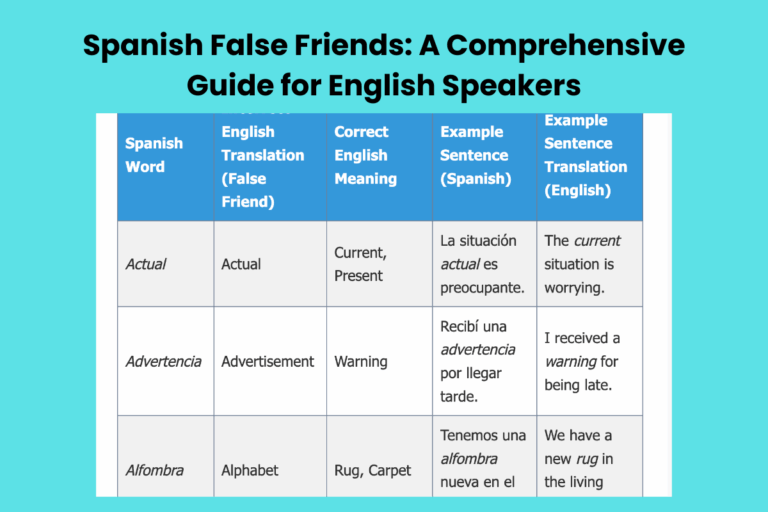
For instance, with Actual:
- The Spanish sentence is: "El precio actual de la gasolina es muy alto."
- The English translation is: "The current price of gasoline is very high."
- This context shows you that
actualmeanscurrent, notactual(which in English meansreal).
Test your understanding!
Read the following sentences. For each bolded word, decide if it is being used as a true cognate or a false friend. Choose the correct Spanish meaning based on the context.
-
My main objective is to finish the project by Friday.
- A)
objetivo(goal, target) - B)
objeción(objection)
- A)
-
She put on a brave face, but her deception was a great disappointment to her friends.
- A)
decepción(disappointment) - B)
engaño(deceit, trickery)
- A)
-
I need to buy some rope to tie this box.
- A)
ropa(clothes) - B)
cuerda(rope)
- A)
Show answer
- A)
objetivo. The context of "finish the project by Friday" clearly indicates a goal or target. This is a true cognate. - B)
engaño. The word "disappointment" is a clue. Anengaño(deception) would cause disappointment. The English worddeceptionis a false friend for the Spanishdecepción. - B)
cuerda. The context "to tie this box" tells you that the person needscuerda, notropa.Ropeis a false friend forropa.
Conclusion
Great work today! You have learned the most important strategy for dealing with false friends: using context to find the true meaning. This skill will help you read more effectively and avoid common misunderstandings.
Key Takeaways:
- Context is your best clue: The words around a potential false friend will help you decide its real meaning.
- Ask yourself, "Does this make sense?": When you read, mentally substitute the meaning you know from Spanish. If the sentence sounds strange, it's probably a false friend.
- Practice makes perfect: The more you read, the more you will see these words in context, and the easier it will be to remember their correct meanings.
In our next module, "Applying Cognates in Reading," you will put everything you've learned together. Our very next lesson will focus on scanning an A1-level text to quickly find potential cognates and begin to understand the main ideas of a paragraph, using the skills you practiced today.