¡Hola! Welcome to our new lesson.
In our previous lessons, we explored very reliable patterns that act as shortcuts between Spanish and English, like converting -ificar to -ify (justificar -> justify). These true cognates are fantastic tools for building your vocabulary quickly.
However, language can be tricky. Some words look like friends but are actually "false friends" (falsos amigos). These are words in English and Spanish that look or sound similar but have different meanings. Using them incorrectly can lead to confusion or even some funny, embarrassing situations!
Today's lesson is all about learning to spot these traps. Our goal is to identify the most common English-Spanish false friends to avoid confusion. By the end of this lesson, you will be able to recognize these tricky words and understand why they are a common pitfall.
What Are False Friends?
First, let's get a clear definition of what "false friends" are. The term in Spanish is falsos cognados, and they are a major source of mistakes for learners of any language.
Spanish False Friends: Tricky Cognates That Fool Learners
The following article, 'Spanish False Friends: Tricky Cognates That Fool Learners' from Migaku, gives a perfect introduction to this topic. It explains what false friends are and why they exist.
Please read the first section of the article, titled What are Spanish false friends anyway. It starts right after the list of contents and ends just before the next heading. Focus on understanding the definition and the reason why these words exist.
As the article explains, false friends exist because English and Spanish borrowed words from the same languages (like Latin), but over time, these words evolved to have different meanings. Recognizing that a familiar-looking word might be a trap is the first and most important step to avoiding errors.
A Gallery of Common False Friends
Now, let's meet some of the most common culprits. These are words that frequently trip up Spanish speakers who are learning English. For each word, we'll look at what it appears to mean versus its true meaning.
| English Word | Looks like (Spanish) | But it actually means... | The correct English for the Spanish word is... |
|---|---|---|---|
| Embarrassed | Embarazada (Pregnant) |
Avergonzado/a |
Pregnant |
| Actually | Actualmente (Currently) |
En realidad / De hecho |
Currently / Nowadays |
| Library | Librería (Bookstore) |
Biblioteca |
Bookstore |
| Exit | Éxito (Success) |
Salida |
Success |
| Carpet | Carpeta (Folder) |
Alfombra |
Folder |
| Large | Largo (Long) |
Grande |
Long |
| Parents | Parientes (Relatives) |
Padres (mother and father) |
Relatives |
| Constipated | Constipado (To have a cold) |
Estreñido/a |
To have a cold |
| Sensible | Sensible (Sensitive) |
Sensato / Razonable |
Sensitive |
| Realize | Realizar (To do/carry out) |
Darse cuenta |
To do / To carry out |
| Fabric | Fábrica (Factory) |
Tela |
Factory |
This list highlights the core of the problem: your brain's instinct is to connect the similar-looking words, but in these cases, that instinct is wrong.
Visualizing the Difference
Sometimes, seeing the contrast visually can make it easier to remember. The infographic below clearly shows the confusion and the correct usage for ten common false friends.
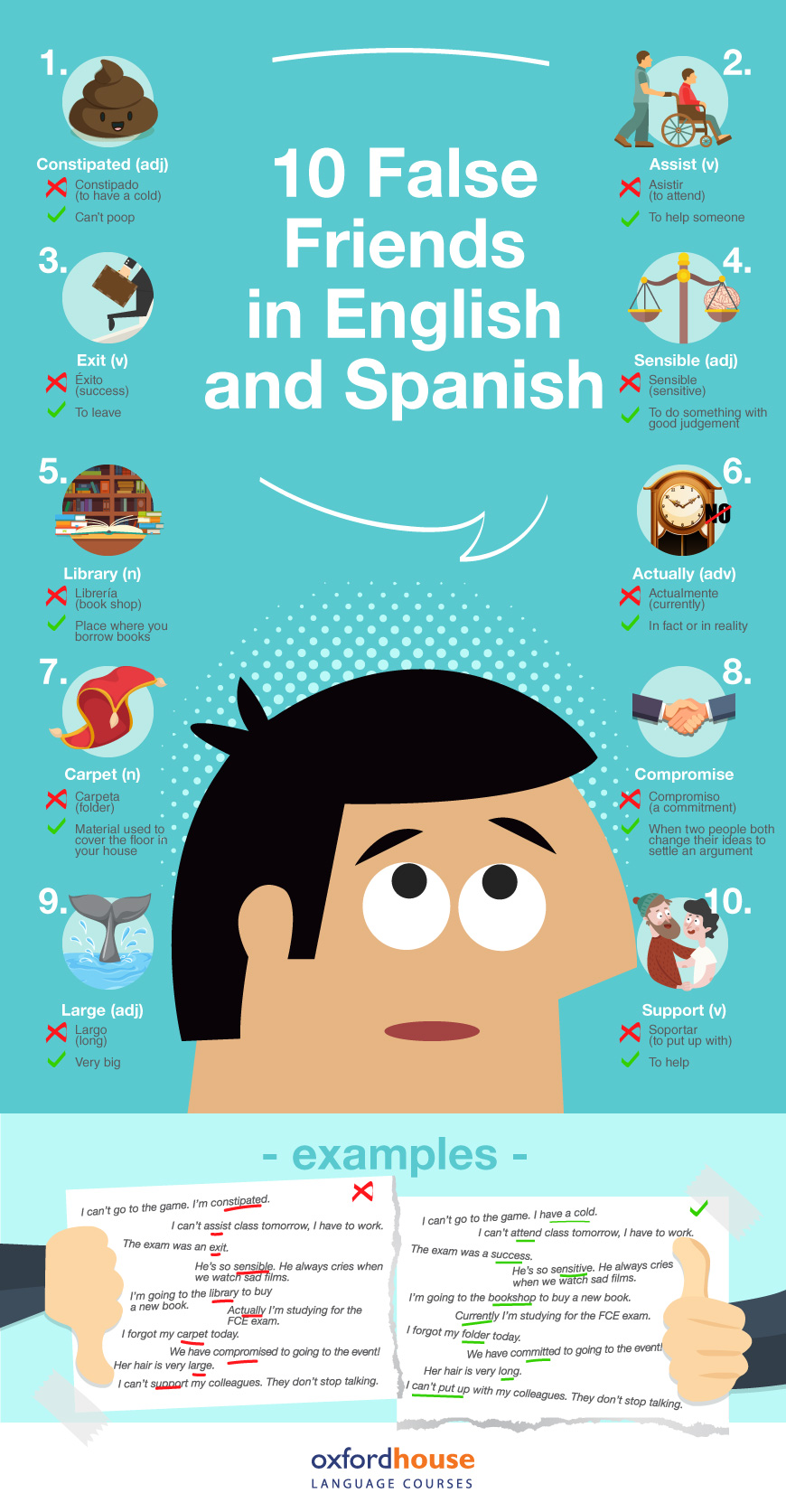
Pay close attention to the example sentences. Seeing how the words are used correctly in context is key to avoiding these mistakes in your own reading.
Hearing the Nuances
Now that you've seen the words in writing, let's listen to how they are used. Hearing the explanations can help solidify the different meanings in your mind.
False Friends: 41 Spanish Words You Don't Want to Mess Up
The video 'False Friends: 41 Spanish Words You Don't Want to Mess Up' from the channel Tell Me In Spanish is excellent for this. The presenter explains the differences very clearly for a Spanish-speaking audience. We will watch a few short clips focusing on some of the trickiest words.
Please watch the following three segments: Actualmente vs. Actually: Watch from 05:43 to 06:29. Embarazada vs. Embarrassed: Watch from 11:51 to 12:28. Sensible vs. Sensible: Watch from 20:38 to the end. Listen carefully to how she explains the correct meaning and usage for each word.
These examples are some of the most important to master, as they relate to everyday conversation and can cause significant misunderstandings.
Test your understanding!
Choose the correct word to complete each sentence. This will test your ability to identify the correct word based on its meaning.
-
I am going to the _______ to borrow a book for my class.
- a) library
- b) bookstore
-
She felt very _______ when she spilled coffee on her boss.
- a) pregnant
- b) embarrassed
-
He looks successful now, but _______, he had to work very hard to get here.
- a) currently
- b) actually
Show answer
- a) library. A
library(biblioteca) is where you borrow books. Abookstore(librería) is where you buy them. - b) embarrassed.
Embarrassed(avergonzado/a) is the feeling of shame.Pregnantmeansembarazada. - b) actually.
Actually(en realidad) is used to state a fact or contrast.Currently(actualmente) refers to the present time.
Conclusion
Great job today! You've taken a huge step in moving beyond simple cognates and learning to navigate the more complex parts of English vocabulary. Identifying false friends is a skill that will save you from a lot of confusion as you continue to learn.
Key Takeaways:
- False Friends (
Falsos Amigos) are words that look similar in English and Spanish but have different meanings. - Always be a little suspicious of a word that seems too easy or familiar. It might be a false friend.
- Some of the most common and important false friends to remember are:
- Embarrassed means
avergonzado/a, notembarazada. - Actually means
en realidad, notactualmente. - Library means
biblioteca, notlibrería.
- Embarrassed means
We are not finished with this important topic. In our next lesson, we will continue working with false friends. Now that you can identify some of the main traps, we will explain their meanings in more detail and focus on how to use their true Spanish and English equivalents correctly. We'll build on what we learned today to make sure you can use these words with confidence. See you then