Welcome to your sixth lesson. In our last session, we mapped out the entire system of the eight national income aggregates and established the logical rules for converting between them. We ended with a promise that our next step would be pure, focused practice. This lesson delivers on that promise.
Today, we will concentrate exclusively on solving numerical problems involving the conversion between these eight aggregates. Your goal is to become proficient and quick in applying the three "golden rules" of conversion. Given your focus on strengthening your numerical skills for the board exam, this high-intensity practice is the most direct way to build the confidence and accuracy you need.
Let's begin.
1. The Systematic Approach to Solving Numericals
As we saw previously, every conversion problem follows a consistent, logical process. Before we start solving, let's watch a clear demonstration of this method. The instructor in this video perfectly illustrates the step-by-step thinking required.
National Income numericals | Complete Basics | Class 12 | Macro eco
This video by Rajat Arora provides an excellent walkthrough of the fundamental conversion rules and then applies them to solve a numerical problem. This will serve as a great warm-up.
Watch the segment from the basics to the first problem. Pay close attention to how he: Sets up the equation: What you need = What you have. Systematically compares each component (G/N, D/N, MP/FC) to decide on the operation. Calculates the values for Net Factor Income from Abroad (NFIA) and Net Indirect Taxes (NIT) when not given directly.
To recap, the core strategy is:
- Set up the equation: Write the aggregate you need to find on the left and the aggregate you are given on the right.
Aggregate to Find = Given Aggregate - Apply adjustments term by term:
- Gross ⇌ Net:
Gross = Net + Depreciation - Domestic ⇌ National:
National = Domestic + NFIA - Market Price ⇌ Factor Cost:
Market Price = Factor Cost + NIT
- Gross ⇌ Net:
- Substitute and Solve: Plug in the given values and calculate the final answer.
Remember the key formulas for the adjustments:
- Net Factor Income from Abroad (NFIA) = Factor Income from Abroad - Factor Income to Abroad.
- Net Indirect Taxes (NIT) = Indirect Taxes - Subsidies.
- Depreciation is also known as Consumption of Fixed Capital.
The diagram below is a useful reference map for these conversions.
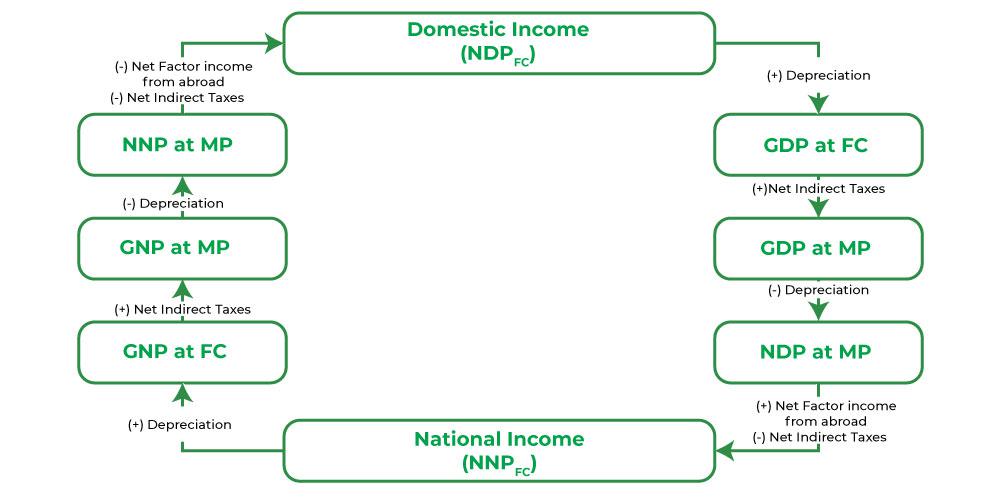
2. Practice Set 1: Direct Conversions
Let's put this into practice. For each question below, try to solve it yourself first, then check your method against the solution provided.
Problem A: Calculate National Income
Given the following data, calculate National Income (NNPFC).
| Particulars | ₹ in crores |
|---|---|
| GDP at MP | 4,800 |
| Indirect Taxes | 300 |
| Net Factor Income from Abroad | 80 |
| Consumption of fixed capital | 200 |
| Subsidies | 60 |
Click for Solution
-
Set up the equation:
-
Determine adjustments:
- To go from Gross (G) to Net (N), we subtract Depreciation (Consumption of fixed capital).
- To go from Domestic (D) to National (N), we add NFIA.
- To go from Market Price (MP) to Factor Cost (FC), we subtract Net Indirect Taxes (NIT).
-
Apply the formula:
-
Calculate NIT first:
-
Substitute all values:
-
Calculate the result:
Answer: National Income (NNPFC) is ₹ 4,440 crores.
Problem B: Calculate GDP at MP
Given the following data, calculate Gross Domestic Product at Market Price (GDPMP).
| Particulars | ₹ in crores |
|---|---|
| National Income (NNPFC) | 6,700 |
| Consumption of fixed capital | 180 |
| Factor income from abroad | 100 |
| Indirect taxes | 130 |
| Subsidies | 70 |
| Factor income to abroad | 150 |
Click for Solution
-
Set up the equation:
-
Determine adjustments:
- To go from Net (N) to Gross (G), we add Depreciation (Consumption of fixed capital).
- To go from National (N) to Domestic (D), we subtract NFIA.
- To go from Factor Cost (FC) to Market Price (MP), we add Net Indirect Taxes (NIT).
-
Apply the formula:
-
Calculate NFIA and NIT first:
-
Substitute all values:
-
Calculate the result:
Answer: GDPMP is ₹ 6,990 crores.
3. Practice Set 2: Finding a Missing Component
Board questions often ask you to work backwards to find a missing component like Depreciation or Subsidies. The logic is the same, but it involves rearranging the equation.
Problem C: Calculate Depreciation
Given the following data, calculate Depreciation.
| Particulars | ₹ in crores |
|---|---|
| NDP at MP | 80,000 |
| Indirect taxes | 10,600 |
| GNP at FC | 75,920 |
| Net Factor income from abroad | -200 |
| Subsidies | 1,770 |
Click for Solution
-
Establish the relationship between the two given aggregates:
Our goal is to isolate Depreciation.
-
Rearrange the formula to solve for Depreciation:
-
Calculate NIT:
-
Substitute all known values:
-
Calculate the result:
Answer: Depreciation is ₹ 4,950 crores.
4. Independent Practice
Now it's time for you to work through some problems entirely on your own. The following resource contains a large set of solved numericals, perfect for exam preparation.
Important Numerical of National Income and related aggregates ...
This webpage from Commerce School provides a question bank of numericals with solutions. This is excellent practice to build speed and confidence.
Work through Problems 5, 6, and 7 on the page. First, solve each problem on your own. Then, compare your answer and method with the solution provided on the webpage. Pay close attention to how they handle items like "Replacement of Fixed Capital" (which is another name for depreciation).
Conclusion
In this lesson, you put theory into practice, working through several numerical problems on converting national income aggregates. We covered direct conversions and problems where you need to find a missing component.
Key Takeaways:
- The systematic approach (
Find = Given ± Adjustments) is the most reliable way to solve any conversion problem. - Always calculate NFIA and NIT first if their components are given separately.
- Be mindful of alternative names for key terms (e.g., Consumption of Fixed Capital = Depreciation; National Income = NNPFC).
- Consistent practice is the only way to achieve the speed and accuracy needed for your board exam.
You have now solidified the foundational numerical skills for this chapter. In our next lesson, we will move on to the three main methods for calculating national income: the Value Added (Product) Method, the Income Method, and the Expenditure Method. You will find that the conversion skills you honed today are essential, as each method often requires you to convert its initial result (like GDPMP) to find the final answer (like National Income).