Welcome to the next stage of our rapid-fire preparation for your Economics board exam. In the last lesson, you mastered the art of converting between the eight national income aggregates. Now, we will take a step back to understand where these aggregates come from in the first place.
This lesson addresses a fundamental question: How is a country's national income actually measured? We will outline the three distinct methods used for this calculation: the Value Added (Product) Method, the Income Method, and the Expenditure Method. Understanding the logic behind each is crucial before we dive into solving the numericals associated with them, which is our primary goal.
1. The Foundation: The Triple Identity
An economy can be viewed from three different perspectives, which should theoretically all yield the same value for national income. This is known as the Triple Identity. It stems from the circular flow of income:
- Production Phase: Firms produce goods and services, generating value.
- Income Phase: The value generated is distributed as income (wages, rent, interest, profit) to the factors of production.
- Expenditure Phase: This income is then spent on the final goods and services produced.
Thus, we can measure the economy's output by looking at the value of what is produced, the income that is earned, or the final expenditure that is made.
To see how these three phases are linked through the circular flow of income, watch the introductory part of the following video.
METHODS OF CALCULATING NATIONAL INCOME - Full Chapter in 50 Min | Class 12th ECONOMICS
The video "METHODS OF CALCULATING NATIONAL INCOME" provides an excellent and comprehensive overview tailored for the CBSE curriculum. We will use it as our guide through all three methods.
Start by watching the first section, which explains the "Triple Identity Function." This will lay the groundwork for everything that follows. Focus on the segment from the beginning until the three methods. Notice how the instructor connects the three methods back to the circular flow of income between households and firms.
Now that you have the basic framework, let's examine each method in detail.
2. Method 1: Value Added (or Product) Method
This method measures national income by looking at the production side. It calculates the contribution of each producing unit in the economy. To avoid the problem of counting the same item multiple times (e.g., counting both the flour and the bread made from it), we only sum the value added at each stage of production.
The Value Added method gives us Gross Domestic Product at Market Price (GDPMP).
METHODS OF CALCULATING NATIONAL INCOME - Full Chapter in 50 Min | Class 12th ECONOMICS
Let's continue with the same video to understand the mechanics of the Value Added Method.
Watch the segment from the Value Added Method. Pay close attention to: The main formula: Value of Output - Intermediate Consumption. The breakdown of each component (e.g., Value of Output = Sales + Change in Stock). The "father-son" rule for numericals, which is a very effective way to avoid double counting components. The discussion on how to avoid the "Problem of Double Counting."
Key Formulas for Value Added Method:
- Gross Value Added (GVA) = Value of Output - Intermediate Consumption
- Summing the GVA of all firms gives GDPMP.
- Value of Output = Sales + Change in Stock
- Change in Stock = Closing Stock - Opening Stock
- Intermediate Consumption = Purchases of raw materials from other firms. Crucially, this does not include the purchase of fixed assets like machinery.
3. Method 2: Income Method
This method measures national income from the distribution side. It sums up all the incomes earned by the factors of production (land, labor, capital, entrepreneurship) within the domestic territory of a country.
The Income Method gives us Net Domestic Product at Factor Cost (NDPFC), which is also known as Domestic Income.
METHODS OF CALCULATING NATIONAL INCOME - Full Chapter in 50 Min | Class 12th ECONOMICS
Now, let's explore the Income Method with the same instructor.
Watch the segment from the Income Method. Focus on: The three main components: Compensation of Employees, Operating Surplus, and Mixed Income. The sub-components of each, especially for Compensation of Employees and Operating Surplus (Profit). The "father-son" rule applied here (e.g., if Operating Surplus is given, you ignore Rent, Interest, and Profit).
Key Formulas for Income Method:
-
NDPFC = Compensation of Employees + Operating Surplus + Mixed Income
-
Compensation of Employees (COE) includes:
- Wages and salaries (in cash and in kind)
- Employer's contribution to social security schemes
-
Operating Surplus (OS) includes:
- Rent and Royalty
- Interest
- Profit
- Profit itself is composed of: Corporation Tax, Dividends, and Undistributed Profits (Retained Earnings).
-
Mixed Income of Self-employed (MI): Income of self-employed individuals (like doctors, small shopkeepers) where it's difficult to separate the components of income.
4. Method 3: Expenditure Method
This method measures national income from the disposition or spending side. It sums up all the final expenditure on goods and services produced within the economy. We only consider final expenditure to avoid double counting.
The Expenditure Method gives us Gross Domestic Product at Market Price (GDPMP).
METHODS OF CALCULATING NATIONAL INCOME - Full Chapter in 50 Min | Class 12th ECONOMICS
Finally, let's examine the Expenditure Method.
Watch the segment from the Expenditure Method. Concentrate on: The four components of final expenditure: PFCE, GFCE, GDCF, and Net Exports. The breakdown of Gross Domestic Capital Formation (GDCF) into "fixed" investment and "inventory" investment (Change in Stock). This is a critical point for numericals. The application of the "father-son" rule to investment and net exports.
Key Formulas for Expenditure Method:
-
GDPMP = Private Final Consumption Expenditure + Government Final Consumption Expenditure + Gross Domestic Capital Formation + Net Exports
-
Private Final Consumption Expenditure (PFCE): Expenditure by households and non-profit institutions serving households.
-
Government Final Consumption Expenditure (GFCE): Expenditure by the government on goods and services.
-
Gross Domestic Capital Formation (GDCF): Investment expenditure.
- GDCF = Gross Fixed Capital Formation + Change in Stock (Inventory Investment)
-
Net Exports (X-M): Exports - Imports.
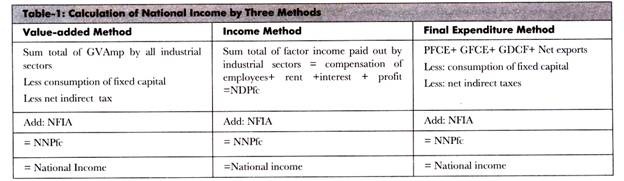
5. Summary of the Three Methods
All three methods are different routes to the same destination. They start by calculating a different aggregate, but once you apply the conversion rules you practiced in the last lesson, they should all result in the same National Income (NNPFC).
The table below provides a concise summary, which is perfect for last-minute revision.
Conclusion
In this lesson, we have outlined the conceptual framework of the three methods for calculating national income. You now understand the logic behind each approach and the key components involved.
Key Takeaways:
- National Income can be measured via Production (Value Added), Income, or Expenditure. This is the Triple Identity.
- Value Added Method sums the value added by all producers to get GDPMP.
- Income Method sums all factor incomes to get NDPFC.
- Expenditure Method sums all final expenditures to get GDPMP.
- Understanding which components belong to which method and avoiding double counting (using the "father-son" rule) are the keys to solving numericals correctly.
You've now built the complete theoretical foundation for this chapter. In our next lesson, we will begin our focused numerical practice, starting with the Income Method. You will see how the formulas and components we discussed today are applied to solve CBSE board exam questions.