Welcome back! In our last lesson, we surveyed the three methods for calculating national income. Now, it's time to roll up our sleeves and put that theory into practice. Your goal is to master the numerical questions, and this lesson is designed to do just that.
We will focus entirely on the Income Method. You will learn to correctly identify the different types of factor incomes from a list of data, sum them up systematically, and calculate any required national income aggregate. This is a crucial skill for your board exam.
1. The Core Idea: Summing Factor Incomes
The Income Method measures national income by adding up all the incomes earned by the factors of production for their contribution to the production process. Let's quickly visualize what these "factor incomes" are.
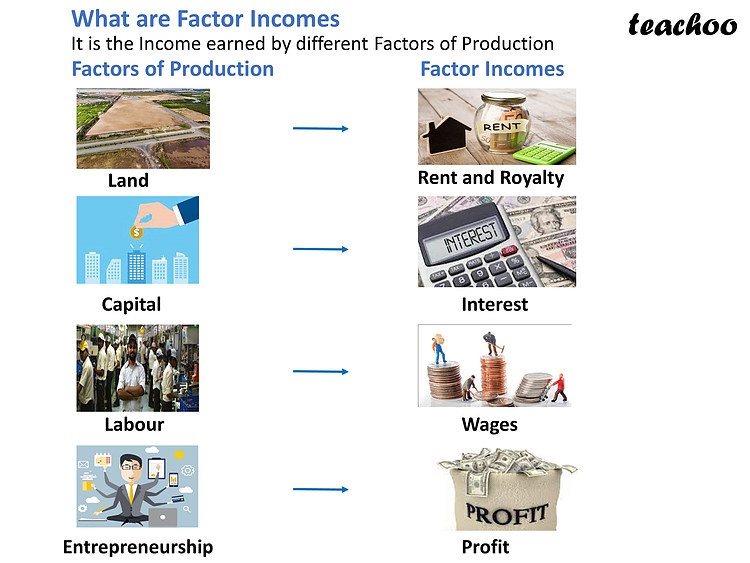
When we add all the factor incomes generated within the domestic territory of a country, we get Net Domestic Product at Factor Cost (NDPFC), which is also called Domestic Income.
2. The Formula and Its Components
The fundamental formula for the Income Method is:
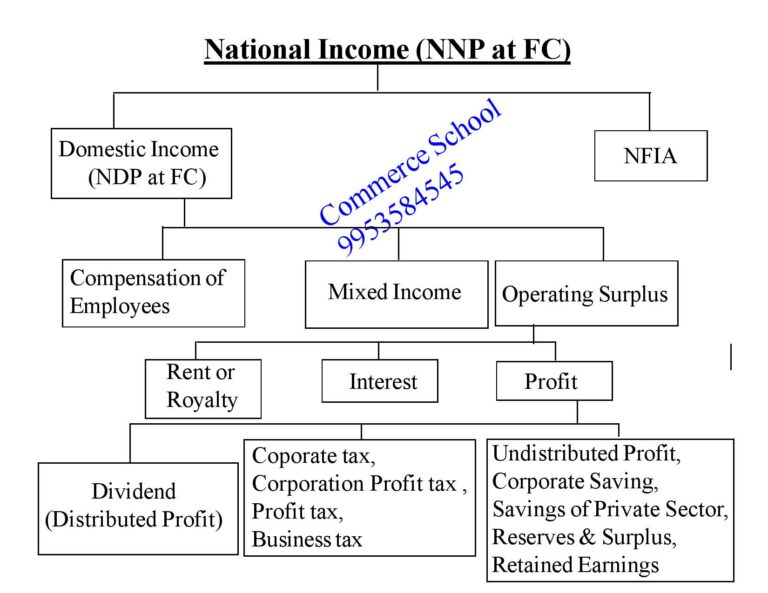
To solve numericals, you must be able to identify these three main components and, if they are not given directly, calculate them from their sub-components.
The flowchart below gives a perfect overview of this structure. It's an excellent tool for revision.
Let's dive into these components with a detailed video explanation.
CBSE Class 12 | National Income - L5 | Income Method with Numericals | Economics | Love Kaushik Sir
The video "Income Method with Numericals" by Love Kaushik Sir from Padhle Commerce provides a very clear, CBSE-focused breakdown of the components and then demonstrates how to solve numericals.
Watch the following sections carefully: Introduction: This part recaps the core idea and the main formula. Compensation of Employees: Pay close attention to what's included (wages, salaries, in-kind benefits) and especially the Employer's contribution to social security schemes. A common exam trap is to include the employee's contribution, which is incorrect. Operating Surplus: This section explains Rent, Interest, and importantly, Profit. Your accounting background will be helpful here, as the components of profit—Corporate Tax, Dividends, and Undistributed Profits (also known as Retained Earnings or Corporate Savings)—are standard accounting terms.
Key Rules for Solving Numericals
Before we start solving, remember the "father-son" rule from our previous lesson. It's critical for the Income Method:
- Rule 1: If a main component (the "father," e.g., Profit) is given, you must ignore its sub-components (the "sons," e.g., Dividends, Corporate Tax).
- Rule 2: If the main component is not given, you must calculate it by adding its sub-components.
For example:
- If the data includes
Profit = 500andDividends = 100, you use500for Profit. - If the data includes
Dividends = 100,Corporate Tax = 50, andUndistributed Profit = 20, you calculateProfit = 100 + 50 + 20 = 170.
3. The Step-by-Step Process for Solving Numericals
Let's apply this knowledge to solve a typical problem. The process is always the same.
Problem: Calculate National Income (NNPFC).
Step 1: Always start by calculating Domestic Income (NDPFC).
Use the formula: NDP_FC = COE + OS + MI.
Step 2: Identify or calculate Compensation of Employees (COE).
Look for "Compensation of Employees". If it's not there, look for "Wages and Salaries" and "Employer's contribution to social security".
Step 3: Identify or calculate Operating Surplus (OS).
Look for "Operating Surplus". If it's not there, calculate it as OS = Rent and Royalty + Interest + Profit.
- To get Profit, look for the "Profit" item. If it's not there, calculate it as
Profit = Corporate Tax + Dividends + Undistributed Profits.
Step 4: Identify Mixed Income (MI).
Look for "Mixed Income of Self-Employed". If it's not in the data, its value is zero.
Step 5: Convert NDPFC to the required aggregate.
The question asks for National Income (NNPFC). Using the conversion rules:
Let's see this process in action with a solved example from the video you just watched.
CBSE Class 12 | National Income - L5 | Income Method with Numericals | Economics | Love Kaushik Sir
Now, watch how the instructor applies these steps to solve a problem where he needs to calculate Profit from its sub-components.
Focus on this specific numerical example from the second problem. Notice how he: Starts by setting up the formula for NDPFC. Identifies that COE is not given directly, so he uses "Wages and Salaries". Sees that Operating Surplus is not given, so he looks for its components. Realizes Profit is also not given, so he first calculates it by adding Corporate Tax, Undistributed Profit, and Dividend. Plugs everything back in to find NDPFC. Finally, converts NDPFC to NNPFC by adding NFIA (which is negative in this case).
4. Practice with Past Board Questions
Your goal is to solve these questions quickly and accurately. The best way to do this is to practice with actual past paper questions. The following resource contains a large set of solved numericals.
50 Important Numerical of Income Method (National ...
This webpage from Commerce School provides a fantastic collection of solved numerical problems, many of which are from previous CBSE board exams. We will use this to solidify your understanding.
Go through the solved problems from Question 1 to Question 10. For each question: Read the question and the data provided. Try to mentally apply the 5-step process we just discussed. Identify the components of COE, OS, and MI. Compare your mental calculation with the provided solution. Pay close attention to: How they handle cases where a main component is given vs. when it needs to be calculated. (e.g., Q1 vs Q2). How they calculate COE when it's not given directly (e.g., Q8). How they calculate Profit when it's not given directly (e.g., Q9). How they use the conversion formulas (NFIA, NIT, Depreciation) at the end.
Working Backwards: A Common Variation
Sometimes, a question will give you a final aggregate (like GDPMP) and ask you to find a missing component like Operating Surplus. The logic is the same, just in reverse.
- Write down the standard Income Method formula:
NDP_FC = COE + OS + MI. - Use the given aggregate (e.g., GDPMP) and convert it to NDPFC.
- Plug in the known values for COE, MI, and the calculated NDPFC into the formula.
- Solve for the unknown component (e.g., OS).
You can see a great example of this in the first video resource.
CBSE Class 12 | National Income - L5 | Income Method with Numericals | Economics | Love Kaushik Sir
Let's go back to the Padhle Commerce video to see how to solve for a missing component.
Watch the example from the third problem. The goal here is to find the Operating Surplus. Notice the instructor's method: He knows he needs NDP_FC for the income method formula. He takes the given GDP_MP and converts it to NDP_FC first. He then plugs this value into NDP_FC = COE + OS + MI and solves for OS.
Conclusion
You have now covered the complete process for tackling any numerical question based on the Income Method. With your accounting background and the structured approach from this lesson, you are well-equipped to handle these questions in your exam.
Key Takeaways:
- The Starting Point: Always begin by calculating NDPFC = COE + OS + MI.
- Component Hierarchy: Know the sub-components of COE and OS (especially Profit). Remember the "father-son" rule to avoid double counting.
- Systematic Process: Follow the 5-step process: find NDPFC first, then convert it to the required aggregate (NNPFC, GDPMP, etc.).
- Precautions: Be careful to only include the employer's contribution to social security and to exclude transfer payments.
In our next lesson, we will apply this same intensive, numerical-focused approach to mastering the Expenditure Method. Keep practicing the problems from the provided resource; repetition is key to building speed and confidence.