Welcome back. In our last lesson, we focused on mastering numericals for the Income Method, and you learned how to systematically build up from factor incomes to national income. Now, we'll apply that same rigorous, problem-solving approach to the second method for calculating national income.
This lesson will teach you how to calculate national income using the Expenditure Method. We will break down its components, focus on the common traps related to investment and capital formation, and work through past CBSE board questions to ensure you can solve these numericals accurately and efficiently in your exam.
1. The Core Idea: Summing Final Expenditures
The Expenditure Method calculates national income by summing up all the final spending on goods and services produced within an economy during a year. This total spending gives us the market value of all final products.
The starting point for this method is Gross Domestic Product at Market Price (GDPMP). This is a crucial difference from the Income Method, which starts with NDPFC.
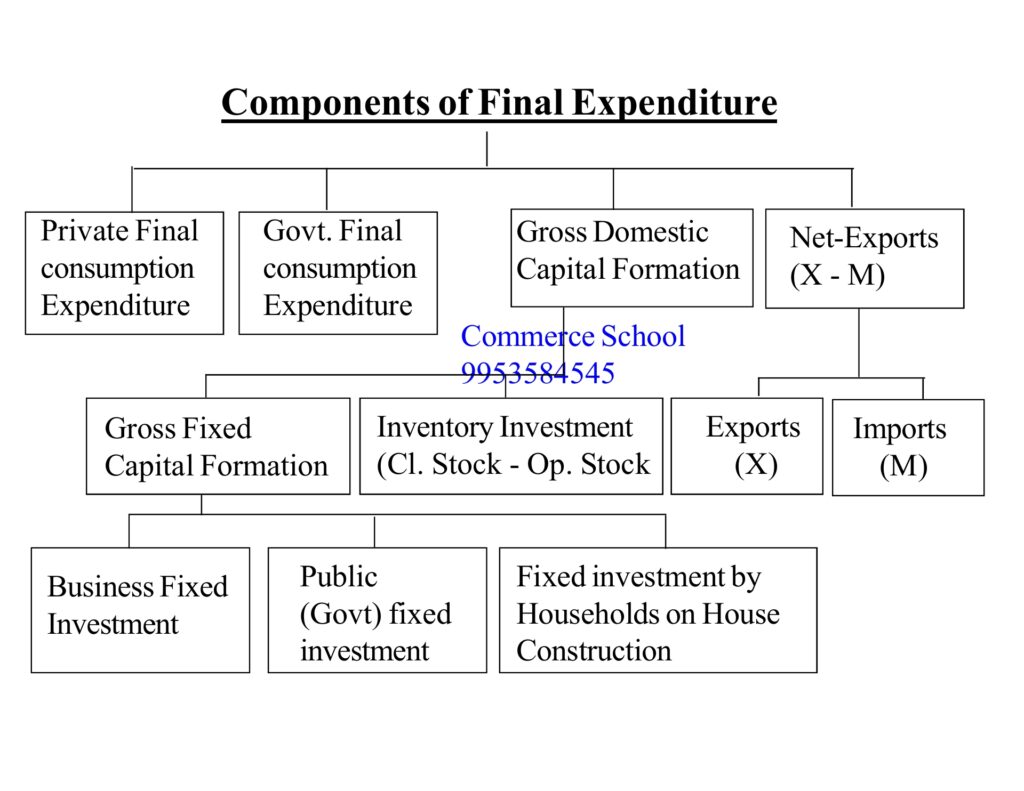
The four key types of expenditure are:
- Private Final Consumption Expenditure (PFCE): Spending by households and non-profit institutions.
- Government Final Consumption Expenditure (GFCE): Spending by the government on goods and services.
- Gross Domestic Capital Formation (GDCF): Spending on investment goods (e.g., machinery, buildings) and changes in inventory.
- Net Exports (NX): The difference between what foreigners spend on our goods (Exports) and what we spend on foreign goods (Imports).
The fundamental formula is:
The diagram below provides a clear visual breakdown of these components.
Let's begin with a video that introduces these four components.
Expenditure Method | National income Part 7 Term 2 12th Economics | Complete Explanation With QNS
This video from Sunil Panda provides a concise and clear explanation of the Expenditure Method, tailored for CBSE students.
Watch the first part of the video from the formula breakdown. The instructor introduces the four components and explains that their sum equals GDPMP.
2. The Key Challenge: Decoding Gross Domestic Capital Formation (GDCF)
While PFCE and GFCE are usually given directly, and Net Exports is straightforward (), Gross Domestic Capital Formation (GDCF) requires careful attention. This is the most common area for errors in numerical problems.
GDCF is also known as Gross Investment. Your accounting knowledge of fixed assets and inventory will be helpful here. GDCF has two main parts:
- Gross Domestic Fixed Capital Formation (GDFCF): Investment in fixed assets like machinery, equipment, and buildings.
- Change in Stock (or Inventory Investment): Calculated as .
A crucial rule, similar to the "father-son" rule from our last lesson, applies here:
- If GDCF is given directly, you must ignore its sub-components (GDFCF and Change in Stock).
- If GDCF is not given, you must calculate it by adding its sub-components: .
Things get more complex when the data includes 'Net' values instead of 'Gross' values. Let's break down the variations you'll encounter.
Expenditure Method | National income Part 7 Term 2 12th Economics | Complete Explanation With QNS
Let's continue with the same video to understand how to handle the different variations of Capital Formation.
Watch these two crucial segments: GDCF Components: This part explains how GDCF is composed of Gross Fixed Capital Formation and Change in Stock. Handling 'Net' Values: This section is extremely important. It explains how to convert 'Net' investment figures to the 'Gross' figures needed for the GDPMP formula by adding depreciation. It also covers what to do if you are given 'Net Imports' instead of 'Net Exports'.
To summarize the rules for calculating GDCF from different data points:
| If you are given... | You must calculate GDCF as... |
|---|---|
| Gross Domestic Capital Formation | Use this value directly. Ignore all other investment components. |
| Gross Domestic Fixed Capital Formation | GDCF = Gross Domestic Fixed Capital Formation + Change in Stock |
| Net Domestic Capital Formation | GDCF = Net Domestic Capital Formation + Depreciation |
| Net Domestic Fixed Capital Formation | GDCF = Net Domestic Fixed Capital Formation + Depreciation + Change in Stock |
Note: Depreciation is also called 'Consumption of Fixed Capital'.
3. The Step-by-Step Process for Solving Numericals
Let's put this all together into a reliable, step-by-step method for solving any expenditure-based numerical.
Step 1: Always start by calculating GDPMP.
Write the formula:
Step 2: Identify or calculate each component.
- Find PFCE and GFCE.
- Calculate Net Exports (NX). If
Net Importsis given, rememberNX = - Net Imports. - Carefully calculate GDCF using the rules from the table above. This is the most critical calculation.
Step 3: Sum the components to find GDPMP.
Step 4: Convert GDPMP to the required aggregate.
Use the conversion rules we've practiced. For example, to find National Income (NNPFC):
4. Practice with Past CBSE Board Questions
Now, let's see this method applied to actual board exam questions. Watching solved examples is the best way to prepare.
Expenditure Method | National income Part 7 Term 2 12th Economics | Complete Explanation With QNS
The video provides two excellent solved examples from past CBSE papers.
Observe the process carefully in these two examples: First Board Question: This is a straightforward problem where GDCF is given directly, but you have to handle Net Imports. Second Board Question: This problem is more complex. You are given 'Net Domestic Fixed Capital Formation', so you have to add both Depreciation and Change in Stock to find GDCF. This is a very common type of question.
Your Turn: Solve a 2024 Board Question
Now it's time for you to apply what you've learned. Here is a question from the 2024 CBSE Board Paper. Try to solve it yourself before looking at the solution.
CBSE Class 12 Economics Question Paper 2024 (Set 1- 58/3/1) with ...
This resource contains a question directly from this year's board exam. It's a perfect test of your understanding.
First, carefully read Question 11(a) and the data provided. On a piece of paper, apply the 4-step process we just discussed. Start by writing the formula for GDPMP. Identify the components. Notice that you are given 'Gross Domestic Fixed Capital Formation' and 'Increase in Stock' (which is the same as Change in Stock). Calculate GDPMP. Convert GDPMP to National Income (NNPFC). Once you have your final answer, compare it with the detailed solution provided in the resource to check your work.
For more practice, the following resource has a large bank of solved numericals from past papers. Working through a few of these will build your speed and confidence.
50 Important Numerical of Expenditure Method (National Income ...
This webpage from Commerce School is an excellent source for practice.
Go through the solved problems from Question 1 to Question 6. For each question, try to identify the components and mentally outline the solution before reading the provided steps. Pay attention to how they handle different variations like 'Net factor income to abroad' and 'Net imports'.
Conclusion
You have now covered the complete methodology for solving numericals based on the Expenditure Method. You understand the core components, know how to handle the complexities of capital formation, and have practiced with real CBSE board questions.
Key Takeaways:
- The Starting Point: The Expenditure Method always starts with calculating GDPMP.
- The Four Pillars: The formula is .
- The Main Hurdle: Pay extremely close attention to Gross Domestic Capital Formation (GDCF). Know how to calculate it from its 'fixed' and 'net' variations by using Change in Stock and Depreciation correctly.
- Final Conversion: Once you have GDPMP, use the standard conversion rules (Depreciation, NIT, NFIA) to find any other required aggregate.
In our next lesson, we will briefly cover the Value Added Method and then focus on the theoretical "precautions" for all three methods. After that, we will move on to solving full-fledged, mixed numerical problems from recent board papers, which will test your ability to choose the right method and apply it under exam conditions.