Welcome back. In the last two lessons, we've tackled the Income and Expenditure methods for calculating national income. You've seen that both methods provide a systematic way to arrive at the same final number, but from different starting points—NDPFC for the Income Method and GDPMP for the Expenditure Method.
Today, we will cover the third and final approach: the Value Added Method. This lesson will equip you to calculate Gross Value Added at Market Price (GVAMP), which is the foundational aggregate for this method. Your background in accounting will be particularly useful here, as we'll be dealing with familiar concepts like sales, purchases, and changes in stock. We'll break down the core formula and then, as you prefer, move straight into solving numericals.
1. The Core Concept: Adding Value, Not Just Output
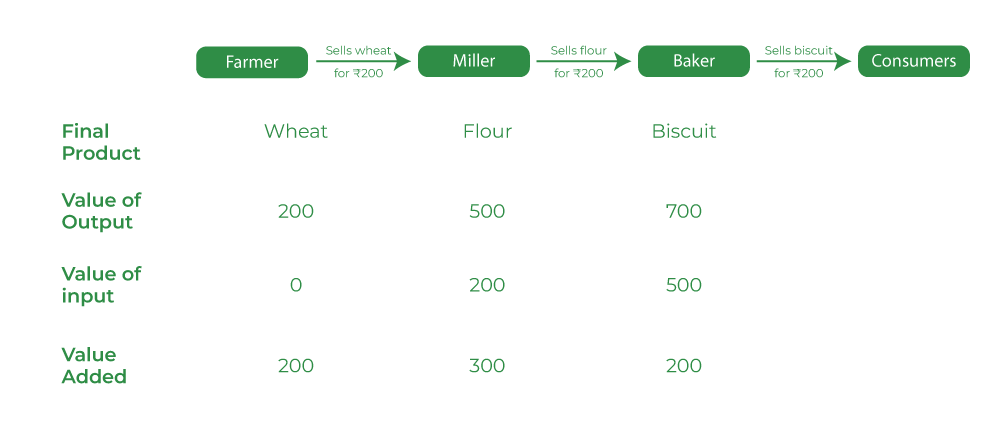
Imagine an economy with a farmer, a miller, and a baker.
- The farmer grows wheat and sells it for ₹500.
- The miller buys the wheat for ₹500, grinds it into flour, and sells the flour for ₹800.
- The baker buys the flour for ₹800, bakes biscuits, and sells them for ₹1,200.
If we simply added up the sales of everyone (₹500 + ₹800 + ₹1,200 = ₹2,500), we would be overcounting. The value of the wheat (₹500) is included in the price of the flour (₹800), and the value of the flour is included in the price of the biscuits (₹1,200). This error is called double counting.
The Value Added Method solves this by measuring only the new value created at each stage.
- Farmer's value added: ₹500 (started from scratch)
- Miller's value added: ₹800 (flour) - ₹500 (wheat) = ₹300
- Baker's value added: ₹1,200 (biscuits) - ₹800 (flour) = ₹400
- Total Value Added: ₹500 + ₹300 + ₹400 = ₹1,200
Notice this total is exactly the market price of the final product (the biscuits). This is the essence of the Value Added Method.
This short video provides a clear explanation of this core idea.
National INCOME | VALUE ADDED METHOD | CLASS 12 | CONCEPT AND NUMERICALS | PART 5
This video from Rajat Arora introduces the concept of value addition and the problem of double counting.
Watch the section from the concept of value added. Pay attention to how the example demonstrates two correct ways to calculate the total value: the final output method and the value-added method.
2. The Formula for Gross Value Added at Market Price (GVAMP)
The value added by a single firm or an entire sector is called Gross Value Added at Market Price (GVAMP). When we sum the GVAMP of all sectors in the economy (Primary, Secondary, and Tertiary), we get the Gross Domestic Product at Market Price (GDPMP).
So, for practical purposes:
This is our starting point, just like in the Expenditure Method. The formula is:
Let's break down these two components.
National INCOME | VALUE ADDED METHOD | CLASS 12 | CONCEPT AND NUMERICALS | PART 5
The same video continues to explain the components of the main formula. This is the most crucial part for solving numericals.
Watch the segment from the GVAmp formula. The instructor clearly explains how to calculate 'Value of Output' and 'Intermediate Consumption'.
A. Value of Output (VoO)
This is the market value of all goods and services produced by a firm during a year.
- Change in Stock is a concept you'll know from accounting: .
- Sales can have variations:
- If the question gives 'Domestic Sales', you must add 'Exports' to get total sales: . If only 'Sales' is given, assume exports are already included.
- Sometimes, sales might be given as
Price per unit × Output sold. - 'Production for self-consumption' is also part of the value of output and should be included if mentioned.
B. Intermediate Consumption (IC)
This refers to the value of all non-factor inputs (like raw materials) purchased from other firms and used up in the production process.
- This is the cost of 'intermediate goods'.
- Crucial point: Expenditure on fixed assets (capital goods like machinery) is NOT intermediate consumption. This is a very common trap in exam questions.
- Imports of raw materials are part of intermediate consumption. If the question gives 'Domestic Purchases' or 'Purchases from domestic firms', you must add 'Imports' to find the total IC.
3. The Step-by-Step Calculation Process
The process is straightforward and builds on what you already know.
Step 1: Calculate the Value of Output.
VoO = Sales + Change in Stock
Step 2: Identify the Intermediate Consumption.
IC = Purchases of raw materials + Imports(if given separately)
Step 3: Calculate GVAMP.
GVA_MP = VoO - IC
Step 4: Convert GVAMP (which is GDPMP) to the required aggregate.
- For example, to find National Income (NNPFC):
The flowchart below visualizes this conversion path.

4. Solving Numerical Problems
Let's apply this method to some typical CBSE questions. Your goal is to get comfortable identifying the components and applying the formulas accurately.
50 Important Numerical of Value Added Method (National ...
This webpage from Commerce School contains a large set of solved numericals, many from past board papers. It's an excellent resource for practice.
We will work through a few selected problems. For each one, read the question, try to solve it on paper, and then check your method against the provided solution.
Problem 1: Basic Calculation
Let's start with a straightforward problem.
Try to solve Question 7 from the resource. The data is:
| Item | ₹ in lakh |
|---|---|
| Goods and service tax | 40 |
| Consumption of fixed capital | 15 |
| Closing stock | 20 |
| Sales | 700 |
| Subsidy | 5 |
| Intermediate consumption | 400 |
| Opening Stock | 10 |
The question asks you to calculate Gross Value Added at Market Price (GVAMP).
Solution Walkthrough:
- Value of Output (VoO) = Sales + Change in Stock
- Change in Stock = Closing Stock - Opening Stock = 20 - 10 = 10
- VoO = 700 + 10 = 710
- Intermediate Consumption (IC) is given directly = 400
- GVAMP = VoO - IC
- GVAMP = 710 - 400 = 310 lakh
Notice that GST, subsidy, and consumption of fixed capital were not needed because the question only asked for GVAMP.
Problem 2: Handling Sales Components
Now, try a question that tests your understanding of the components of 'Sales'.
Solve Question 3 from the resource. Data:
| Item | ₹ in lakh |
|---|---|
| Depreciation | 20 |
| Domestic Sales | 200 |
| Net Change in Stocks | (-) 10 |
| Exports | 10 |
| Single use producer goods | 120 |
The question asks for Gross Value Added at Market Price (GVAMP). Hint: 'Single use producer goods' is another name for intermediate consumption.
... After you've tried it, check the solution for Question 3 in the 50 Important Numerical... resource. The key step is calculating Sales as Domestic Sales + Exports.
Problem 3: Inter-Firm Transactions
This is a classic board question format involving two firms.
Solve Question 1 from the resource. The question asks for:
a) Value Added by firm A and B
b) Gross Value Added at Factor Cost
Hint: A purchase by one firm from another firm is the buyer's intermediate consumption and part of the seller's sales.
... Check your full solution against the one provided for Question 1 in the resource. This will solidify your understanding of how inter-firm transactions are handled.
Conclusion
You have now learned the third and final method for calculating national income. By focusing on the value added at each stage, this method provides a unique perspective on the economy's output while systematically avoiding double counting.
Key Takeaways:
- The Value Added Method's starting point is GVAMP, which is equivalent to GDPMP.
- The core formula is GVAMP = Value of Output - Intermediate Consumption.
- Value of Output = Sales + Change in Stock. Remember to add exports if 'domestic sales' are given.
- Intermediate Consumption includes all raw materials but excludes purchases of fixed assets (capital goods).
- The sum of value added across all firms/sectors gives the economy's GDPMP.
In our next lesson, we will consolidate our knowledge by discussing the theoretical "precautions" for all three methods. This is important for 1-mark or 3-mark theory questions. After that, we will be fully prepared to tackle a final set of mixed numerical problems from the 2019-2024 board papers, simulating real exam conditions.