Welcome to the fifth lesson in your Macroeconomics crash course. In the last few sessions, we established the three "golden rules" for converting between key economic measures: Gross/Net, Domestic/National, and Market Price/Factor Cost. We also explored the difference between Nominal and Real GDP. Today, we'll synthesize all these concepts.
This lesson focuses on defining and distinguishing between the eight related aggregates of national income. We'll move beyond looking at the rules in isolation and see how they combine to form a complete system. For you, this is a critical step. Mastering these eight aggregates and the conversions between them is the absolute foundation for tackling the numerical questions on National Income in your board exam.
1. Understanding the Structure of the Aggregates
Before we list all eight aggregates, let's first understand their common structure. Each aggregate is a four-part name that tells you exactly what it measures. For example, in GDPMP, the 'G' stands for Gross, 'D' for Domestic, 'P' for Product, and 'MP' for Market Price.
To see how this structure works for all aggregates, let's watch a short, clear explanation.
NATIONAL INCOME and RELATED AGGREGATES class 12 ONE SHOT numerical Macroeconomics | GAURAV JAIN
This clip from the video by THE GAURAV JAIN breaks down the "anatomy" of a national income aggregate, explaining what each part of the name signifies.
Watch the segment from this part where the instructor explains the four "places" in an aggregate's name and what can go in each one (Gross/Net, Domestic/National, Product, and FC/MP).
2. The Eight Aggregates of National Income
As you just saw, by combining the different options (Gross/Net, Domestic/National, FC/MP), we arrive at a total of eight aggregates. These are the key measures you'll encounter.
The eight aggregates are:
- GDPMP (Gross Domestic Product at Market Price)
- GDPFC (Gross Domestic Product at Factor Cost)
- NDPMP (Net Domestic Product at Market Price)
- NDPFC (Net Domestic Product at Factor Cost)
- GNPMP (Gross National Product at Market Price)
- GNPFC (Gross National Product at Factor Cost)
- NNPMP (Net National Product at Market Price)
- NNPFC (Net National Product at Factor Cost)
It is crucial to remember two specific definitions that are used as standard terms:
- Domestic Income = NDPFC
- National Income = NNPFC
If a question asks you to calculate "National Income," it is asking for NNPFC.
Let's watch a brief segment that lists these aggregates and reinforces the specific definitions for Domestic and National Income.
Macroeconomics | National income and related aggregates | Class 12 | chapter 3
In this video, Rajat Arora lists the eight aggregates and highlights the two most important ones that you need to know by their special names.
Please watch the section from the eight components. Pay close attention to which aggregate is labelled "National Income" and which is "Domestic Income."
For a detailed textual definition of each aggregate and a clear comparison, the following reading is highly recommended.
National Income and Related Aggregates - GeeksforGeeks
This GeeksforGeeks article provides concise definitions for each of the eight aggregates. It also includes helpful tables comparing Domestic Income (NDPFC) with National Income (NNPFC).
Read the sections titled "Gross Domestic Product at Market Price (GDPMP)" through to "Net National Product at Factor Cost (NNPFC)" to see the definition of each aggregate. Then, carefully study the comparison table under the heading "Domestic Income (NDPFC) vs National Income (NNPFC)".
The diagram below provides a great visual summary of how these aggregates are related through the three key adjustments: Depreciation, Net Indirect Taxes (NIT), and Net Factor Income from Abroad (NFIA).
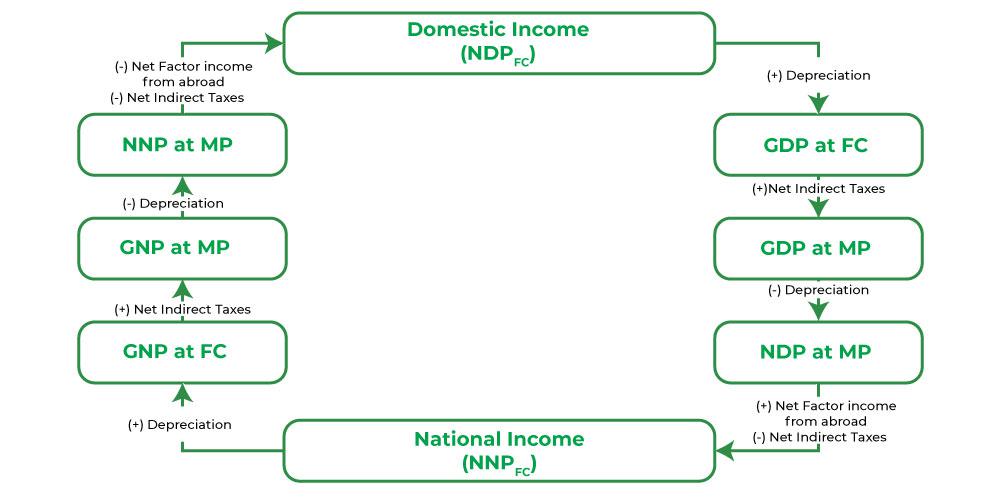
3. Distinguishing Aggregates through Conversion
The best way to truly "distinguish" between these aggregates is to practice converting one into another. The path of conversion—the additions and subtractions you perform—is the difference between them.
Let's walk through the process of solving these numericals. The logic is always the same:
- Write what you need to find on the left side of the equation.
- Write what you are given on the right side.
- Go term by term (e.g., Gross to Net, Domestic to National, FC to MP) and apply the necessary adjustment (+/- Depreciation, +/- NFIA, +/- NIT).
The following video demonstrates this process with several clear examples. As you watch, try to predict the next step the instructor will take.
Macroeconomics | National income and related aggregates | Class 12 | chapter 3
This is the core of today's lesson. Rajat Arora solves three different conversion problems step-by-step. This will build your confidence in applying the formulas you've learned.
Watch the entire segment from solving numericals. Notice how he systematically compares the starting aggregate with the target aggregate to decide which operations to perform.
4. Your Turn: A Quick Practice Problem
Let's apply what you've just seen.
Calculate GNPFC from the following data:
- NDPMP = ₹ 25,000
- Depreciation = ₹ 5,000
- Net Indirect Taxes (NIT) = ₹ 1,500
- Net Factor Income from Abroad (NFIA) = ₹ 400
Take a moment to solve this on your own before checking the solution.
Click for the solution
-
Set up the equation:
-
Determine the adjustments:
- To go from Net (N) to Gross (G), we add Depreciation.
- To go from Domestic (D) to National (N), we add NFIA.
- To go from Market Price (MP) to Factor Cost (FC), we subtract NIT.
-
Apply the formula:
-
Substitute the values:
-
Calculate the result:
Conclusion
In this lesson, we organized our knowledge of the three "golden rules" into a systematic framework of eight national income aggregates. You learned the specific terminology for each and, most importantly, how to distinguish between them by converting one to another.
Key Takeaways:
- There are eight related aggregates of national income, each being a combination of Gross/Net, Domestic/National, and Market Price/Factor Cost.
- National Income is specifically NNPFC, and Domestic Income is NDPFC.
- The conversion between any two aggregates is a systematic process of applying three key adjustments:
- Gross ⇌ Net (using Depreciation)
- Domestic ⇌ National (using NFIA)
- MP ⇌ FC (using NIT)
- Mastering these conversions is non-negotiable for solving numerical problems in this unit.
You now have all the foundational theory needed for national income accounting. Our next lesson will be a pure, high-intensity practice session. We will focus exclusively on solving a variety of numerical problems involving these eight aggregates, including different question types from past CBSE board papers, to build your speed and accuracy for the exam.