Hello! In our previous lessons, we've dissected the first two pillars of India's 1991 New Economic Policy: Liberalisation and Privatisation. You've seen how the economy was unshackled from internal controls and how the role of the public sector was redefined.
Today, we complete our look at the three pillars by focusing on Globalisation. This lesson will explain what globalisation means in the Indian context, the specific policy measures India adopted to open its economy to the world, and the crucial role played by the World Trade Organization (WTO) in this new global landscape. Understanding this is key to seeing how India transformed from a relatively closed economy to an active participant in the global marketplace.
1. Understanding Globalisation and its Measures
Globalisation refers to the integration of a country's economy with the world economy. It's about creating a "borderless world" by removing barriers to international trade and investment. This process allows for the free flow of goods, services, capital, technology, and even people across national boundaries.
For a clear explanation of what globalisation entails and its potential positive and negative impacts, the following video provides an excellent overview.
Economic Reforms since 1991 | One Shot | Chapter 3 | Best Explanation | Class 12
This clip from Rajat Arora's one-shot revision video clearly defines globalisation and outlines its main consequences, which is great for building a conceptual understanding.
Please watch the section from What is Globalisation?. Pay attention to the core idea of 'integrating the national economy with the world economy' and note the arguments for and against it.
To achieve this integration, the Indian government introduced several specific policy measures. While the video gives you the concept, for your exams, you need to know the specific policy points. The revision notes below provide a concise, exam-ready list.
[PDF] Revision Notes for Class 12 Indian Economic Development Chapter 3
These notes succinctly list the key policies that promoted globalisation in India after 1991. This is a perfect summary for your exam answers.
In this PDF, find the heading Globalisation. Read the short section directly below it titled "Policy promoting globalisation". This lists four key measures.
Based on the resources, we can summarize the main policy measures for globalisation as follows:
- Increase in Equity Limit of Foreign Investment: The investment limit for foreign capital, particularly Foreign Direct Investment (FDI), was raised. In many sectors, it was permitted up to 51%, and in some, even 100%, to attract foreign capital and technology.
- Reduction in Tariffs: Tariffs (taxes on imported goods) were progressively lowered to make imported goods cheaper and increase international competition.
- Removal of Quantitative Restrictions: Quotas and other non-tariff barriers that limited the quantity of goods that could be imported were phased out, starting from April 2001.
- Long-term Trade Policy: Trade policies were made more stable and long-term to give foreign investors confidence and predictability.
- Partial Convertibility of Rupee: The Indian Rupee was made partially, and later fully, convertible on the current account. This means it became easier to convert rupees into foreign currency for trade-related transactions (like paying for imports or receiving payment for exports).
2. A Key Outcome: Outsourcing
One of the most significant results of globalisation for India has been the rise of outsourcing. This is when a company hires another firm, often in a different country, to perform some of its business functions. Due to its large pool of skilled, English-speaking workers available at a lower cost, India became a prime destination for services like call centers (BPOs), IT services, and software development.
ECONOMIC REFORMS SINCE 1991 | FINAL ONE SHOT REVISION 🔴LIVE | 12th INDIAN ECONOMY BOARD EXAM 2026
In this video, Sunil Panda gives a practical and easy-to-understand explanation of outsourcing as an important outcome of the globalisation process.
Watch the clip from What is Outsourcing?. Note how he connects this business practice directly to globalisation and why India became a favourable destination.
3. The Role of the World Trade Organization (WTO)
The process of globalisation is overseen by international institutions. The most important of these is the World Trade Organization (WTO).
The WTO was established in 1995 as the successor to the General Agreement on Tariffs and Trade (GATT), which had been in place since 1948. India is a founding member of the WTO. The primary goal of the WTO is to ensure that global trade flows as smoothly, predictably, and freely as possible.
To understand its functions, watch this segment.
Economic Reforms since 1991 | One Shot | Chapter 3 | Best Explanation | Class 12
Rajat Arora returns to explain the origins of the WTO from GATT and summarises its main functions in governing international trade.
Watch from World Trade Organization. Focus on the transition from GATT to WTO and the list of functions provided at the end of the clip.
The key functions of the WTO are to facilitate international trade through a rule-based system. The following flowchart gives you a clear, visual summary of its core roles, which is very helpful for memorization.
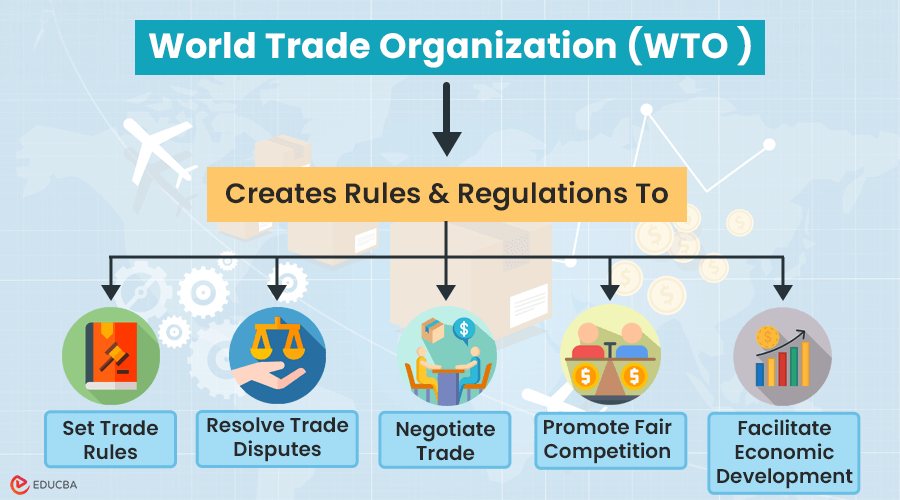
To summarize, the main functions of the WTO include:
- Administering Trade Agreements: It oversees the implementation of trade agreements negotiated by its member countries.
- Acting as a Forum for Trade Negotiations: It provides a platform for countries to negotiate and lower trade barriers.
- Settling Trade Disputes: If a member country believes another member is violating trade rules, it can file a complaint with the WTO, which acts as a neutral judge.
- Monitoring National Trade Policies: It reviews the trade policies of its members to ensure they are transparent and consistent with WTO rules.
- Providing Technical Assistance: It helps developing countries build their capacity to participate more fully in the global trading system.
Conclusion
In this lesson, we have examined Globalisation, the final pillar of the 1991 reforms. We saw how it aimed to integrate the Indian economy with the rest of the world and explored the specific measures used to achieve this.
Key Takeaways:
- Globalisation is the process of increasing economic integration and interdependence between nations, driven by the removal of barriers to trade and investment.
- India's key globalisation measures included reducing tariffs, removing quantitative restrictions, raising FDI limits, and making the rupee convertible.
- A major outcome for India was the growth of outsourcing, particularly in the IT and service sectors.
- The World Trade Organization (WTO), established in 1995, is the primary international body that sets the rules for global trade and works to resolve disputes between member nations.
Now that we have covered Liberalisation, Privatisation, and Globalisation individually, we are ready to take a step back and assess their overall impact. The next lesson will offer a critical appraisal of the LPG reforms, evaluating their successes and failures in transforming the Indian economy.