Hello! In our last lesson, we critically appraised the Green Revolution and its impact on Indian agriculture. We saw how policy was used to achieve the national goal of self-reliance in food. Now, we'll turn our attention to the second major pillar of the economy: industry.
This lesson will focus on the cornerstone of India's industrial strategy during the planning era, the Industrial Policy Resolution (IPR) of 1956. We will examine its key features and then conduct a critical appraisal, weighing its achievements against its shortcomings. Understanding this policy is crucial as it shaped the Indian economy for decades and set the stage for the major economic reforms of 1991.
1. The Rationale for State-Led Industrialisation
At the time of independence, India's industrial sector was very weak, primarily consisting of cotton and jute textile mills. To achieve the goals of growth and modernisation, rapid industrialization was essential. The question was: who would lead this effort?
The private sector at the time lacked the enormous capital required for heavy industries like steel, machinery, and power. Furthermore, the market was not large enough to encourage such massive private investment. For these reasons, combined with the political vision of building a "socialist pattern of society," the government decided to take the leading role.
The NCERT textbook provides a clear explanation of this context.
Chapter 02 Indian Economy 1950–1990 - SATHEE
This reading from your NCERT textbook explains why the government (public sector) had to play a dominant role in promoting industrial development after independence.
Read the section titled "Public and Private Sectors in Indian Industrial Development". Focus on the two main reasons given for why the government had to take the lead: the lack of capital in the private sector and the limited size of the market.
2. Key Features of the Industrial Policy Resolution (IPR) 1956
With the state positioned as the main driver of industrial growth, the Industrial Policy Resolution of 1956 was adopted. This policy acted as a comprehensive blueprint for industrial development and was the basis for the Second Five-Year Plan, which had a strong focus on industry.
The IPR 1956 had two main pillars: the classification of industries and the licensing system. The following video explains these features clearly.
Indian Economy 1950-1990 | One Shot | Chapter 2 | Best Explanation | Class 12
This video from Rajat Arora's "One Shot" series provides a clear and exam-oriented explanation of the core components of IPR 1956.
Watch the following segments: Three Schedules: Pay close attention to how industries were divided into three categories (Schedule A, B, and C) and the role of the public and private sectors in each. Industrial Licensing: Understand what licensing was and why it was required (for setting up, expanding, or diversifying an industry).
To summarise the video, the key features were:
A. Three-fold Classification of Industries:
The policy divided all industries into three schedules, which clearly demarcated the roles of the public and private sectors.
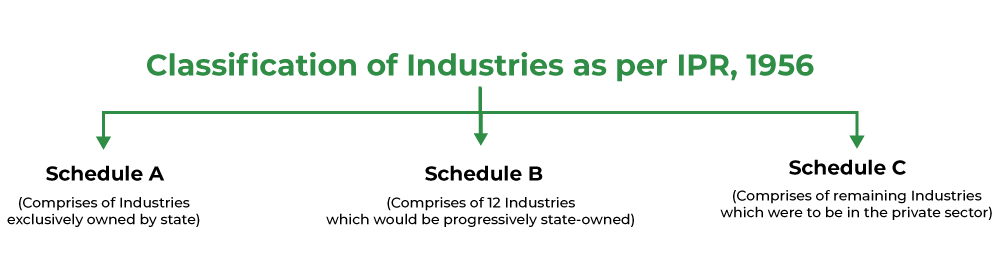
- Schedule A: Comprised 17 industries that were the exclusive responsibility of the State (public sector). This included strategic sectors like arms and ammunition, atomic energy, heavy machinery, iron and steel, and railways.
- Schedule B: Included 12 industries where the public sector would take the lead, but the private sector could supplement its efforts. The state would be responsible for starting new units in this category. Examples include aluminum, machine tools, and fertilisers.
- Schedule C: Consisted of all remaining industries, which were left open to the private sector. However, even these industries were subject to state regulation.
B. Industrial Licensing:
This was the primary tool for the government to control the private sector. No new industry could be established, and no existing one could expand or diversify its production, without obtaining a license from the government. The stated purposes of this "license raj" (or permit raj) were:
- To channel investment into desired areas.
- To promote regional equality by encouraging industries to set up in backward areas (where licenses were easier to get).
- To prevent the concentration of economic power.
- To ensure that the quantity of goods produced was not more than what the economy required.
3. Critical Appraisal of the Industrial Policy (1950-1990)
Now for the most important part of the learning outcome: the "critical appraisal." This means evaluating the policy's effectiveness by looking at both its positive and negative impacts.
Achievements
The industrial policies of the first seven Five-Year Plans had some notable successes.
- Increased Contribution to GDP: The share of the industrial sector in GDP increased significantly, from about 13% in 1950-51 to nearly 25% in 1990-91. This structural transformation is a key indicator of economic development.
- Diversification of Industry: The industrial base became much more diversified. India was no longer just a producer of cotton and jute goods. Thanks to the public sector, industries in engineering, capital goods, and various intermediate goods were established.
- Growth of Small-Scale Industries (SSI): The policy gave opportunities to entrepreneurs with less capital to start businesses, promoting employment and equity.
- Development of Indigenous Industries: Protection from foreign competition allowed domestic industries in sectors like electronics and automobiles to develop, which would have been difficult otherwise. This was a direct result of the import substitution strategy we will discuss in the next lesson.
Criticisms and Failures
Despite the achievements, the state-controlled industrial regime was widely criticised for its many shortcomings, which ultimately led to the reforms of 1991. The video below provides an excellent summary of the overall performance of the industrial sector and the major criticisms.
Indian Economy 1950-1990 | One Shot | Chapter 2 | Best Explanation | Class 12
This final segment from Rajat Arora's video provides a comprehensive appraisal of the industrial sector's performance from 1950-1990, highlighting both the good and the bad.
Watch from Overall Appraisal. Focus on the criticisms discussed: Poor performance of the public sector. Negative effects of the licensing policy. Drawbacks of being an inward-looking economy (protectionism).
Let's break down the main points of criticism:
-
Poor Performance of the Public Sector: Many public sector undertakings (PSUs) incurred huge losses yet continued to operate, becoming a drain on the nation's finances. The government also entered non-essential areas like hotels and bread manufacturing, where the private sector could have performed efficiently. The absence of competition often led to inefficiency and poor service (e.g., waiting for months to get a telephone connection).
-
Negative Effects of the 'Permit License Raj': The licensing system, instead of promoting efficiency, led to delays, corruption, and bureaucracy. Large industrial houses sometimes misused the system by obtaining a license not to start a new firm, but simply to prevent competitors from entering the market. Industrialists spent more time lobbying ministers for permits than focusing on improving their products.
-
Drawbacks of Protectionism: While protection helped domestic industries grow, it also shielded them from international competition. This meant producers had little incentive to improve the quality of their products or reduce costs. Indian consumers had to buy whatever was available, often low-quality goods at high prices.

Conclusion
The industrial policy of the 1950-1990 period, epitomised by the IPR 1956, had a dual legacy. On one hand, it successfully laid the foundation for a diversified industrial base and was instrumental in building key infrastructure, fulfilling the goal of Growth and Modernisation.
On the other hand, the dominance of an often inefficient public sector, the stifling effects of the license raj, and the lack of foreign competition created an uncompetitive and high-cost economy. This system fell short on efficiency and often hampered the very growth it was designed to promote. This complex legacy is essential to understand why India embarked on a path of major economic reforms in 1991.
Key Takeaways:
- IPR 1956 was the blueprint for India's state-led industrialization.
- Key Features: It classified industries into three schedules (A, B, C) giving a dominant role to the public sector and used a system of industrial licensing to regulate the private sector.
- Achievements: It diversified the industrial base and increased industry's share in GDP.
- Failures: It led to inefficient PSUs, corruption and delays due to the "license raj," and a lack of competition, resulting in low-quality goods for consumers.
In our next lesson, we will examine the trade policy that went hand-in-hand with this industrial strategy: Import Substitution. We will critically appraise this "inward-looking" trade strategy and its impact on the Indian economy.