Hello! In our previous lesson, we analyzed India's industrial policy under the IPR 1956 and saw how it gave a dominant role to the public sector. Today, we'll examine the trade policy that worked in tandem with this industrial strategy. Both were key components of India's "inward-looking" approach to economic development from 1950 to 1990.
This lesson focuses on India's foreign trade policy of import substitution. Our goal is to critically appraise this policy, which means we will first understand what it is and why it was adopted, and then evaluate its positive and negative consequences for the Indian economy.
1. What is Import Substitution?
As the name suggests, the policy of import substitution is about replacing or substituting goods that are imported from other countries with goods that are produced domestically. This was the central pillar of India's trade policy during the first seven Five-Year Plans (roughly 1951 to 1990). This entire strategy is often called an "inward-looking trade strategy" because its primary focus was on the domestic economy rather than on trade with the rest of the world.
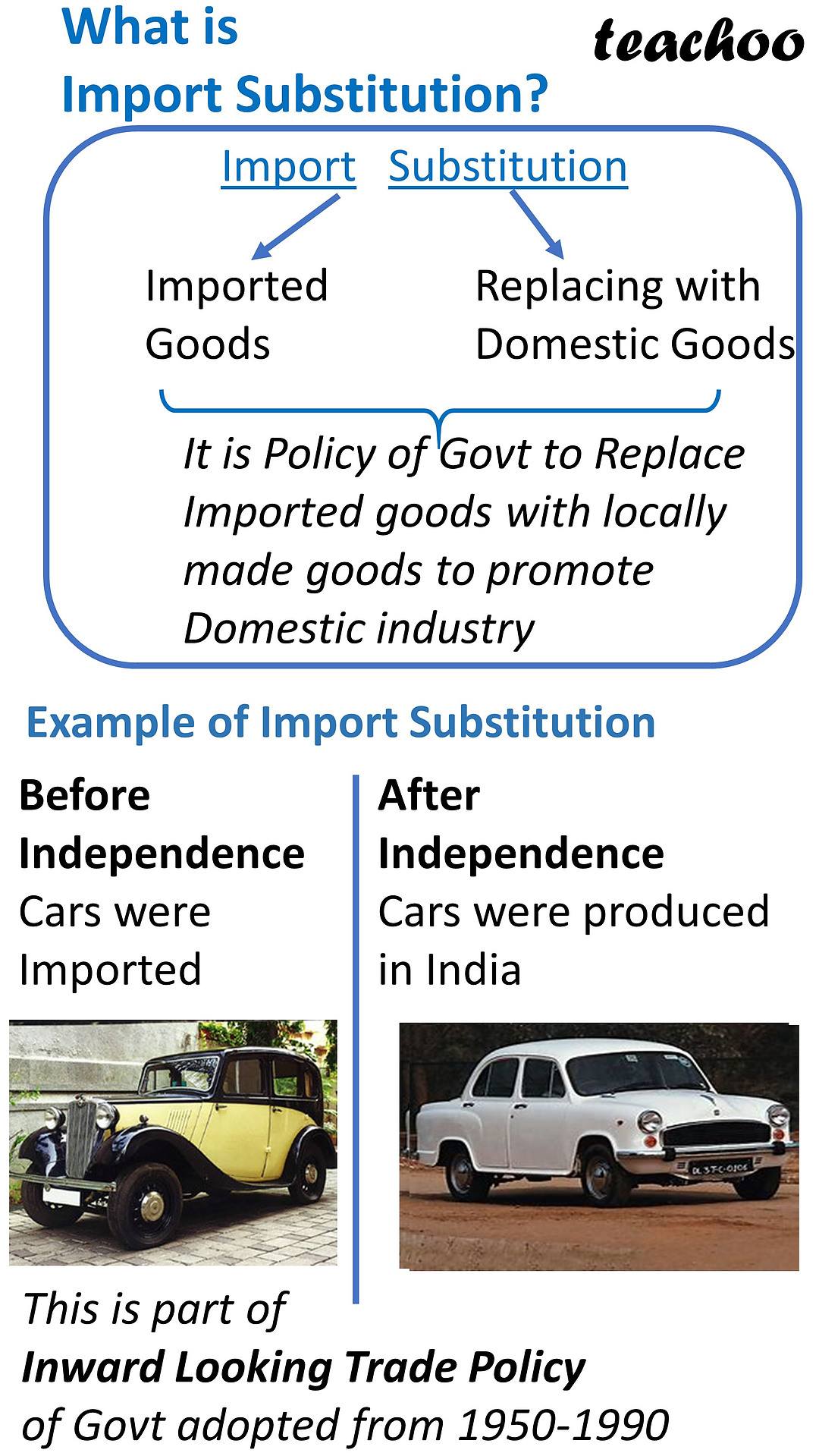
To get a clear understanding of the policy and the reasons behind it, let's watch a short video.
FOREIGN TRADE | INWARD LOOKING TRADE STRATEGY | INDIAN ECONOMY 1950-1990 | CLASS 12
This video by Rajat Arora provides a concise explanation of what import substitution is and why it was considered necessary for India after independence.
Watch the following two segments: Introduction: This part sets the context by linking to the experience under British rule and the need to protect domestic producers. Meaning and Objectives: This segment defines import substitution and explains its three main objectives.
As the video explains, the rationale for adopting this policy was based on three main objectives:
- To Protect Domestic Industries: After independence, Indian industries were new and underdeveloped (often called 'infant industries'). They were in no position to compete with the large, established, and efficient industries from developed countries. Protection from foreign competition was seen as essential for their survival and growth.
- To Conserve Foreign Exchange: As a developing nation, India had limited reserves of foreign currency. This foreign exchange was crucial for importing essential goods like heavy machinery, technology, and crude oil, which could not be produced at home. By restricting the import of non-essential consumer goods, the government aimed to save this precious foreign exchange.
- To Achieve Self-Reliance: A key goal of India's Five-Year Plans was to become self-reliant and reduce dependence on other countries, especially for critical goods. This was seen as vital for the nation's economic sovereignty.
2. How was Import Substitution Implemented?
To enforce this policy and protect domestic industries, the government used a two-pronged approach of trade barriers. The goal was simple: make imports either more expensive or harder to get.
The video you just watched briefly introduces these tools. Let's delve into them more formally.
FOREIGN TRADE | INWARD LOOKING TRADE STRATEGY | INDIAN ECONOMY 1950-1990 | CLASS 12
This next segment of the same video explains the two primary instruments used by the government to implement the import substitution policy.
Please watch from Tariffs and Quotas. Pay attention to the difference between the two.
To summarize the government's tools of protection:
- Tariffs: These are essentially taxes imposed on imported goods. By levying heavy taxes on imports, the government made them more expensive for Indian consumers. This price difference naturally discouraged their use and made domestically produced goods seem cheaper and more attractive.
- Quotas: These are non-tariff barriers that specify the maximum quantity of a good that can be imported. For example, the government could declare that no more than 10,000 television sets could be imported in a year. This directly restricted the supply of foreign goods in the market, forcing consumers to turn to domestic producers.
Together, tariffs and quotas created a protected market where domestic firms could operate without the threat of foreign competition.
3. Critical Appraisal of the Policy
Now we come to the core of our lesson: a "critical appraisal." This involves a balanced evaluation, looking at both the achievements (the good effects) and the failures (the bad effects) of the policy.
Achievements (The Good Effects)
The policy of import substitution did have some significant positive impacts, especially in the initial decades.
- Diversification of Industrial Base: Protected from foreign competition, India's industrial sector grew and diversified significantly. By 1990, India was producing a wide variety of goods, from consumer products to engineering goods, a big change from being dependent on just cotton and jute textiles at independence.
- Growth of Indigenous Industries: The policy was crucial for the development of indigenous industries in sectors like automobiles and electronics. Without this protection, these sectors might not have developed at all.
- Foundation for Self-Reliance: It laid the groundwork for self-sufficiency and reduced the country's vulnerability to external economic shocks for a period.
Criticisms (The Bad Effects)
Despite the initial successes, by the 1980s, it became clear that prolonged protection was doing more harm than good. The following animated video provides an excellent summary of the policy's impact and its major criticisms.
Indian Economy 1950-1990 | Economics Class12 NCERT| Animation
This animated video from SpeltOut provides a clear overview of the trade policy and its overall impact, both positive and negative.
Watch the following parts: Trade Policy: This section quickly recaps the policy and its tools. Impact and Criticism: This is the most important part. Focus on the reasons why economists began to criticize the policy, such as lack of competition and poor quality.
To elaborate on these criticisms, let's turn to the detailed explanation in your NCERT textbook.
[PDF] Indian Economy 1950-1990 - NCERT
This reading from your NCERT textbook provides a detailed critical evaluation of the protectionist policies, which is essential for answering board exam questions effectively.
Find the subsection titled "Effect of Policies on Industrial Development". Read from the paragraph that begins "In spite of the contribution made by the public sector..." to the paragraph that ends with "...the rich nations continue to do so." Focus on the arguments against the public sector monopolies and the protection from foreign competition.
Based on the video and the textbook, the major failures of the import substitution policy were:
- Lack of Competition and Inefficiency: By shielding domestic producers from any foreign competition, the policy removed the incentive to innovate, improve efficiency, or reduce costs. Producers knew they had a captive market and could sell whatever they produced.
- Low-Quality and High-Priced Goods: As a result of the lack of competition, Indian consumers often had to settle for low-quality products at high prices. There was little choice and no pressure on firms to improve their offerings.
- Growth of Inefficient Public Sector Monopolies: Many public sector firms, operating as monopolies in a protected market, became notoriously inefficient and unresponsive to consumer needs (the video's example of waiting years for a telephone connection is a classic case).
- Failure to Promote Exports: The policy was so focused on replacing imports (inward-looking) that it completely neglected the promotion of exports (outward-looking). A strong export sector is vital for earning foreign exchange and driving growth, but this was not a priority. The strategy was about saving foreign exchange, not earning it.
Conclusion
India's policy of import substitution had a mixed legacy. In the early years, it was successful in achieving its goals of protecting infant industries and diversifying the industrial base. It fulfilled the objective of self-reliance to a large extent.
However, the prolonged protection from competition ultimately created a high-cost, inefficient, and non-competitive economy. The lack of incentive to improve quality and the failure to build a strong export sector were significant drawbacks. By the late 1980s, there was a widespread consensus that this inward-looking strategy had run its course and that the economy needed to open up to competition and global trade. These failures were a primary catalyst for the landmark New Economic Policy of 1991, which we will study in the next module.
Key Takeaways:
- Import Substitution: An inward-looking trade policy to replace foreign imports with domestic production.
- Objectives: To protect infant industries, conserve foreign exchange, and achieve self-reliance.
- Tools: High tariffs (taxes on imports) and strict quotas (quantitative limits on imports).
- Achievements: Diversified industrial base and growth of indigenous industries.
- Failures: Led to inefficiency, low-quality goods at high prices, and a weak export sector due to lack of competition.
In our next lesson, we will put this knowledge to the test by tackling representative CBSE board paper questions from 2019-2024 related to the entire 1950-1990 period. This will help you apply these concepts just as you'll need to in your exam.