Welcome back! In our last lesson, we established the four main goals of India's Five-Year Plans: Growth, Modernisation, Self-Reliance, and Equity. Now, we'll see how these goals were put into action in one of the most critical sectors of the economy—agriculture.
Given the stagnant state of agriculture at independence, radical policy changes were necessary to achieve growth and self-reliance in food. This lesson focuses on the most significant of these policies: the Green Revolution. We will break down its key features and, most importantly, critically evaluate its successes and failures, which is a common requirement in board exams.
1. The Need for the Green Revolution
In the mid-1960s, India faced a severe food crisis. Agricultural productivity was extremely low due to outdated technology, dependence on the monsoon, and the legacy of the exploitative land tenure system. This forced India to import food grains, mainly from the USA, which contradicted the national goal of self-reliance.
To understand the context that led to the Green Revolution, let's start with your NCERT textbook.
[PDF] Indian Economy 1950-1990 - NCERT
This section explains the dire state of Indian agriculture post-independence and introduces the Green Revolution as the solution to permanently break the stagnation.
Find the heading "The Green Revolution". Read from the beginning of this section until the paragraph ending with "...or any other nation, for meeting its food requirements." Focus on the reasons mentioned for low productivity and why achieving self-sufficiency was so crucial.
As the text highlights, the threat of food scarcity and dependence on foreign aid created an urgent need for a new agricultural strategy. This strategy came to be known as the Green Revolution.
2. What was the Green Revolution? Key Features
The term "Green Revolution" refers to the large increase in the production of food grains resulting from a package of modern agricultural inputs. It wasn't just one change, but a combination of several new technologies and policies introduced in the mid-1960s.
The following video provides a comprehensive overview of the core features of the Green Revolution.
GREEN REVOLUTION- Features, Achievements & Failures| Indian Agriculture| Indian Economy| Class-12
Watch this segment from "GREEN REVOLUTION- Features, Achievements & Failures" by Surbhi Gupta Academy. It clearly explains the components of this new strategy.
Watch the following parts: Definition: Get a simple definition of the Green Revolution. Three Elements: Understand the three core pillars of the strategy. Detailed Features: Pay close attention to the specific policies implemented, like credit provision and Minimum Support Price (MSP).
To summarize, the key features of the Green Revolution package included:
- High-Yielding Variety (HYV) Seeds: These were "miracle seeds," particularly for wheat and rice, which could produce much larger quantities of grain.
- Chemical Fertilisers and Pesticides: The HYV seeds required specific chemical inputs to achieve their high-yield potential and protection from pests.
- Irrigation: The new seeds also required a regular and controlled supply of water, making the expansion of irrigation facilities (canals, tubewells) essential.
- Farm Mechanisation: Use of modern machinery like tractors, threshers, and harvesters increased.
- Agricultural Credit: The government ensured that farmers, especially smaller ones, could get loans from banks to afford the expensive new inputs.
- Minimum Support Price (MSP): The government guaranteed a minimum price for farmers' produce to protect them from price fluctuations and encourage them to adopt the new, riskier technology.
3. Critical Appraisal: The Impacts of the Green Revolution
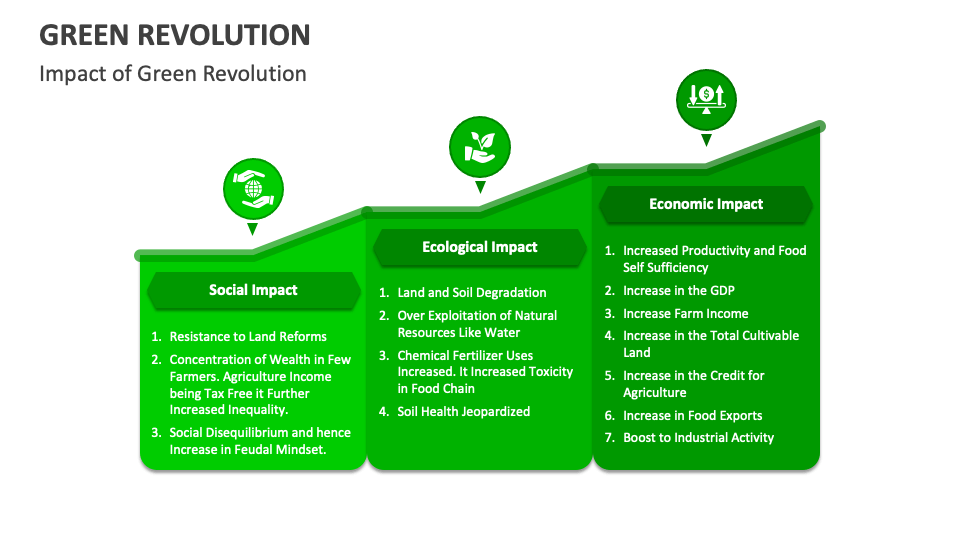
Now for the most important part: a "critical appraisal." This means looking at both the positive and negative consequences. The Green Revolution was a game-changer for India, but its benefits were not universal, and it came at a cost.
The image below provides a fantastic summary of the economic, social, and ecological impacts, which we will explore in detail.
Achievements (The "Good")
The Green Revolution was immensely successful in its primary objective: making India self-sufficient in food grains.
GREEN REVOLUTION- Features, Achievements & Failures| Indian Agriculture| Indian Economy| Class-12
Continue with the Surbhi Gupta Academy video to understand the positive outcomes.
Watch the section from Achievements. The video explains several key benefits. Focus on: Rise in production and productivity. Attaining self-sufficiency in food grains. Increase in farmers' income. Shift from subsistence to commercial farming.
Two key concepts that are direct results of these achievements are:
- Marketable Surplus: This is the portion of agricultural produce that farmers sell in the market after meeting their own consumption needs. The huge increase in production led to a substantial marketable surplus, especially for wheat and rice. This helped control food grain prices in urban areas.
- Buffer Stocks: The government was able to purchase the surplus food grains (a process called procurement) and build large emergency reserves or "buffer stocks." As the video below explains, this was crucial for ensuring national food security.
Most Important Previous year questions | Indian eco Chapter 1 & 2 | Class 12 Economics Board 2025
This clip from Sunil Panda's channel explains how the Green Revolution helped the government build buffer stocks, a key objective for your exams.
Watch from Buffer Stocks to see how surplus production enabled the government to create food reserves for times of shortage.
Failures and Criticisms (The "Bad" and the "Ugly")
Despite its successes, the Green Revolution had significant downsides. A critical appraisal must address these limitations.
GREEN REVOLUTION- Features, Achievements & Failures| Indian Agriculture| Indian Economy| Class-12
The final segment of the Surbhi Gupta Academy video provides a detailed list of the failures and negative consequences.
Watch the section on Failures. Pay close attention to the following points: Limited Crops and Areas: Why the revolution was not 'green' everywhere. Increased Inequalities: The gap between rich and poor farmers widened. Ecological Degradation: The environmental cost of the new technology.
Let's expand on two of the most important criticisms:
1. Increased Disparity:
There was a fear that the benefits of the Green Revolution would only go to rich farmers who could afford the expensive HYV seeds, fertilisers, and machinery. This would increase the income gap between rich and poor farmers, and between prosperous regions (like Punjab, Haryana) and the rest of the country.
Your NCERT textbook explains how the government tried to address this.
[PDF] Indian Economy 1950-1990 - NCERT
This section discusses the risks associated with the Green Revolution and the government's response.
Find the paragraph that starts with "While the nation had immensely benefited from the green revolution..." and read to the end of that section. Notice the role the government played by providing subsidised loans and fertilisers to help small farmers.
2. Ecological Damage:
The intensive use of chemical fertilisers and pesticides, along with the over-extraction of groundwater for irrigation, led to serious environmental problems.
Most Important Previous year questions | Indian eco Chapter 1 & 2 | Class 12 Economics Board 2025
This clip from Sunil Panda's channel directly answers a board-style question about the ecological criticisms of the Green Revolution.
Watch from Ecological Criticisms. This concisely explains how the use of chemicals led to soil degradation and water pollution.
This issue is also highlighted in the case study below, which is typical of what you might see in your board paper.
This case study from the CBSE Support Material summarizes the Green Revolution and its environmental consequences.
Read the text under Case Study 1. Focus on the last paragraph, which lists environmental problems like waterlogging, soil erosion, and the decline of the groundwater table.
4. The Debate Over Subsidies
A key policy tool used to promote the Green Revolution was subsidies—on fertilisers, water, and credit. This remains a hotly debated topic even today. Understanding this debate adds depth to your critical appraisal.
[PDF] Indian Economy 1950-1990 - NCERT
This section presents both sides of the argument regarding agricultural subsidies.
Read the section titled "The Debate Over Subsidies". Try to summarize the main argument for continuing subsidies and the main argument against them.
- Argument For: Subsidies are necessary because farming is risky, most farmers are poor and cannot afford inputs otherwise, and eliminating them would increase inequality.
- Argument Against: Subsidies are a huge burden on government finances, and they often benefit the fertiliser industry and wealthy farmers in prosperous regions more than the poor farmers they are intended for.
Conclusion
The Green Revolution was a pivotal moment in India's economic history. It successfully addressed the critical challenge of food security, transforming India from a food-deficient nation to a self-sufficient one. This was a major step towards achieving the planning goals of Growth and Self-Reliance.
However, this success came at a cost. It bypassed many regions and small farmers, contributing to regional and personal inequality, which went against the goal of Equity. Furthermore, its environmental impact raises serious questions about long-term sustainability. A complete "critical appraisal" requires you to present this balanced view, acknowledging both the monumental achievements and the significant drawbacks.
Key Takeaways:
- The Green Revolution was a technology and policy package designed to increase food grain production using HYV seeds, fertilisers, pesticides, and irrigation.
- Successes: It led to self-sufficiency in food grains, created buffer stocks, increased farmers' incomes, and generated a marketable surplus.
- Failures: Its benefits were limited to certain crops (wheat, rice) and regions (Punjab, Haryana, Western UP), it increased inequality between rich and poor farmers, and it caused severe ecological damage.
- Government intervention through subsidies and credit was crucial for spreading the technology but remains a debated topic.
In our next lesson, we will shift our focus from agriculture to industry and trade, examining the policies that shaped India's industrial development during the 1950-1990 period.