Hello! In our last lesson, we explored how the Balance of Payments account is always brought into balance using autonomous and accommodating transactions. We learned that a deficit or surplus is determined by autonomous ("above the line") items, and then settled by accommodating ("below the line") items.
Today, we'll shift our focus to the price at which these international transactions happen: the foreign exchange rate. This lesson will explain how this rate is determined in a free market. Your learning outcome is to understand how the equilibrium foreign exchange rate is set by the fundamental economic forces of demand and supply. This is a core concept in macroeconomics and a frequent topic in your board exams.
1. The Market for Foreign Exchange
Before we can determine the price, we need to understand the market itself. What is being bought and sold, and why?
A foreign exchange rate is simply the price of one currency in terms of another. For example, if ₹80 are needed to buy $1, the exchange rate is ₹80/$.
The demand for and supply of foreign currency (like the US Dollar) creates the foreign exchange market. Let's understand who demands dollars and who supplies them.
Foreign Exchange Rate | One Shot | Easiest Explanation | Chapter 11 | Class 12 | Macro Economics
We'll watch a clip from the video "Foreign Exchange Rate | One Shot" by Rajat Arora to understand the sources of demand and supply, and how they relate to the exchange rate.
Watch the segment from Demand and Supply. As you watch, focus on two key things for both demand and supply: Sources: Why do we need foreign currency (demand) and where does it come from (supply)? Relationship with Price: How does the quantity demanded or supplied change when the exchange rate (price) changes?
Let's break down what you just saw:
The Demand for Foreign Exchange
People in India demand foreign currency (e.g., US dollars) for various reasons, all of which involve making payments to other countries:
- To import goods and services: Buying an iPhone from the US requires payment in dollars.
- To travel abroad (tourism): A vacation in New York requires dollars for expenses.
- To purchase assets abroad: Buying property or shares in a US company.
- To send gifts or grants: Remittances sent to family members abroad.
- To repay international loans.
The demand curve for foreign exchange is downward-sloping. This is due to an inverse relationship between the exchange rate and the quantity demanded.
- If the exchange rate falls (e.g., $1 = ₹75 instead of ₹80), US goods become cheaper for Indians. This will likely increase imports from the US, leading to a higher quantity demanded of dollars.
- If the exchange rate rises (e.g., $1 = ₹85), US goods become more expensive, and the quantity demanded of dollars will fall.
The Supply of Foreign Exchange
Foreign currency flows into India for reasons that are the mirror image of demand:
- Exports of goods and services: When an Indian company sells software to a US client, it earns dollars, which it supplies to the market to convert into rupees.
- Foreign tourism in India: American tourists supply dollars to the market to get rupees for their expenses here.
- Foreign investment in India: When a US firm invests in India (FDI or FII), it supplies dollars.
- Remittances from Indians living abroad.
The supply curve for foreign exchange is upward-sloping. This reflects a positive relationship between the exchange rate and the quantity supplied.
- If the exchange rate rises (e.g., $1 = ₹85 instead of ₹80), Indian goods become cheaper for Americans. They will likely buy more from India, increasing our exports and thus increasing the supply of dollars to the Indian market.
- If the exchange rate falls (e.g., $1 = ₹75), Indian goods become more expensive for them, and the supply of dollars will decrease.
2. Equilibrium in the Foreign Exchange Market
Now that we have our demand and supply curves, finding the equilibrium rate is straightforward. Just like in any market, the equilibrium price is where the quantity demanded equals the quantity supplied.
Determination of Exchange Rate - GeeksforGeeks
This article from GeeksforGeeks provides a clear, textbook-style explanation of how the equilibrium rate is determined.
Read the section under the heading "How Foreign Exchange Rate is Determined?". Pay close attention to the diagram and the explanation of the equilibrium point 'E'.
The key idea is that under a flexible exchange rate system, the rate is determined by the "invisible hand" of market forces. There is no government intervention.
The point where the downward-sloping demand curve intersects the upward-sloping supply curve is the equilibrium.
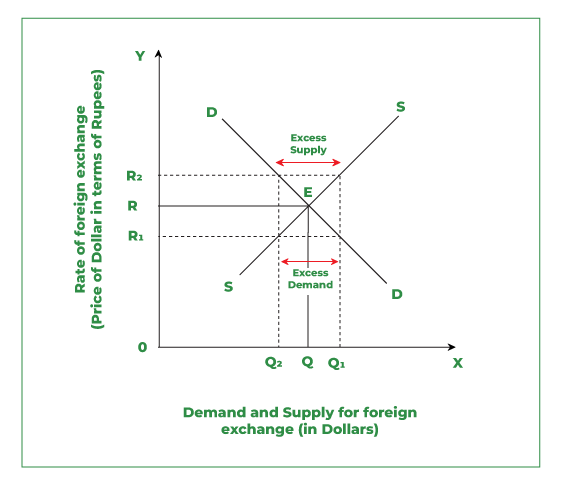
At the equilibrium rate OR, the quantity of foreign exchange demanded by the market (OQ) is exactly equal to the quantity supplied (OQ). The market clears, and there is no pressure for the rate to change.
3. Disequilibrium: Excess Supply and Excess Demand
What happens if the prevailing exchange rate is not at the equilibrium level? The market forces will automatically push it back towards equilibrium.
Let's use the same diagram to understand this.
Case 1: Excess Supply (Rate is above equilibrium)
Imagine the rate is at OR₂, which is higher than the equilibrium rate OR.
- Supply: At this higher rate, supplying foreign currency is more attractive. The quantity supplied increases to Q₂. (Exporters want to sell more).
- Demand: At this higher rate, foreign currency is more expensive. The quantity demanded falls to Q₁. (Importers want to buy less).
- Result: There is an excess supply of foreign currency equal to the gap between Q₁ and Q₂. With more sellers than buyers, the price (exchange rate) will be pushed down, moving back towards the equilibrium rate OR.
Case 2: Excess Demand (Rate is below equilibrium)
Now, imagine the rate is at OR₁, which is lower than the equilibrium rate OR.
- Demand: At this lower rate, foreign currency is cheaper. The quantity demanded increases to Q₂. (Importers rush to buy).
- Supply: At this lower rate, supplying foreign currency is less attractive. The quantity supplied falls to Q₁. (Exporters hold back).
- Result: There is an excess demand for foreign currency equal to the gap between Q₁ and Q₂. With more buyers than sellers, the price (exchange rate) will be bid up, moving back towards the equilibrium rate OR.
This self-correcting mechanism is the hallmark of a flexible exchange rate system.
Foreign Exchange Rate | One Shot | Easiest Explanation | Chapter 11 | Class 12 | Macro Economics
Let's watch Rajat Arora explain this dynamic adjustment process on the graph.
Watch the section from Equilibrium and Disequilibrium. Notice how he walks through the scenarios when the rate is too low (creating excess demand) and too high (creating excess supply).
4. Applying the Concept: CBSE Board Questions
As you requested, let's practice with questions from past papers. This will help you structure your answers for the exam.
Important Questions for class 12 economics Foreign Exchange Rate
This resource from LearnCBSE compiles important questions, including those from past boards.
Review Question 15 and Question 32. Notice that both ask the same fundamental question. For your exam, a good answer would include: A statement that the rate is determined by the forces of demand and supply. A brief explanation of why the demand curve slopes down and the supply curve slopes up. A correctly labelled diagram showing the intersection of the demand and supply curves to determine the equilibrium rate and quantity.
This simple, three-part structure (statement, explanation, diagram) is a reliable way to score full marks on such a question.
Conclusion
In this lesson, we have seen how the foreign exchange rate is determined in a free market, much like the price of any other commodity.
Key Takeaways:
- The demand for foreign exchange is driven by outflows (imports, foreign investment, etc.) and has an inverse relationship with the exchange rate.
- The supply of foreign exchange is driven by inflows (exports, investment from abroad, etc.) and has a positive relationship with the exchange rate.
- The equilibrium exchange rate is determined at the intersection of the demand and supply curves, where the quantity demanded equals the quantity supplied.
- If the rate is above equilibrium, an excess supply will push it down. If the rate is below equilibrium, an excess demand will push it up.
You now have a solid foundation for how the exchange rate is set. In our next lesson, we will build directly on this by asking: What causes the exchange rate to change? We will analyze how shifts in the demand and supply curves lead to currency appreciation and depreciation.