Hello! In our last lesson, we established the difference between the Balance of Trade (BoT) and the broader Balance of Payments (BoP). We concluded by noting a fascinating aspect of BoP accounting: while it can show a "deficit" or "surplus," the final statement always balances. Today, we'll uncover exactly how this balancing act is performed.
This lesson focuses on distinguishing between autonomous and accommodating transactions. Understanding this distinction is the key to deciphering how a country manages imbalances in its international payments. This is a fundamental concept for your board exams and frequently appears in questions.
1. The Core Idea: Profit Motive vs. Balancing Motive
At the heart of international transactions are two different motivations. Some transactions are made for their own economic reasons, like earning a profit. Others are made purely to settle the accounts and cover any shortfalls or manage any excess funds that arise from the first type of transaction.
Let's watch a short video that introduces these two types of transactions and the common terminology used to describe them.
Balance of Payments | One Shot | Easiest Explanation | Chapter 12 | Class 12 | Macro Economics
We'll once again turn to the "Balance of Payments | One Shot" video by Rajat Arora for a concise explanation.
Please watch the segment from defining the terms. Pay close attention to the motive behind each transaction type and the alternate names he introduces: "above the line" and "below the line."
As the video explains, we can categorize all international economic transactions based on their primary purpose:
-
Autonomous Transactions: These are international economic transactions undertaken with an economic motive, such as earning income or making a profit. They are independent of the country's BoP situation. Think of a company exporting goods to make money or investing abroad to get returns. These are the "standard" business transactions. They are called "above the line" items because they are recorded first, and it is their net outcome that determines if the BoP is in surplus or deficit.
-
Accommodating Transactions: These are transactions undertaken to cover a deficit or absorb a surplus in the autonomous transactions. They are not driven by a profit motive. Instead, their purpose is to "accommodate" the gap left by the autonomous items and bring the BoP account back into balance. These are called "below the line" items because they are the final balancing entries in the BoP account.
In simple terms:
Autonomous transactions create the BoP imbalance. Accommodating transactions correct it.
2. Deepening the Distinction
Now that you have the basic idea, let's formalize the differences. This is exactly the kind of point-by-point comparison you might need for a descriptive question in your exam.
The table below provides a clear summary of the key differences.
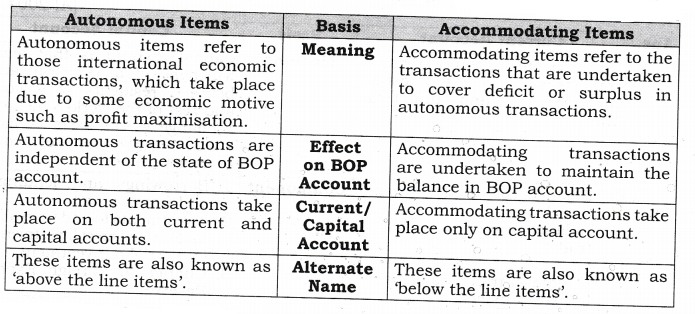
To reinforce these points, let's review a segment that directly compares the two.
Balance of Payments | One Shot | Easiest Explanation | Chapter 12 | Class 12 | Macro Economics
This is another clip from the same Rajat Arora video.
Watch the short segment on the key differences. Notice the crucial point made at the end: accommodating items appear only in the Capital Account.
This brings us to a critical distinction:
- Autonomous items can be part of both the Current Account (e.g., export/import of goods and services) and the Capital Account (e.g., foreign direct investment, commercial loans).
- Accommodating items are exclusively Capital Account transactions. They typically involve the country's central bank and its official reserves. Examples include borrowing from the IMF or selling/buying foreign currency from the official reserve account.
3. Application with CBSE Board Questions
Your goal is to master exam questions, so let's apply this theory to real scenarios from past papers.
Case Study Application
This first video presents a case study that perfectly illustrates the difference in motive. Try to answer the question yourself before the video reveals the solution.
Most Important Questions Balance Of Payment Class 12 Economics | Cbse Board Exam 2026
This video from Next Toppers presents a case study involving two different types of loans.
Watch the "Mr. Spector" case study. Why is Mr. Spector's loan for his business considered autonomous, while the government's loan to cover the deficit is accommodating? The explanation will solidify your understanding.
The reasoning is straightforward:
- Mr. Spector's loan is for business expansion, a profit-motivated activity. This is an autonomous transaction.
- The government's loan is explicitly to cover a BoP deficit, a balancing activity. This is an accommodating transaction.
Board Paper Questions
Now let's tackle questions directly from recent CBSE board papers. This is the best way to prepare.
Question 1 (CBSE 2024 Paper)
CBSE Class 12 Economics Question Paper 2024 (Set 1- 58/4/1) with ...
This resource contains a direct question on our topic.
Read Question 12 and its provided solution. Note how the answer is structured: a clear definition for each item followed by a simple, direct example. This is a model answer format.
Question 2 (CBSE 2024 Paper)
This multiple-choice question tests a very important implication of the concept.
[PDF] CBSE BOARD EXAMINATION–2024
This resource contains an MCQ that tests a subtle but important aspect of the topic.
Find and read Question 10 and its corresponding explanation in the solution section.
Question: The measurement of Balance of Payments deficit is based on ________ transactions.
Answer: (A) Autonomous
Explanation: This is a crucial point. The "BoP deficit" or "BoP surplus" refers to the net outcome of only the autonomous transactions. If autonomous inflows are greater than autonomous outflows, there is a surplus. If outflows are greater, there is a deficit. The accommodating transactions are then undertaken to settle this deficit or surplus.
Conclusion
In this lesson, we have dissected the difference between autonomous and accommodating transactions, the two forces that shape the Balance of Payments account.
Key Takeaways:
- Autonomous transactions are independent economic activities driven by a profit motive. They occur on both the Current and Capital accounts.
- Accommodating transactions are dependent transactions undertaken to settle the BoP balance. They are not for profit and occur only on the Capital Account.
- The net result of all autonomous transactions determines the BoP surplus or deficit.
- Accommodating transactions (like using foreign reserves or borrowing from the IMF) finance this deficit or absorb the surplus, ensuring the final BoP account balances.
We have now covered the core components and structure of the Balance of Payments. In the next lesson, we will move to the second half of this chapter and explore how the foreign exchange rate is determined in the market through the forces of demand and supply.