Welcome back! In our last lesson, we broke down the Balance of Payments (BOP) into its two main components: the Current Account and the Capital Account. You learned that the key difference lies in whether a transaction affects a country's assets and liabilities.
Today, we will build directly on that knowledge to tackle a very common and important distinction: the difference between the Balance of Trade (BoT) and the Balance of Payments (BoP). While they sound similar, they measure very different things, and understanding this difference is crucial for accurately interpreting a country's international economic position.
Let's begin by defining these two concepts.
1. Defining Balance of Trade (BoT) and Balance of Payments (BoP)
As you know from your accounting studies, accounts can be broken down into sub-accounts. The Balance of Payments is the main account, and the Balance of Trade is a specific, smaller part of it.
Let's watch a video that introduces both concepts and shows how they relate to each other.
Balance of Payments | One Shot | Easiest Explanation | Chapter 12 | Class 12 | Macro Economics
We'll revisit the "Balance of Payments | One Shot" video by Rajat Arora, which you saw in the previous lesson. It provides a very clear visual explanation of how BoT fits within the larger BoP framework.
Please watch the following segments: What is BoP? This is a quick recap. Focus on how BoP is an accounting statement that records all economic transactions (visibles, invisibles, unilateral, capital). BOP Components: This section lays out the different transactions. Notice how the instructor groups the first three (visibles, invisibles, unilateral) into the Current Account. What is BoT? This is the key part. Pay close attention to how the instructor isolates only the "Visibles" (goods) to define the Balance of Trade.
From the video, we can establish two clear definitions:
- Balance of Payments (BoP): A comprehensive and systematic record of all economic transactions between the residents of a country and the rest of the world over a period. It's the whole picture.
- Balance of Trade (BoT): A narrow record showing the difference between the value of a country's export of goods and import of goods only. It is also known as the balance of visible trade or merchandise trade.
The BoT can be in one of three states:
- BoT Surplus (or Favourable BoT): Value of exports of goods > Value of imports of goods.
- BoT Deficit (or Unfavourable BoT): Value of exports of goods < Value of imports of goods.
- Balanced BoT: Value of exports of goods = Value of imports of goods.
2. The Relationship: BoT as a Part of BoP
The most important thing to remember is that BoT is just one component of the BoP. Specifically, it is the first item within the Current Account.
This flowchart provides a clear visual breakdown:

3. Key Differences Summarised
Now that we understand the basic relationship, let's explore the specific differences in more detail. The following article provides a concise comparison.
Difference Between Balance of Trade and Balance of Payments
This article from KeyDifferences.com lays out the distinctions very clearly.
Please read the "Comparison Chart" first. It's a quick, at-a-glance summary. Then, read the section titled "Key Differences Between Balance of Trade and Balance of Payments" for a point-by-point explanation. Focus on differences in scope, components, and the type of economic picture each provides.
To consolidate what you've just read, here is another summary table that is formatted slightly differently but conveys the same core ideas.
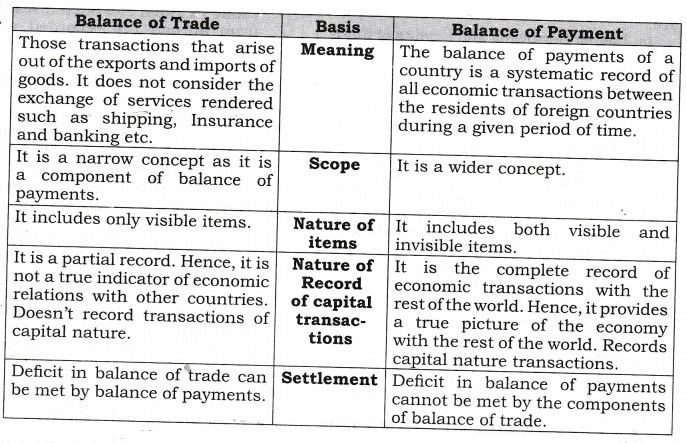
Based on these resources, the key distinctions are:
- Scope: BoT is a narrow concept (only goods), while BoP is a wide concept (goods, services, transfers, capital).
- Components: BoT is a part of the Current Account. BoP is composed of the Current Account and the Capital Account.
- Capital Transactions: BoT does not record any capital transactions. BoP does record all capital transactions.
- Economic Picture: BoT gives a partial view of a country's economic standing. BoP provides a complete view.
A crucial point, especially given your accounting background, is that while the BoT can show a surplus or deficit, the final BoP statement, in an accounting sense, must always balance (Credits = Debits) through the use of accommodating transactions, which we will discuss in the next lesson.
4. Practice Questions
Let's apply this knowledge to some exam-style questions, which is a key part of your preparation strategy.
Numerical Application
First, watch this short video for a simple numerical example of calculating the Balance of Trade.
Most Important Questions Balance Of Payment Class 12 Economics | Cbse Board Exam 2026
This video from Next Toppers demonstrates a straightforward calculation.
Watch the segment from BoT Calculation. Notice how the formula is simply Exports - Imports and a positive result means a 'surplus'.
CBSE Board Question
Now, try this question from a past CBSE paper.
[PDF] CBSE Class XII Economics Set III Question Paper with Solutions
This resource contains a question directly related to our topic.
Find Question 6 in the paper. Read the question, and before looking at the solution, try to calculate the answer yourself using the BoT formula.
Let's walk through it:
- Formula: Balance of Trade (BOT) = Exports of merchandise - Imports of merchandise
- Given:
- A "favourable balance" of ₹500 crore. This means BoT Surplus, so BOT = +500.
- Exports of merchandise = ₹1,200 crore.
- Transfer payments = ₹400 crore. (Note: This is a distractor! Transfer payments are part of the Current Account, but not the BoT).
- Calculation:
- The correct answer is (C) 700. This is a classic example of how the exam tests your precise understanding of what is included (and excluded) from the BoT.
Conclusion
In this lesson, we have clearly distinguished between the Balance of Trade and the Balance of Payments. You now know that the BoT is a small, specific part of the much larger BoP.
Key Takeaways:
- Balance of Trade (BoT) only measures the balance of exports and imports of goods (visibles).
- Balance of Payments (BoP) is a comprehensive statement recording all international economic transactions, including goods, services, transfers, and capital flows.
- BoT is a component of the BoP's Current Account.
- A country can have a BoT deficit but a BoP surplus if inflows from services, remittances, or capital investments are large enough to offset the trade deficit.
In our next lesson, we will explore the final foundational concept for this chapter: the difference between autonomous and accommodating transactions. This will help you understand how the BoP account, in its final form, always balances.