Welcome back! In our last session, we established how the foreign exchange rate reaches equilibrium at the intersection of demand and supply. We saw that any rate above or below this equilibrium creates an excess supply or demand, which naturally pushes the rate back to balance.
Today, we're taking the next logical step: we will analyze what happens when the underlying conditions change, causing the entire demand or supply curve to shift. This is the heart of understanding why exchange rates fluctuate daily. Our goal is to analyze the impact of an increase or decrease in demand and supply on the foreign exchange rate, which will lead to currency appreciation or depreciation. This is a very common topic for 3 and 4-mark questions in your board exam.
1. Shifts in the Curves: A Crucial Distinction
In the last lesson, we saw how a change in the exchange rate causes a movement along the demand and supply curves. Today, we're looking at what happens when an external factor causes the entire curve to shift. This is a critical distinction that can be a source of confusion.
Foreign Exchange Rate Class 12 In One Shot | All Concepts + PYQs + Numericals | Economics Jatin Sir
To understand this key difference, let's watch a clip from "Foreign Exchange Rate Class 12 In One Shot" by Jatin Rajpal. He does an excellent job of highlighting this common point of error for students.
Watch the segment from Two Types of Questions. Focus on the difference he explains between "Case 1" (the effect of a rate change on demand) and "Case 2" (the effect of a demand change on the rate). Today's lesson is all about "Case 2".
As the video explains, when a question asks "How will [an event] affect the foreign exchange rate?", it means the rate is the outcome we need to determine. The event causes a shift in either demand or supply, leading to a new equilibrium rate. These changes are called appreciation and depreciation.
- Currency Depreciation: A decrease in the value of the domestic currency in terms of a foreign currency. For example, if the rate goes from $1 = ₹80 to $1 = ₹85, the rupee has depreciated. You need more rupees to buy one dollar.
- Currency Appreciation: An increase in the value of the domestic currency in terms of a foreign currency. For example, if the rate goes from $1 = ₹80 to $1 = ₹75, the rupee has appreciated. You need fewer rupees to buy one dollar.
Now, let's analyze the four possible shifts.
2. Changes in Demand for Foreign Exchange
Recall that demand for foreign currency comes from activities like imports, tourism abroad, and purchasing assets overseas. Any event that makes these activities more or less popular will shift the demand curve.
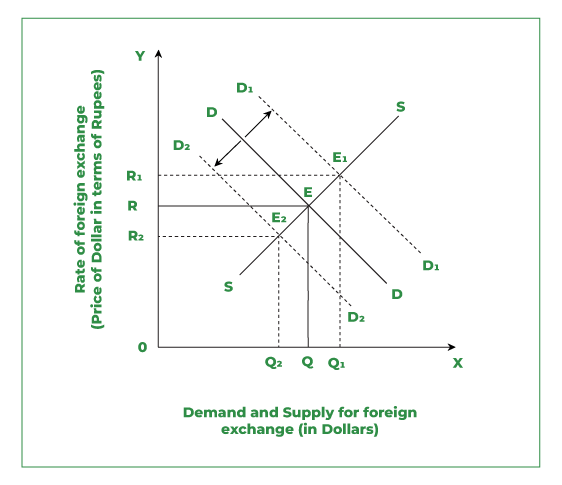
a) Increase in Demand
- Causes: More Indians want to travel abroad; a rise in imports of goods (e.g., oil); increased investment by Indians in foreign countries.
- Mechanism: The demand curve for foreign exchange shifts to the right (from D to D1 in the graph).
- Impact: At the original rate (R), there is now an excess demand. This competition for foreign currency bids the price up until a new, higher equilibrium exchange rate (R1) is reached.
- Result: The exchange rate rises. This is depreciation of the domestic currency (e.g., the rupee).
b) Decrease in Demand
- Causes: A fall in imports (e.g., due to higher import taxes); fewer Indians travelling abroad.
- Mechanism: The demand curve for foreign exchange shifts to the left (from D to D2).
- Impact: At the original rate (R), there is now an excess supply. Sellers must lower their price to find buyers, pushing the rate down to a new, lower equilibrium (R2).
- Result: The exchange rate falls. This is appreciation of the domestic currency.
3. Changes in Supply of Foreign Exchange
Supply of foreign currency comes from exports, foreign tourists visiting India, and foreign investment (FDI/FII) coming into India.
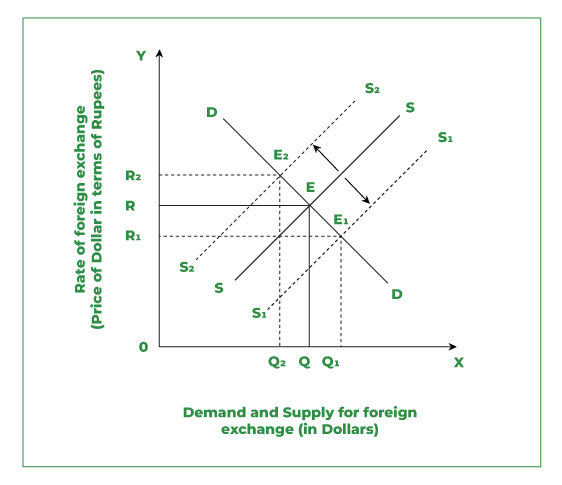
a) Increase in Supply
- Causes: A surge in exports from India; a rise in Foreign Direct Investment (FDI) into India; more foreign tourists visiting India.
- Mechanism: The supply curve for foreign exchange shifts to the right (from S to S1 in the graph).
- Impact: At the original rate (R), there is now an excess supply. This surplus pushes the price of foreign currency down to a new, lower equilibrium rate (R1).
- Result: The exchange rate falls. This is appreciation of the domestic currency.
b) Decrease in Supply
- Causes: A decline in India's exports; foreign investors pulling money out of the Indian stock market.
- Mechanism: The supply curve for foreign exchange shifts to the left (from S to S2).
- Impact: At the original rate (R), there is now an excess demand. The shortage of foreign currency bids the price up to a new, higher equilibrium rate (R2).
- Result: The exchange rate rises. This is depreciation of the domestic currency.
Here is a summary table for your quick reference:
| Shift | Effect on Exchange Rate | Outcome for Domestic Currency |
|---|---|---|
| Increase in Demand | Rises | Depreciation |
| Decrease in Demand | Falls | Appreciation |
| Increase in Supply | Falls | Appreciation |
| Decrease in Supply | Rises | Depreciation |
4. Applying the Concepts: A Step-by-Step Approach
Board exam questions will give you a real-world scenario and ask you to analyze its impact. The best way to answer these is with a clear, three-step process.
Step 1: Identify the event and its primary impact. Does the event affect the demand for foreign currency or the supply of it?
Step 2: Determine the direction of the shift. Does it cause an increase or a decrease? The curve will shift right for an increase and left for a decrease.
Step 3: Explain the result and draw the diagram. Describe how the shift leads to a new equilibrium rate (appreciation or depreciation) and support your explanation with a correctly labelled diagram.
Foreign Exchange Rate Class 12 In One Shot | All Concepts + PYQs + Numericals | Economics Jatin Sir
Let's watch Jatin Rajpal apply this exact logic to a sample question.
Watch from a practical example, where he analyzes the impact of a US company shifting its factory to India. Notice how he first identifies that this is an inflow of investment (a source of supply), then shows the supply curve shifting right, and concludes that this leads to appreciation.
5. Practice with Past CBSE Questions
Your preference for active learning with past papers is a great strategy. Let's apply this framework to some actual questions from the CBSE board.
Important Questions for class 12 economics Foreign Exchange Rate
This resource contains a bank of past board questions. Let's use it to practice our 3-step analysis.
Find and analyze the following questions. For each one, first try to identify the shift and the outcome yourself, then read the provided answer to check your reasoning. Question 10: "Visits of foreign countries for sightseeing etc. by the people of India is on the rise. What will be its likely impact on foreign exchange rate and how?" Step 1: Indians travelling abroad need foreign currency. This affects demand. Step 2: Since travel is on the rise, this is an increase in demand (shift right). Step 3: An increase in demand leads to a higher exchange rate, i.e., depreciation of the rupee. Check the answer and the diagram provided. Question 17: "How can increase in foreign direct investment affect the price of foreign exchange?" Step 1: FDI into India is an inflow of foreign currency. This affects supply. Step 2: An increase in FDI means an increase in supply (shift right). Step 3: An increase in supply leads to a lower exchange rate, i.e., appreciation of the rupee. Check the answer and diagram in the resource (you might have to sketch it based on the logic from Question 8, which also involves a supply increase). Question 9: "Recently Government of India has doubled the import duty on gold. What impact is it likely to have on foreign exchange rate and how?" Step 1: Importing gold requires foreign currency. This affects demand. Step 2: A higher import duty will make gold more expensive, so imports will fall. This is a decrease in demand (shift left). Step 3: A decrease in demand leads to a lower exchange rate, i.e., appreciation of the rupee. Check the answer and the diagram provided.
Working through these questions will solidify your understanding and prepare you to write perfect, structured answers in the exam.
Conclusion
We've now fully explored how a flexible exchange rate changes. It's not random; it's a direct consequence of shifts in the demand for and supply of foreign currency, driven by real economic activities like trade, tourism, and investment.
Key Takeaways:
- A change in the exchange rate causes a movement along the demand/supply curves.
- A change in an underlying factor (like trade or investment flows) causes a shift of the entire curve, leading to a new equilibrium rate.
- Depreciation (higher rate) is caused by an increase in demand or a decrease in supply.
- Appreciation (lower rate) is caused by a decrease in demand or an increase in supply.
- To answer board questions, use the 3-step method: Identify the event's impact on D/S, determine the shift's direction, and explain the result with a diagram.
In our next and final lesson for this module, we will consolidate our knowledge by solving a wider range of representative CBSE board paper questions covering both the Balance of Payments and the Foreign Exchange Rate, fully preparing you for this unit.