Hello! In our last lesson, we delved into the spine-leaf architecture and saw how it modernized data center networking by optimizing for east-west traffic. We highlighted themes of abstraction and improved efficiency. Today, we'll see those same themes applied to a different domain: the Wide Area Network.
This lesson contrasts the traditional WAN with its modern successor, the Software-Defined WAN (SD-WAN). We will explore why the old model is struggling to keep up with the demands of cloud computing and how SD-WAN provides a more agile, cost-effective, and intelligent solution. By the end, you'll be able to articulate the architectural differences between these two approaches and explain the core benefits that SD-WAN brings to the table.
The Traditional WAN: Built for a Different Era
For decades, the Wide Area Network (WAN) has been the backbone connecting an organization's geographically scattered sites. A typical setup involved connecting branch offices back to a central headquarters or data center using private, dedicated circuits, with Multiprotocol Label Switching (MPLS) being the gold standard for its reliability and performance.
The design was simple and effective for its time: a "hub-and-spoke" model where the data center was the center of the universe. All traffic, including requests destined for the public internet, would be routed from the branch (the spoke) back to the data center (the hub). This process is known as traffic backhauling. At the data center, traffic would pass through a centralized security stack (firewalls, intrusion prevention systems, etc.) before being sent to its final destination.
This architecture is illustrated in the diagram below on the left.

While secure, this model has become a major bottleneck in the age of the cloud. The following video from Kevin Wallace Training explains this problem clearly.
This video introduces the concept of SD-WAN by first explaining the limitations of the traditional WAN architecture, particularly the problem of backhauling traffic in a cloud-centric world.
Please watch from the start. Focus on understanding why backhauling traffic from a branch to a central data center is inefficient for accessing cloud services.
As the video explains, sending a branch user's request for a cloud application (like Office 365 or a service on AWS) all the way back to the data center, only to have it sent right back out to the internet, adds significant latency and consumes expensive, private MPLS bandwidth. This is the core problem that SD-WAN was designed to solve.
What is SD-WAN? - NetworkAcademy.IO
This excerpt from NetworkAcademy.IO reinforces the problem with traditional WANs and introduces Cisco's SD-WAN as a modern solution.
Read the first two paragraphs, from the description of Traditional WAN to the sentence about digital transformation. This text succinctly summarizes the challenges we've just discussed.
SD-WAN: A Software-Defined Revolution
SD-WAN applies the principles of Software-Defined Networking (SDN) to the WAN. At its core, it separates the network's control plane (the "brain" that decides where traffic should go) from the data plane (the hardware that actually forwards the packets).
Instead of configuring each router individually, SD-WAN uses a centralized controller to manage the entire WAN fabric. This controller has a complete view of the network and can make intelligent, real-time routing decisions based on policies you define.
A key innovation of SD-WAN is its use of an overlay network. It creates a virtual, encrypted network fabric on top of whatever physical connections are available—this is the underlay. This gives SD-WAN its "transport independence."
This next segment of the video explains the concepts of overlay vs. underlay networks and how this leads to transport independence, a foundational benefit of SD-WAN.
Please continue watching from this segment. Pay close attention to the distinction between the physical underlay (MPLS, LTE, internet) and the virtual SD-WAN overlay.
This transport independence means you can use a mix of connections—reliable but expensive MPLS, cheap but less reliable broadband internet, and wireless 4G/5G—and the SD-WAN controller will intelligently steer traffic according to your policies.
For example, you could create a policy stating:
- Voice over IP (VoIP) traffic: Must use the high-quality MPLS link. If MPLS performance degrades, automatically fail over to the broadband link.
- Office 365 traffic: Send directly from the branch to the internet (this is called Direct Internet Access or DIA). This avoids the backhauling problem entirely, as shown on the right side of the "Traditional WAN vs SD-WAN" diagram above.
- Bulk data backup traffic: Use the cheap broadband link during off-peak hours.
Contrasting the Architectures
Now that we have a grasp of both models, let's put them side-by-side. The image below provides a high-level comparison of the key features.
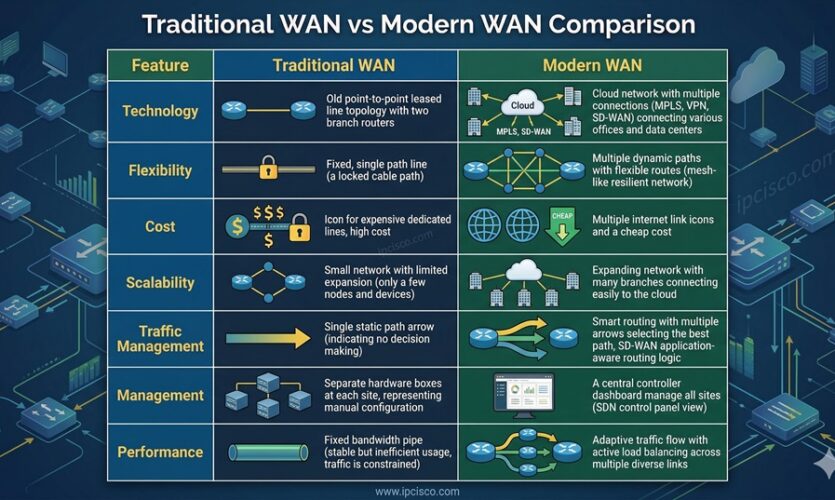
To dig deeper into this comparison, the following article from Palo Alto Networks provides an excellent breakdown.
Traditional WAN vs. SD-WAN: What Are the Differences? - Palo Alto Networks
This article provides a detailed, point-by-point comparison of traditional WAN and SD-WAN across five critical areas.
Please read the section titled What are the differences. Focus on the comparison table and the subsequent explanations for each of the five features: Network management, Traffic optimization, Scalability, Cost, and Security.
The article you just read makes the contrast clear. Let's summarize the core shift in thinking for each category:
- Management: Moves from manual, error-prone, device-by-device CLI configuration to centralized, automated, policy-based GUI management.
- Traffic Optimization: Moves from static, rigid traffic paths to dynamic, application-aware path selection based on real-time network conditions.
- Scalability: Moves from a slow, complex, hardware-dependent process to a fast, agile, software-defined model, often featuring Zero-Touch Provisioning (ZTP) for new sites.
- Cost: Moves from a dependency on expensive, private MPLS circuits to a hybrid model that intelligently leverages cheaper public internet connections, significantly reducing operational expenses.
- Security: Moves from relying on a centralized security stack at the data center to integrating security features (like encryption and unified policy) directly into the WAN fabric, enabling secure direct internet access from the branch.
Conclusion
In this lesson, we contrasted the rigid, hardware-centric architecture of traditional WANs with the flexible, software-centric approach of SD-WAN. We saw that while traditional WANs served us well for decades, their hub-and-spoke design and reliance on backhauling traffic are ill-suited for the decentralized, cloud-driven world.
Key Takeaways:
- Traditional WANs typically use private MPLS circuits in a hub-and-spoke model, backhauling all branch traffic to a central data center. This is inefficient and expensive for cloud applications.
- SD-WAN is a software-defined overlay architecture that separates the control plane from the data plane.
- It provides transport independence, allowing it to run over any mix of MPLS, broadband, and LTE connections.
- A centralized controller enables automated, policy-based management and dynamic, application-aware path selection.
- The core benefits of SD-WAN are improved application performance (especially for cloud), lower costs, greater agility and scalability, and simplified network management.
The principles we've discussed today—separating the control and data planes, centralizing intelligence, and enabling automation—are central to the broader field of Software-Defined Networking. In our next lesson, we will explore the SDN architecture in more detail, examining the roles of northbound and southbound APIs and the capabilities of SDN controllers like Cisco DNA Center.