Welcome to your next lesson on modern network architectures. In our previous session, we contrasted the traditional three-tier and two-tier campus network designs, focusing on how they manage traffic flowing into and out of the network—what we call "north-south" traffic.
Today, we shift our focus from the campus to the data center. Modern data centers have vastly different traffic patterns, dominated by server-to-server communication. To handle this, a new architecture was needed. This lesson will introduce you to the spine-leaf network architecture, the current standard for building scalable, high-performance data centers. We will explore its components, the rules that govern its design, and the significant benefits it offers over traditional models.
From North-South to East-West: A New Problem
In a traditional campus network, most traffic flows "north-south": a client at the access layer requests a resource, and the request travels "north" up through the distribution and core layers to a server or the internet, with the response flowing "south" back down. The three-tier model we discussed is optimized for this pattern.
However, the rise of virtualization and distributed applications fundamentally changed traffic patterns inside the data center. Instead of one powerful server hosting an entire application, modern applications are often broken into microservices running on many different virtual servers, which need to communicate with each other constantly. This explosion of server-to-server traffic is called "east-west" traffic.
The following video from Jeremy's IT Lab provides an excellent overview of this shift and explains why the traditional three-tier architecture struggles with the demands of a modern data center.
Free CCNA | LAN Architectures | Day 52 | CCNA 200-301 Complete Course
This video explains the context for spine-leaf architecture, detailing the shift from north-south to east-west traffic patterns and the limitations of traditional designs in data centers.
Please watch the segment from the beginning of the spine-leaf topic. Focus on understanding the distinction between north-south and east-west traffic and why virtualization caused the latter to dominate.
As the video highlighted, pushing a high volume of east-west traffic through a three-tier design leads to performance bottlenecks and unpredictable latency, as traffic may need to traverse multiple switch hops (access -> distribution -> core -> distribution -> access) just to get from one server rack to another. This inefficiency prompted the development of a new architecture designed specifically for this challenge.
The Spine-Leaf Architecture
The spine-leaf architecture is a two-tier topology designed to overcome the limitations of the three-tier model in high-traffic data centers. It creates a clean, scalable, and predictable path for all traffic.
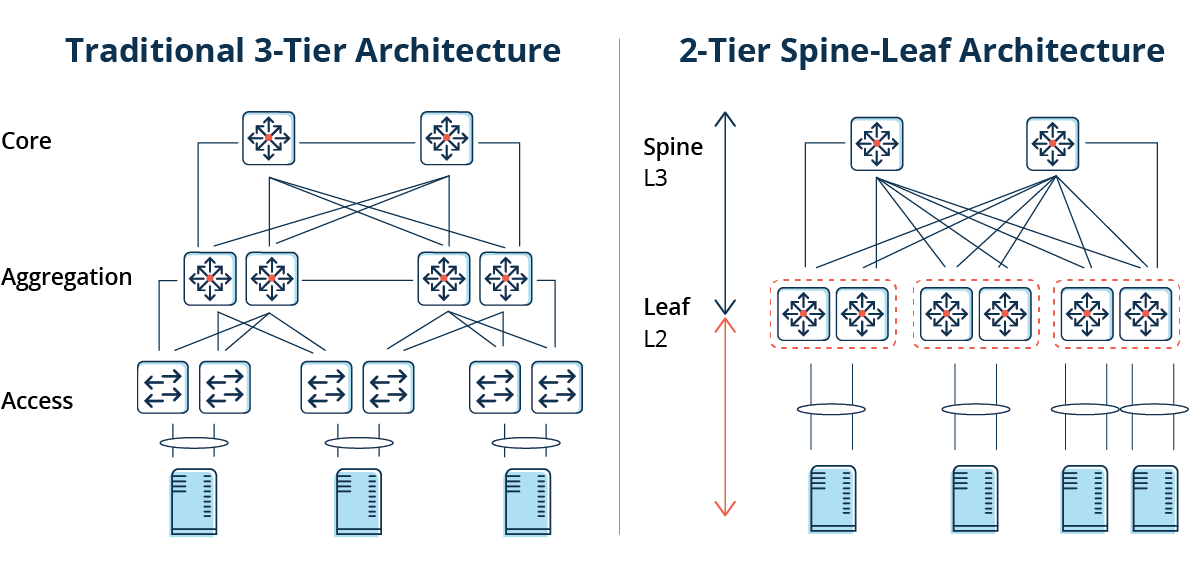
As you can see, the design consists of just two layers:
- Leaf Switches: These switches function like the access layer. Servers, storage devices, and other endpoints connect directly to the leaf switches. They are often placed at the top of each server rack (hence the term "Top-of-Rack" or ToR switch).
- Spine Switches: These are the backbone of the network. The spine layer is responsible for interconnecting all the leaf switches. It provides a high-speed transit path between different parts of the network.
The power of this design lies in its very specific and strict connectivity rules. The following tutorial from 9tut lays these out clearly.
CCNA Training » Spine-Leaf Architecture Tutorial
This article explains the core components of the spine-leaf architecture and its strict connectivity rules.
Please read the section titled Components of Spine-Leaf Architecture. Pay close attention to the five rules listed at the end of the section, as these define the topology.
To summarize these crucial rules:
- Every leaf switch must connect to every spine switch.
- Spine switches only connect to leaf switches.
- Leaf switches only connect to spine switches (and endpoints).
- There are no direct connections between spine switches.
- There are no direct connections between leaf switches.
This full-mesh connectivity between the two layers is the cornerstone of the architecture's performance.
How It Works: Predictable, Low-Latency Hops
Now, let's see how these rules translate into superior performance for east-west traffic. Because every leaf is connected to every spine, any data that needs to travel between two different leaf switches has a simple, predictable path.
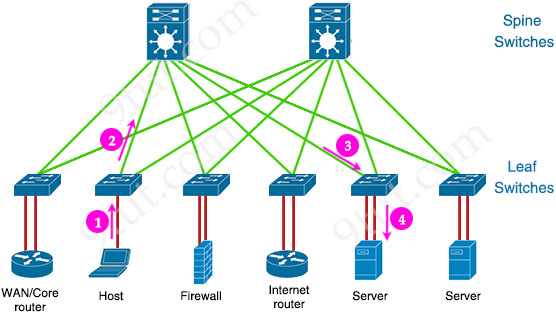
No matter which two servers in the data center need to communicate (as long as they are on different leaf switches), the traffic path is always the same length: two hops.
- From the source server's leaf switch to a spine switch.
- From that spine switch to the destination server's leaf switch.
This predictable latency is a massive advantage over the variable and often longer paths in a three-tier design.
The following video from NetworkChuck provides a dynamic explanation of this two-hop rule and introduces another critical concept: the use of Layer 3 routing.
Data Center NETWORKS (what do they look like??) // FREE CCNA // EP 7
This video visually demonstrates the two-hop path and explains the crucial role of Layer 3 routing in making the spine-leaf architecture work.
First, watch the segment that introduces the new design. Focus on the "two-hop" principle and how it creates predictable performance for east-west traffic. Next, watch the segment explaining the use of Layer 3 connections. This is a key technical detail. Pay attention to why using routing between switches is beneficial.
As Chuck explains, the connections between spine and leaf switches are Layer 3 (routed) links. This is a fundamental departure from traditional designs where switch-to-switch links are Layer 2. This has two major implications:
- No Spanning Tree Protocol (STP): Since STP is a Layer 2 protocol designed to prevent loops in a switched network, it's not needed here. This means none of the links are blocked; all connections are active and can forward traffic.
- Equal-Cost Multi-Path (ECMP): Because all links are active, routers can use ECMP to load-balance traffic across all available paths between the leaf and spine layers. This dramatically increases available bandwidth and resilience.
Benefits of Spine-Leaf Architecture
By combining a simple, strict topology with Layer 3 routing, the spine-leaf architecture delivers a range of benefits perfectly suited to the modern data center.
What is Spine and Leaf Network Architecture? - Study CCNA
This article provides a concise summary of the key advantages of implementing a spine-leaf design.
Please read the section on the Benefits of Spine and Leaf Architecture. This will consolidate the concepts we've just discussed.
Let's recap the primary advantages:
- Predictable Low Latency: The fixed two-hop path between any two leaf switches ensures consistent performance for applications, which is critical for distributed services.
- High Bandwidth and Availability: The elimination of STP and the use of ECMP allow all inter-switch links to be active simultaneously, providing massive, load-balanced bandwidth and excellent redundancy. If a spine switch fails, traffic is simply routed through the remaining active spines.
- Seamless Scalability: The architecture is incredibly easy to scale.
- If you run out of server ports, you add a new leaf switch and connect it to all existing spine switches.
- If you need more bandwidth between leaves (i.e., you are seeing oversubscription on the spine links), you add a new spine switch and connect it to all existing leaf switches.
- Cost-Effective: This design often uses smaller, fixed-configuration switches rather than large, expensive, and complex modular chassis systems required for the core layer in a three-tier network.
Conclusion
In this lesson, we explored the spine-leaf architecture, the de facto standard for modern data center networking. We saw how the shift towards east-west traffic, driven by virtualization, rendered traditional hierarchical designs inefficient. The spine-leaf model addresses this by creating a simple, scalable, and high-performance fabric.
Key Takeaways:
- Spine-leaf is a two-tier architecture designed for the high volume of east-west (server-to-server) traffic in modern data centers.
- It consists of leaf switches (connecting to endpoints) and spine switches (interconnecting all leaves).
- The design follows strict rules, creating a full mesh between the leaf and spine layers.
- Communication between any two servers on different leaves always takes a predictable two hops, ensuring low and consistent latency.
- It utilizes Layer 3 routing between switches, enabling ECMP for load balancing and eliminating the need for STP, which means all links are active.
- The primary benefits are predictable latency, high bandwidth, seamless scalability, and high availability.
Just as spine-leaf architecture revolutionized data center networking by abstracting and simplifying the fabric, our next topic, Software-Defined WAN (SD-WAN), explores how similar principles of abstraction and centralized control are revolutionizing the way we build and manage wide area networks.