Welcome back. In our previous lesson, we explored how Software-Defined WAN (SD-WAN) revolutionizes wide-area networking by separating the network's control logic from the hardware that forwards traffic. This principle is not unique to WANs; it is the cornerstone of a much broader architectural shift in networking.
Today, we will formalize this concept by dissecting the architecture of Software-Defined Networking (SDN). Our goal is to describe this architecture, with a special focus on the crucial separation of the control plane and the data plane. Understanding this is fundamental to grasping modern network automation and programmability, which is the focus of this entire module.
The Planes of a Traditional Network Device
Before we can appreciate how SDN rearranges the network, we must first understand the distinct functions that coexist inside a traditional router or switch. Your CCNA studies have given you practical experience with these functions, even if you haven't always categorized them this way. Every network device operates on three conceptual "planes": the data plane, the control plane, and the management plane.
An excellent, in-depth explanation of these planes is provided in the CCNA Official Cert Guide by Cisco Press.
SDN and Controller-Based Networks - Cisco Press
This article section provides a clear, technical definition of the data, control, and management planes, using examples you'll recognize from your networking studies.
Please read the entire section titled The Data, Control, and Management Planes. As you read, focus on how familiar processes map to each plane: Data Plane: Forwarding packets based on a routing table, switching frames based on a MAC address table, and applying ACLs. These are per-packet actions. Control Plane: Running routing protocols like OSPF to build the routing table, learning MAC addresses, and running STP. These are the "thinking" processes that populate the tables used by the data plane. Management Plane: Your direct interaction with the device via SSH, Telnet, or SNMP for configuration and monitoring.
To summarize the key points from your reading:
- The Data Plane (or Forwarding Plane) does the actual work of moving packets. It's the high-speed engine that makes forwarding decisions based on pre-populated tables.
- The Control Plane is the intelligence. It runs protocols (like OSPF, BGP, ARP, STP) to learn about the network topology and builds the tables (routing table, MAC address table) that the data plane uses.
- The Management Plane is for us, the network engineers. It's how we configure, manage, and monitor the device.
In traditional networks, every single device—each router and switch—contains all three of these planes. This creates what is known as a distributed control plane, where each device independently runs its own control plane protocols and builds its own understanding of the network.
The Architectural Shift: Centralizing Control
The core innovation of SDN is to challenge this distributed model. Instead of each device having its own "brain," SDN extracts the control plane from the network devices and centralizes it in a software application called an SDN controller.
The network devices are left with only their data planes, becoming simple packet-forwarding engines that take instructions from the central controller. This is the fundamental separation of the control plane and the data plane.
The following diagram perfectly illustrates this shift.
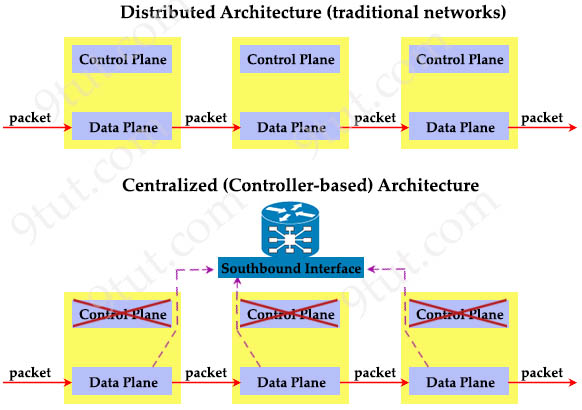
As you can see on the top, in a traditional network, each device is a self-contained unit. In the SDN model on the bottom, the individual control planes are gone. A single, central controller communicates with the data planes of all the network devices.
The Three-Layer SDN Architecture
This new model gives rise to a layered architecture. While the terminology can vary slightly, it is most often described as having three main layers or planes: the Application Plane, the Control Plane, and the Data (or Infrastructure) Plane.
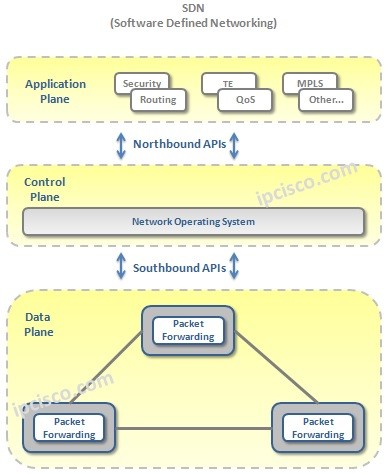
Let's break down each layer's role.
1. The Data Plane (or Infrastructure Plane)
This is the foundation of the network. It consists of the physical and virtual network devices (switches, routers) that are responsible for forwarding traffic. In an SDN world, these devices are sometimes called "dumb" hardware because their primary function is simply to execute the forwarding instructions given to them by the controller. They listen for instructions from above and report back on their status.
2. The Control Plane
This is the centralized brain of the network—the SDN controller. It's a software application that has a complete, holistic view of the entire network topology. It gathers information from the data plane devices, calculates the best paths for traffic, and creates the forwarding rules. It then pushes these rules down to the data plane devices, programming their forwarding tables.
3. The Application Plane
This layer consists of the network applications and services that use the network. These applications communicate their requirements to the controller. For example, a load-balancing application could tell the controller to distribute traffic across several servers. A security application could instruct the controller to block traffic from a malicious source. This is where the true power of programmability comes to life.
The following short video provides a clear, animated overview of this three-layer structure.
SDN Explained | Traditional Networking vs SDN | Northbound & Southbound Interface Made Simple
This segment from Cyber connect clearly explains the three-layer SDN architecture and how the control plane is separated from the physical devices.
Please watch from this section. Focus on the role of each of the three layers: Application, Control, and Physical (Data/Infrastructure).
To reinforce this, the "CCNA 200-301 Complete Course" from Jeremy's IT Lab also provides an excellent summary of these concepts. Notice the use of slightly different terminology ("Infrastructure Layer" instead of "Data Plane"), which is common in this field.
Free CCNA | Software-Defined Networking | Day 62 | CCNA 200-301 Complete Course
This video reviews the core concepts of SDN and introduces the names for the three layers of the SDN architecture.
Watch from this segment. Pay attention to the defined roles of the Application, Control, and Infrastructure layers.
This architectural separation is what enables the agility and automation promised by SDN. By having a central point of control with a global view, we can write applications that manage the network as a single, cohesive system rather than a collection of disparate, manually configured devices.
Conclusion
In this lesson, we established the foundational principles of Software-Defined Networking. We began by defining the distinct data, control, and management planes that have traditionally coexisted within every network device. We then explored the primary architectural shift of SDN: extracting the control plane from each device and centralizing it into an SDN controller.
Key Takeaways:
- Traditional networks use a distributed architecture, where each device has its own integrated control and data plane.
- The control plane is the "brain" that builds forwarding tables using protocols like OSPF and STP.
- The data plane is the "engine" that forwards packets based on the tables created by the control plane.
- SDN's core principle is the separation of the control plane from the data plane.
- The SDN architecture is composed of three layers:
- Application Plane: Network services that define network behavior.
- Control Plane: The centralized SDN controller that manages the network.
- Data Plane (Infrastructure Plane): The network hardware that forwards traffic based on the controller's instructions.
This separation of concerns is the key that unlocks network programmability. But how do these new, separate layers communicate with each other? In our next lesson, we will answer that question by examining the role of northbound and southbound APIs in the SDN environment.